第22章原核生物:細菌と古細菌
Migration of Diseases to New Populations新しい集団への病気の移動
One of the negative consequences of human exploration was the accidental “biological warfare” that resulted from the transport of a pathogen into a population that had not previously been exposed to it. Over the centuries, Europeans tended to develop genetic immunity to endemic infectious diseases, but when European conquerors reached the western hemisphere, they brought with them disease-causing bacteria and viruses, which triggered epidemics that completely devastated many diverse populations of Native Americans, who had no natural resistance to many European diseases. It has been estimated that up to 90 percent of Native Americans died from infectious diseases after the arrival of Europeans, making conquest of the New World a foregone conclusion.
英語のヒント
人類の探検がもたらした負の結果の一つは、それまで接触したことのない集団へ病原体を運び込むことで起きた、偶発的な「生物戦」だった。何世紀もの間、ヨーロッパ人は、地域に常在する感染症への遺伝的な免疫を発達させる傾向にあった。しかし、ヨーロッパの征服者が西半球へ到達したとき、病原細菌やウイルスも持ち込んだ。それが流行を引き起こし、多くの多様なアメリカ先住民の集団を壊滅させた。先住民には、ヨーロッパの多くの病気に対する自然な抵抗力がなかった。ヨーロッパ人の到着後、アメリカ先住民の最大90%が感染症で死亡したと推定されており、それによって新世界の征服は、ほぼ決まった結末となった。
Emerging and Re-emerging Diseases新興・再興感染症
The distribution of a particular disease is dynamic. Changes in the environment, the pathogen, or the host population can dramatically impact the spread of a disease. According to the World Health Organization (WHO), an emerging disease (Figure 22.22) is one that has appeared in a population for the first time, or that may have existed previously but is rapidly increasing in incidence or geographic range. This definition also includes re-emerging diseases that were previously under control. Approximately 75 percent of recently emerging infectious diseases affecting humans are zoonotic diseases. Zoonoses are diseases that primarily infect animals but can be transmitted to humans; some are of viral origin and some are of bacterial origin. Brucellosis is an example of a prokaryotic zoonosis that is re-emerging in some regions, and necrotizing fasciitis (commonly known as flesh-eating bacteria) has been increasing in virulence for the last 80 years for unknown reasons.
英語のヒント
ある病気の分布は、変化する。環境、病原体、宿主集団の変化によって、病気の広がりは大きく影響されうる。世界保健機関(WHO)によると、新興疾患(図22.22)とは、集団内に初めて現れた病気、または以前から存在していた可能性はあるが、発生率や地理的範囲が急速に増えている病気である。この定義には、以前は抑えられていた再興疾患も含まれる。最近出現し、ヒトに影響する感染症の約75%は、人獣共通感染症である。これは主に動物へ感染するが、ヒトにも伝わる病気で、ウイルス性のものも細菌性のものもある。ブルセラ症は、一部の地域で再興している、原核生物による人獣共通感染症の例である。また、壊死性筋膜炎、一般に人食いバクテリアとして知られる病気は、理由は分からないが、過去80年間に病原性が増している。
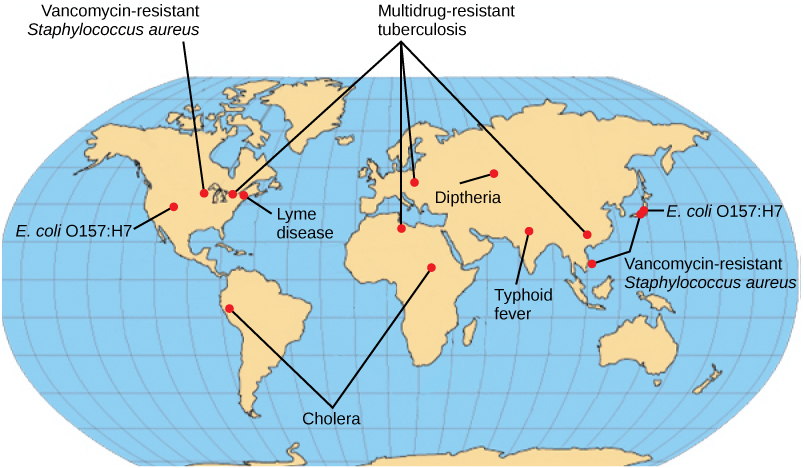
Figure 22.22図 22.22
Emerging diseases. The map shows regions where bacterial diseases are emerging or re-emerging. (credit: modification of work by NIH)
新興疾患。地図は、細菌性疾患が出現、または再出現している地域を示す。(クレジット:NIHの作品を改変)
Some of the present emerging diseases are not actually new, but are diseases that were catastrophic in the past (Figure 22.23). They devastated populations and became dormant for a while, just to come back, sometimes more virulent than before, as was the case with bubonic plague. Other diseases, like tuberculosis, were never eradicated but were under control in some regions of the world until coming back, mostly in urban centers with high concentrations of immunocompromised people. WHO has identified certain diseases whose worldwide re-emergence should be monitored. Among these are three viral diseases (dengue fever, yellow fever, and zika), and three bacterial diseases (diphtheria, cholera, and bubonic plague). The war against infectious diseases has no foreseeable end.
英語のヒント
現在の新興疾患の中には、実際には新しいものではなく、過去に壊滅的な被害をもたらした病気もある(図22.23)。人々を壊滅させた後、しばらく沈静化し、再び戻ってきたのである。腺ペストのように、以前より病原性を増して戻ることもある。結核など、別の病気は根絶されたことはないが、世界の一部の地域では抑えられていた。その後、主に免疫機能の低下した人が多く集まる都市部で再び増えた。WHOは、世界的な再興を監視すべき病気を挙げている。これには、三つのウイルス疾患、デング熱、黄熱、ジカと、三つの細菌性疾患、ジフテリア、コレラ、腺ペストがある。感染症との闘いに、見通せる終わりはない。
OpenStax, Rice University; Biology 2e. (credit a: James Gathany, CDC; credit b: CDC; scale-bar data from Matt Russell) · CC BY 4.0 · Source出典
Figure 22.23図 22.23
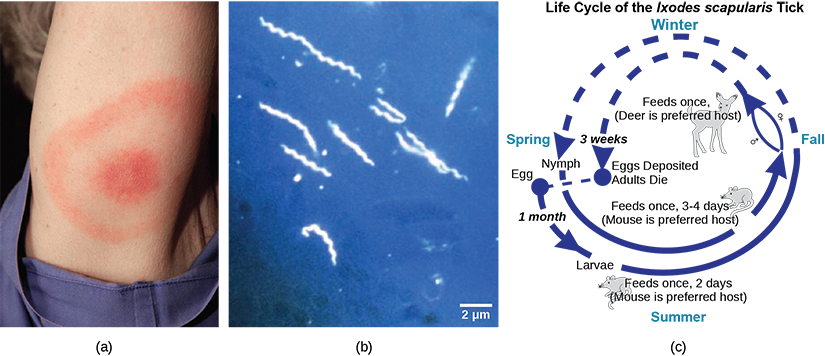
Lyme Disease. Lyme disease often, but not always, results in (a) a characteristic bullseye rash. The disease is caused by a (b) Gram-negative spirochete bacterium of the genus Borrelia. The bacteria (c) infect ticks, which in turn infect mice. Deer are the preferred secondary host, but the ticks also may feed on humans. Untreated, the disease causes chronic disorders in the nervous system, eyes, joints, and heart. The disease is named after Lyme, Connecticut, where an outbreak occurred in 1995 and has subsequently spread. The disease is not new, however. Genetic evidence suggests that Ötzi the Iceman, a 5,300-year-old mummy found in the Alps, was infected with Borrelia. (credit a: James Gathany, CDC; credit b: CDC; scale-bar data from Matt Russell)
英語のヒント
ライム病。ライム病では、必ずではないが、しばしば(a)特徴的な的状の発疹ができる。原因は、(b)Borrelia属のグラム陰性スピロヘータ細菌である。細菌は(c)ダニに感染し、そのダニが次にネズミへ感染を広げる。シカが好まれる第二の宿主だが、ダニはヒトを吸血することもある。治療しなければ、神経系、眼、関節、心臓に慢性障害を起こす。病名は、1995年に流行が起こり、その後広がったコネチカット州ライムに由来する。しかし、この病気は新しいものではない。遺伝的証拠によると、アルプスで見つかった5300年前のミイラ、アイスマンのエッツィは、Borreliaに感染していたと考えられる。(クレジットa:James Gathany、CDC。クレジットb:CDC。スケールバーのデータ:Matt Russell)
Foodborne Diseases食品媒介疾患
Prokaryotes are everywhere: They readily colonize the surface of any type of material, and food is not an exception. Most of the time, prokaryotes colonize food and food-processing equipment in the form of a biofilm, as we have discussed earlier. Outbreaks of bacterial infection related to food consumption are common. A foodborne disease (commonly called “food poisoning”) is an illness resulting from the consumption the pathogenic bacteria, viruses, or other parasites that contaminate food. Although the United States has one of the safest food supplies in the world, the U.S. Centers for Disease Control and Prevention (CDC) has reported that “76 million people get sick, more than 300,000 are hospitalized, and 5,000 Americans die each year from foodborne illness.”
英語のヒント
原核生物はどこにでもいる。あらゆる種類の物質の表面へ容易に定着し、食品も例外ではない。すでに説明したように、食品や食品加工設備には、たいていバイオフィルムの形で定着する。食品の摂取に関わる細菌感染の集団発生は、よく起こる。食品媒介疾患、一般に「食中毒」と呼ばれるものは、食品を汚染する病原細菌、ウイルス、ほかの寄生体を摂取して起こる病気である。米国の食品供給は世界でも特に安全な部類に入るが、米国疾病予防管理センター(CDC)は、「毎年、食品媒介疾患によって7600万人が病気になり、30万人以上が入院し、5000人の米国人が死亡する」と報告している。
The characteristics of foodborne illnesses have changed over time. In the past, it was relatively common to hear about sporadic cases of botulism, the potentially fatal disease produced by a toxin from the anaerobic bacterium Clostridium botulinum. Some of the most common sources for this bacterium were non-acidic canned foods, homemade pickles, and processed meat and sausages. The can, jar, or package created a suitable anaerobic environment where Clostridium could grow. Proper sterilization and canning procedures have reduced the incidence of this disease.
英語のヒント
食品媒介疾患の特徴は、時間とともに変わってきた。過去には、嫌気性細菌Clostridium botulinumの毒素によって起こる、命に関わりうる病気、ボツリヌス症の散発例を聞くことが比較的多かった。この細菌のよくある発生源は、酸性ではない缶詰、自家製の漬物、加工肉やソーセージだった。缶、瓶、包装が、Clostridiumの増殖に適した嫌気環境を作った。適切な滅菌や缶詰製造の手順によって、この病気の発生率は減少した。
While people may tend to think of foodborne illnesses as associated with animal-based foods, most cases are now linked to produce. There have been serious, produce-related outbreaks associated with raw spinach in the United States and with vegetable sprouts in Germany, and these types of outbreaks have become more common. The raw spinach outbreak in 2006 was produced by the bacterium E. coli serotype O157:H7. A serotype is a strain of bacteria that carries a set of similar antigens on its cell surface, and there are often many different serotypes of a bacterial species. Most E. coli are not particularly dangerous to humans, but serotype O157:H7 can cause bloody diarrhea and is potentially fatal.
英語のヒント
食品媒介疾患は動物性食品と関係すると考えられがちだが、今では大半の事例が農産物に結びついている。米国の生ホウレンソウや、ドイツの野菜のスプラウトに関連する深刻な集団発生があり、このような事例は増えている。2006年の生ホウレンソウによる集団発生は、大腸菌E. coliの血清型O157:H7によって起きた。血清型とは、細胞表面に共通する抗原群をもつ細菌の株であり、一つの細菌種に多くの異なる血清型があることは珍しくない。大腸菌の大半はヒトに特に危険ではないが、O157:H7は血性下痢を起こし、命に関わることがある。
All types of food can potentially be contaminated with bacteria. Recent outbreaks of Salmonella reported by the CDC occurred in foods as diverse as peanut butter, alfalfa sprouts, and eggs. A deadly outbreak in Germany in 2010 was caused by E. coli contamination of vegetable sprouts (Figure 22.24). The strain that caused the outbreak was found to be a new serotype not previously involved in other outbreaks, which indicates that E. coli is continuously evolving. Outbreaks of listeriosis, due to contamination of meats, raw cheeses, and frozen or fresh vegetables with Listeria monocytogenes, are becoming more frequent.
英語のヒント
どのような食品にも、細菌に汚染される可能性がある。CDCが最近報告したサルモネラの集団発生は、ピーナッツバター、アルファルファのスプラウト、卵といった、多様な食品で起きた。2010年にドイツで起きた致死的な集団発生は、野菜のスプラウトの大腸菌汚染が原因だった(図22.24)。原因株は、過去のほかの集団発生に関わったことのない新しい血清型だと分かり、大腸菌が絶えず進化していることを示している。食肉、非加熱チーズ、冷凍または生鮮野菜がListeria monocytogenesに汚染されて起こるリステリア症の集団発生も、増えている。
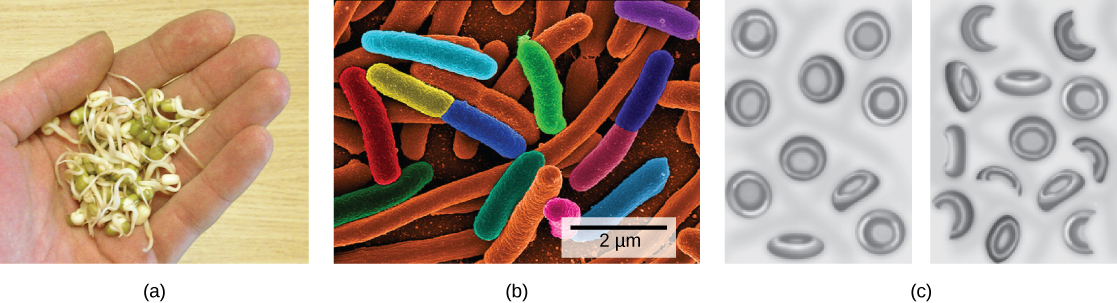


Figure 22.24図 22.24
Foodborne pathogens. (a) Vegetable sprouts grown at an organic farm were the cause of an (b) E. coli outbreak that killed 32 people and sickened 3,800 in Germany in 2011. The strain responsible, E. coli O104:H4, produces Shiga toxin, a substance that inhibits protein synthesis in the host cell. The toxin (c) destroys red blood cells resulting in bloody diarrhea. Deformed red blood cells clog the capillaries of the kidney, which can lead to kidney failure, as happened to 845 patients in the 2011 outbreak. Kidney failure is usually reversible, but some patients experience kidney problems years later. (credit c: NIDDK, NIH)
英語のヒント
食品媒介病原体。(a)有機農場で育てた野菜のスプラウトは、2011年にドイツで32人が死亡し、3800人が発病した(b)大腸菌の集団発生の原因となった。原因株のE. coli O104:H4は、宿主細胞のタンパク質合成を阻害する志賀毒素を作る。この毒素は(c)赤血球を破壊し、血性下痢を引き起こす。変形した赤血球は腎臓の毛細血管を詰まらせ、腎不全につながることがある。2011年の集団発生では845人の患者で起きた。腎不全は通常は回復可能だが、数年後に腎臓の問題を経験する患者もいる。(クレジットc:NIDDK、NIH)