第22章原核生物:細菌と古細菌
The Ancient Atmosphere古代の大気
Evidence indicates that during the first two billion years of Earth’s existence, the atmosphere was anoxic, meaning that there was no molecular oxygen. Therefore, only those organisms that can grow without oxygen—anaerobic organisms—were able to live. Autotrophic organisms that convert solar energy into chemical energy are called phototrophs, and they appeared within one billion years of the formation of Earth. Then, cyanobacteria, also known as “blue-green algae,” evolved from these simple phototrophs at least one billion years later. It was the ancestral cyanobacteria (Figure 22.4) that began the “oxygenation” of the atmosphere: Increased atmospheric oxygen allowed the evolution of more efficient O2-utilizing catabolic pathways. It also opened up the land to increased colonization, because some O2 is converted into O3 (ozone) and ozone effectively absorbs the ultraviolet light that could have otherwise caused lethal mutations in DNA. The current evidence suggests that the increase in O2 concentrations allowed the evolution of other life forms.
英語のヒント
証拠によると、地球誕生後の最初の20億年間、大気は無酸素、すなわち分子状酸素のない状態だった。そのため、酸素なしで成長できる嫌気性生物だけが生きられた。太陽エネルギーを化学エネルギーへ変換する独立栄養生物は光栄養生物と呼ばれ、地球形成から10億年以内に現れた。その後、少なくとも10億年後に、これらの単純な光栄養生物から、「藍藻」とも呼ばれるシアノバクテリアが進化した。大気の「酸素化」を始めたのは、祖先的なシアノバクテリア(図22.4)だった。大気中の酸素が増えると、O2を利用する、より効率のよい異化経路が進化できた。また、陸上への進出も増えた。一部のO2がO3、すなわちオゾンへ変わり、オゾンが紫外線を効果的に吸収するためである。オゾンがなければ、その紫外線はDNAに致死的な変異を起こしていたかもしれない。現在の証拠は、O2濃度の上昇が、ほかの生命の形の進化を可能にしたことを示唆する。
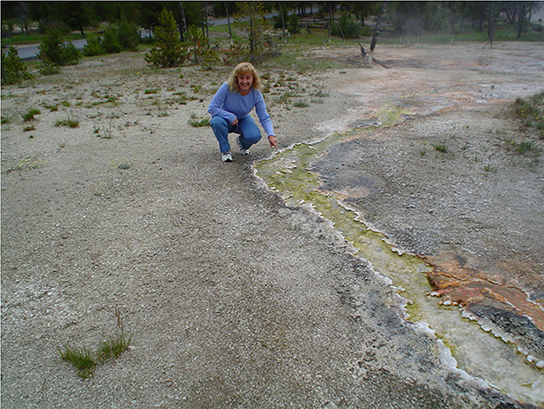

Figure 22.4図 22.4
Cyanobacteria. This hot spring in Yellowstone National Park flows toward the foreground. Cyanobacteria in the spring are green, and as water flows down the gradient, the intensity of the color increases as cell density increases. The water is cooler at the edges of the stream than in the center, causing the edges to appear greener. (credit: Graciela Brelles-Mariño)
英語のヒント
シアノバクテリア。イエローストーン国立公園のこの温泉は、手前へ向かって流れる。温泉内のシアノバクテリアは緑色で、水が勾配を下るにつれて細胞密度が高まり、色も濃くなる。流れの縁では中央より水温が低く、そのため縁がより緑色に見える。(クレジット:Graciela Brelles-Mariño)
Microbes Are Adaptable: Life in Moderate and Extreme Environments適応力のある微生物:穏やかな環境と極限環境での生活
Some organisms have developed strategies that allow them to survive harsh conditions. Almost all prokaryotes have a cell wall, a protective structure that allows them to survive in both hypertonic and hypotonic aqueous conditions. Some soil bacteria are able to form endospores that resist heat and drought, thereby allowing the organism to survive until favorable conditions recur. These adaptations, along with others, allow bacteria to remain the most abundant life form in all terrestrial and aquatic ecosystems.
英語のヒント
一部の生物は、厳しい条件を生き延びる戦略を発達させている。ほぼすべての原核生物は細胞壁をもち、この保護構造によって、高張な水溶液中でも低張な水溶液中でも生きられる。土壌細菌の中には、熱や乾燥に耐える内生胞子を作れるものがあり、それによって、好ましい条件が戻るまで生き延びられる。これらを含むさまざまな適応によって、細菌は、陸上と水中のあらゆる生態系で、最も豊富な生命の形であり続けられる。
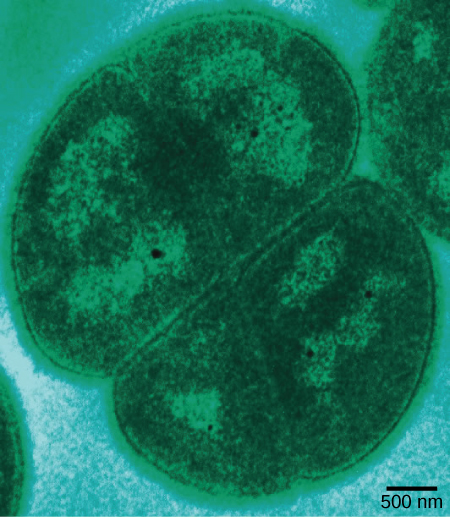
Prokaryotes thrive in a vast array of environments: Some grow in conditions that would seem very normal to us, whereas others are able to thrive and grow under conditions that would kill a plant or an animal. Bacteria and archaea that are adapted to grow under extreme conditions are called extremophiles, meaning “lovers of extremes.” Extremophiles have been found in all kinds of environments: the depths of the oceans, hot springs, the Arctic and the Antarctic, in very dry places, deep inside Earth, in harsh chemical environments, and in high radiation environments (Figure 22.5), just to mention a few. Because they have specialized adaptations that allow them to live in extreme conditions, many extremophiles cannot survive in moderate environments. There are many different groups of extremophiles: They are identified based on the conditions in which they grow best, and several habitats are extreme in multiple ways. For example, a soda lake is both salty and alkaline, so organisms that live in a soda lake must be both alkaliphiles and halophiles (Table 22.1). Other extremophiles, like radioresistant organisms, do not prefer an extreme environment (in this case, one with high levels of radiation), but have adapted to survive in it (Figure 22.5). Organisms like these give us a better understanding of prokaryotic diversity and open up the possibility of finding new prokaryotic species that may lead to the discovery of new therapeutic drugs or have industrial applications.
英語のヒント
原核生物は、きわめて幅広い環境で繁栄する。私たちにはごく普通と思える条件で成長するものもあれば、植物や動物なら死んでしまう条件でも繁栄し、成長できるものもある。極端な条件下で成長するよう適応した細菌や古細菌は、「極限を好むもの」という意味で、極限環境生物と呼ばれる。極限環境生物は、深海、温泉、北極、南極、非常に乾いた場所、地球の内部深く、厳しい化学環境、放射線の強い環境など、あらゆる種類の環境で見つかっている(図22.5)。これらはほんの数例である。極端な条件で暮らせる特殊な適応をもつため、多くの極限環境生物は、穏やかな環境では生きられない。極限環境生物には多くの異なる群があり、最もよく生育する条件に基づいて区別される。複数の点で極端な生息地もある。たとえば、ソーダ湖は塩分が多く、アルカリ性でもあるため、そこに住む生物は、好アルカリ性かつ好塩性でなければならない(表22.1)。放射線耐性生物など、ほかの極限環境生物は、極端な環境、この場合は放射線量の高い環境を好むわけではないが、その中で生きられるよう適応している(図22.5)。こうした生物は、原核生物の多様性への理解を深めてくれる。また、新たな治療薬の発見につながったり、工業的な用途をもったりする、新種の原核生物を見つける可能性を開いてくれる。
Extremophiles and Their Preferred Conditions 極限環境生物と、その好む条件 |
|
|---|---|
Extremophile 極限環境生物 |
Conditions for Optimal Growth 最適な成長条件 |
Acidophiles 好酸性生物 |
pH 3 or below pH 3以下 |
Alkaliphiles 好アルカリ性生物 |
pH 9 or above pH 9以上 |
Thermophiles 好熱性生物 |
Temperature 60–80 °C (140–176 °F) 温度60〜80 °C(140〜176 °F) |
Hyperthermophiles 超好熱性生物 |
Temperature 80–122 °C (176–250 °F) 温度80〜122 °C(176〜250 °F) |
Psychrophiles 好冷性生物 |
Temperature of -15-10 °C (5-50 °F) or lower 温度−15〜10 °C(5〜50 °F)、またはそれ以下 |
Halophiles 好塩性生物 |
Salt concentration of at least 0.2 M 少なくとも0.2 Mの塩濃度 |
Osmophiles 好浸透圧性生物 |
High sugar concentration 高い糖濃度 |
OpenStax, Rice University; Biology 2e. (credit: modification of work by Michael Daly; scale-bar data from Matt Russell) · CC BY 4.0 · Source出典

Figure 22.5図 22.5
Radiation-tolerant prokaryotes. Deinococcus radiodurans, visualized in this false color transmission electron micrograph, is a prokaryote that can tolerate very high doses of ionizing radiation. It has developed DNA repair mechanisms that allow it to reconstruct its chromosome even if it has been broken into hundreds of pieces by radiation or heat. (credit: modification of work by Michael Daly; scale-bar data from Matt Russell)
英語のヒント
放射線に耐える原核生物。この疑似カラーの透過型電子顕微鏡写真に示すDeinococcus radioduransは、非常に高い線量の電離放射線に耐えられる原核生物である。放射線や熱によって染色体が何百もの断片に壊されても再構築できる、DNA修復機構を発達させている。(クレジット:Michael Dalyの作品を改変。スケールバーのデータ:Matt Russell)