第22章原核生物:細菌と古細菌
The Ways in Which Prokaryotes Obtain Carbon原核生物の炭素獲得方法
Prokaryotes not only can use different sources of energy, but also different sources of carbon compounds. Autotrophic prokaryotes synthesize organic molecules from carbon dioxide. In contrast, heterotrophic prokaryotes obtain carbon from organic compounds. To make the picture more complex, the terms that describe how prokaryotes obtain energy and carbon can be combined. Thus, photoautotrophs use energy from sunlight, and carbon from carbon dioxide and water, whereas chemoheterotrophs obtain both energy and carbon from an organic chemical source. Chemolithoautotrophs obtain their energy from inorganic compounds, and they build their complex molecules from carbon dioxide. Finally, prokaryotes that get their energy from light, but their carbon from organic compounds, are photoheterotrophs. The table below (Table 22.3) summarizes carbon and energy sources in prokaryotes.
英語のヒント
原核生物は、異なるエネルギー源だけでなく、異なる炭素化合物の供給源も使える。独立栄養性の原核生物は、二酸化炭素から有機分子を合成する。対照的に、従属栄養性の原核生物は、有機化合物から炭素を得る。話をさらに複雑にすると、原核生物のエネルギーと炭素の獲得方法を表す用語は、組み合わせることができる。たとえば光独立栄養生物は、太陽光からエネルギーを、二酸化炭素と水から炭素を得る。一方、化学従属栄養生物は、有機化学物質から、エネルギーと炭素の両方を得る。化学無機独立栄養生物は、無機化合物からエネルギーを得て、二酸化炭素から複雑な分子を作る。最後に、光からエネルギーを得るが、有機化合物から炭素を得る原核生物は、光従属栄養生物である。下の表22.3に、原核生物の炭素源とエネルギー源をまとめる。
Carbon and Energy Sources in Prokaryotes 原核生物の炭素源とエネルギー源 |
||||
|---|---|---|---|---|
Energy Source エネルギー源 |
Electron Source 電子源 |
Carbon Source 炭素源 |
Nutritional Type 栄養型 |
|
Light (phototroph) 光(光栄養生物) |
Organic material (organotroph) 有機物(有機栄養生物) |
Organic material (heterotroph) 有機物(従属栄養生物) |
Photoorganoheterotroph 光有機従属栄養生物 |
|
Carbon dioxide (autotroph) 二酸化炭素(独立栄養生物) |
||||
Inorganic material (lithotroph) 無機物(無機栄養生物) |
Organic material (heterotroph) 有機物(従属栄養生物) |
|||
Carbon dioxide (autotroph) 二酸化炭素(独立栄養生物) |
Photolithoautotroph 光無機独立栄養生物 |
|||
Chemicals (chemotroph) 化学物質(化学栄養生物) |
Organic material (organotroph) 有機物(有機栄養生物) |
Organic material (heterotroph) 有機物(従属栄養生物) |
Chemoorganoheterotroph 化学有機従属栄養生物 |
|
Carbon dioxide (autotroph) 二酸化炭素(独立栄養生物) |
||||
Inorganic material (lithotroph) 無機物(無機栄養生物) |
Organic material (heterotroph) 有機物(従属栄養生物) |
Chemolithoheterotroph 化学無機従属栄養生物 |
||
Carbon dioxide (autotroph) 二酸化炭素(独立栄養生物) |
Chemolithoautotroph 化学無機独立栄養生物 |
|||
Role of Prokaryotes in Ecosystems生態系における原核生物の役割
Prokaryotes are ubiquitous: There is no niche or ecosystem in which they are not present. Prokaryotes play many roles in the environments they occupy. The roles they play in the carbon and nitrogen cycles are vital to life on Earth. In addition, the current scientific consensus suggests that metabolically interactive prokaryotic communities may have been the basis for the emergence of eukaryotic cells.
英語のヒント
原核生物は至るところに存在する。原核生物のいないニッチや生態系はない。住んでいる環境で、多くの役割を果たす。炭素循環や窒素循環における役割は、地球の生命に不可欠である。さらに、現在の科学的な共通理解では、代謝を通じて相互作用する原核生物群集が、真核細胞の出現の基盤だった可能性があると考えられている。
Prokaryotes and the Carbon Cycle原核生物と炭素循環
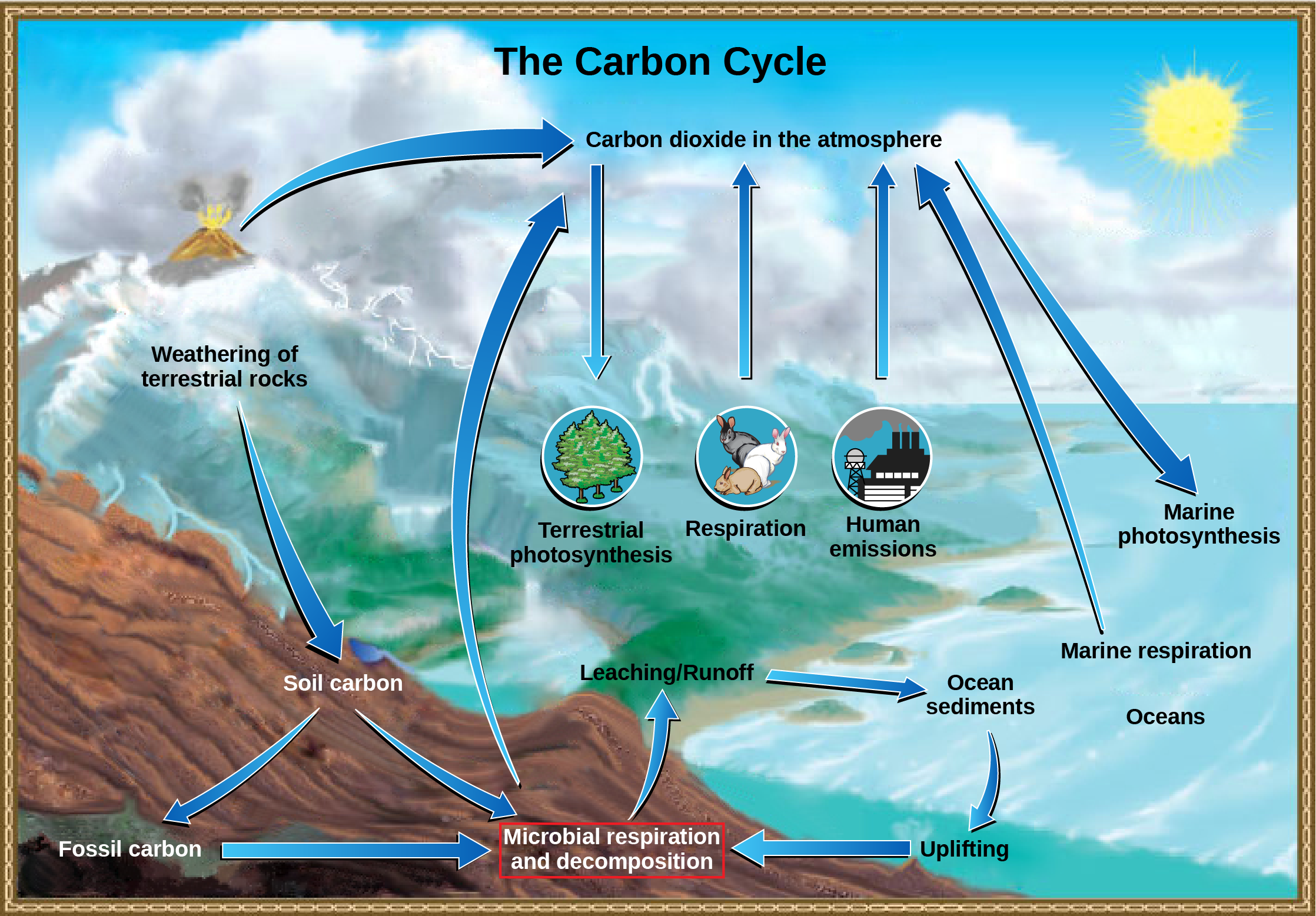
Carbon is one of the most important macronutrients, and prokaryotes play an important role in the carbon cycle (Figure 22.18). The carbon cycle traces the movement of carbon from inorganic to organic compounds and back again. Carbon is cycled through Earth’s major reservoirs: land, the atmosphere, aquatic environments, sediments and rocks, and biomass. In a way, the carbon cycle echoes the role of the “four elements” first proposed by the ancient Greek philosopher, Empedocles: fire, water, earth, and air. Carbon dioxide is removed from the atmosphere by land plants and marine prokaryotes, and is returned to the atmosphere via the respiration of chemoorganotrophic organisms, including prokaryotes, fungi, and animals. Although the largest carbon reservoir in terrestrial ecosystems is in rocks and sediments, that carbon is not readily available.
英語のヒント
炭素は最も重要な多量栄養素の一つであり、原核生物は炭素循環で重要な役割を果たす(図22.18)。炭素循環は、炭素が無機化合物から有機化合物へ、そして再び戻る動きをたどる。炭素は、陸、大気、水圏、堆積物と岩石、生物量という、地球の主要な貯蔵場所を循環する。ある意味で、炭素循環は、古代ギリシャの哲学者エンペドクレスが初めて提案した、火、水、土、空気という「四元素」の役割と響き合う。二酸化炭素は、陸上植物や海の原核生物によって大気から取り除かれ、原核生物、菌類、動物など、化学有機栄養生物の呼吸によって大気へ戻る。陸上生態系で最大の炭素貯蔵場所は岩石と堆積物だが、そこにある炭素は容易には利用できない。
Participants in the carbon cycle are roughly divided among producers, consumers, and decomposers of organic carbon compounds. The primary producers of organic carbon compounds from CO2 are land plants and photosynthetic bacteria. A large amount of available carbon is found in living land plants. A related source of carbon compounds is humus, which is a mixture of organic materials from dead plants and prokaryotes that have resisted decomposition. (The term "humus," by the way, is the root of the word "human.") Consumers such as animals and other heterotrophs use organic compounds generated by producers and release carbon dioxide to the atmosphere. Other bacteria and fungi, collectively called decomposers, carry out the breakdown (decomposition) of plants and animals and their organic compounds. Most carbon dioxide in the atmosphere is derived from the respiration of microorganisms that decompose dead animals, plants, and humus.
英語のヒント
炭素循環の担い手は、有機炭素化合物の生産者、消費者、分解者に大きく分けられる。CO2から有機炭素化合物を作る主な生産者は、陸上植物と光合成細菌である。生きた陸上植物には、利用できる炭素が大量に存在する。関連する炭素化合物の供給源に腐植がある。これは、死んだ植物や原核生物に由来し、分解されずに残った有機物の混合物である。ちなみに英語のhumus(腐植)は、human(人間)という語の語根である。動物やほかの従属栄養生物のような消費者は、生産者が作った有機化合物を使い、大気へ二酸化炭素を放出する。ほかの細菌や菌類は、まとめて分解者と呼ばれ、植物や動物と、それらの有機化合物を分解する。大気中の二酸化炭素の大部分は、死んだ動物、植物、腐植を分解する微生物の呼吸に由来する。
In aqueous environments and their anoxic sediments, there is another carbon cycle taking place. In this case, the cycle is based on one-carbon compounds. In anoxic sediments, prokaryotes, mostly archaea, produce methane (CH4). This methane moves into the zone above the sediment, which is richer in oxygen and supports bacteria called methane oxidizers that oxidize methane to carbon dioxide, which then returns to the atmosphere.
英語のヒント
水域と、そこの無酸素の堆積物では、別の炭素循環が起こっている。この場合、循環は炭素原子を一つもつ化合物に基づく。無酸素の堆積物では、主に古細菌である原核生物が、メタンCH4を作る。メタンは堆積物の上の領域へ移動する。そこは酸素がより豊富で、メタン酸化細菌と呼ばれる細菌が生息できる。これらはメタンを二酸化炭素へ酸化し、その二酸化炭素が大気へ戻る。
OpenStax, Rice University; Biology 2e. (credit: modification of work by John M. Evans and Howard Perlman, USGS) · CC BY 4.0 · Source出典

Figure 22.18図 22.18
The carbon cycle. Prokaryotes play a significant role in continuously moving carbon through the biosphere. (credit: modification of work by John M. Evans and Howard Perlman, USGS)
炭素循環。原核生物は、生物圏を通じて炭素を絶えず移動させる、重要な役割を果たす。(クレジット:John M. Evans、Howard Perlman、USGSの作品を改変)
Prokaryotes and the Nitrogen Cycle原核生物と窒素循環
Nitrogen is a very important element for life because it is a major constituent of proteins and nucleic acids. It is a macronutrient, and in nature, it is recycled from organic compounds to ammonia, ammonium ions, nitrate, nitrite, and nitrogen gas by many processes, many of which are carried out only by prokaryotes. As illustrated in Figure 22.19, prokaryotes are key to the nitrogen cycle. The largest pool of nitrogen available in the terrestrial ecosystem is gaseous nitrogen (N2) from the air, but this nitrogen is not usable by plants, which are primary producers. Gaseous nitrogen is transformed, or “fixed” into more readily available forms, such as ammonia (NH3), through the process of nitrogen fixation. Nitrogen-fixing bacteria include Azotobacter in soil and the ubiquitous photosynthetic cyanobacteria. Some nitrogen fixing bacteria, like Rhizobium, live in symbiotic relationships in the roots of legumes. Another source of ammonia is ammonification, the process by which ammonia is released during the decomposition of nitrogen-containing organic compounds. The ammonium ion is progressively oxidized by different species of bacteria in a process called nitrification. The nitrification process begins with the conversion of ammonium to nitrite (NO2-), and continues with the conversion of nitrite to nitrate. Nitrification in soils is carried out by bacteria belonging to the genera Nitrosomas, Nitrobacter, and Nitrospira. Most nitrogen in soil is in the form of ammonium (NH4+) or nitrate (NO3-). Ammonia and nitrate can be used by plants or converted to other forms.
英語のヒント
窒素はタンパク質と核酸の主要成分であるため、生命にとって非常に重要な元素である。多量栄養素であり、自然界では多くの過程を通じて、有機化合物からアンモニア、アンモニウムイオン、硝酸、亜硝酸、窒素ガスへと循環する。その過程の多くは、原核生物だけが行う。図22.19に示すように、原核生物は窒素循環の鍵を握る。陸上生態系で利用可能な最大の窒素の蓄えは、空気中の窒素ガスN2だが、一次生産者である植物はこれを使えない。窒素ガスは、窒素固定によって、アンモニアNH3など、より利用しやすい形へ変換、すなわち「固定」される。窒素固定細菌には、土壌中のAzotobacterや、至るところに存在する光合成性のシアノバクテリアがある。Rhizobiumなど、一部の窒素固定細菌は、マメ科植物の根で共生している。アンモニアのもう一つの供給源は、アンモニア化である。これは、窒素を含む有機化合物が分解される際に、アンモニアが放出される過程をいう。アンモニウムイオンは、硝化という過程で、異なる細菌種によって段階的に酸化される。硝化はアンモニウムから亜硝酸NO2-への変換から始まり、亜硝酸から硝酸への変換へ続く。土壌中の硝化は、Nitrosomas、Nitrobacter、Nitrospiraの各属の細菌が行う。土壌中の窒素の大部分は、アンモニウムNH4+または硝酸NO3-の形である。アンモニアや硝酸は植物に利用されるか、ほかの形へ変換される。
Ammonia released into the atmosphere, however, represents only 15 percent of the total nitrogen released; the rest is as N2 and N2O (nitrous oxide). Ammonia is catabolized anaerobically by some prokaryotes, yielding N2 as the final product. Denitrifying bacteria reverse the process of nitrification, reducing the nitrate from soils to gaseous compounds such as N2O, NO, and N2.
英語のヒント
しかし、大気へ放出されるアンモニアは、放出窒素全体のわずか15%であり、残りはN2と、亜酸化窒素N2Oである。一部の原核生物は、アンモニアを嫌気的に異化し、最終生成物としてN2を生む。脱窒細菌は硝化の逆の過程を行い、土壌中の硝酸を、N2O、NO、N2などの気体化合物へ還元する。