第28章無脊椎動物
Classification of Phylum Mollusca軟体動物門の分類
Phylum Mollusca comprises a very diverse group of organisms that exhibits a dramatic variety of forms, ranging from chitons to snails to squids, the latter of which typically show a high degree of intelligence. This variability is a consequence of modification of the basic body regions, especially the foot and mantle. The phylum is organized into eight classes: Caudofoveata, Solenogastres, Monoplacophora, Polyplacophora, Gastropoda, Cephalopoda, Bivalvia, and Scaphopoda. Although each molluscan class appears to be monophyletic, their relationship to one another is unclear and still being reviewed.
英語のヒント
軟体動物門は、ヒザラガイから巻貝、イカまで、驚くほど多様な形態を示す生物の群からなる。最後のイカは通常、高い知能を示す。この多様性は、基本的な体の領域、特に足と外套膜の改変によって生じた。この門は、尾腔綱、溝腹綱、単板綱、多板綱、腹足綱、頭足綱、二枚貝綱、掘足綱の八つに分けられる。各綱は単系統と考えられるものの、綱同士の関係は不明確で、現在も検討されている。
Both the Caudofoveata and the Solenogastres include shell-less, worm-like animals primarily found in benthic marine habitats. Although these animals lack a calcareous shell, they get some protection from calcareous spicules embedded in a cuticle that covers their epidermis. The mantle cavity is reduced, and both groups lack eyes, tentacles, and nephridia (excretory organs). The Caudofoveata possess a radula, but the Solenogastres do not have a radula or gills. The foot is also reduced in the Solenogastres and absent from the Caudofoveata.
英語のヒント
尾腔類と溝腹類には、主に海底に生息する、殻のない虫状の動物が含まれる。石灰質の殻はないが、表皮を覆うクチクラに埋め込まれた石灰質の骨片によって、ある程度保護される。外套腔は縮小し、両群とも眼、触手、腎管(排泄器官)を欠く。尾腔類には歯舌があるが、溝腹類には歯舌も鰓もない。足も、溝腹類では縮小し、尾腔類にはない。
Long thought to be extinct, the first living specimens of Monoplacophora, Neopilina galatheae, were discovered in 1952 on the ocean bottom near the west coast of Costa Rica. Today there are over 25 described species. Members of class Monoplacophora (“bearing one plate”) possess a single, cap-like shell that covers the dorsal body. The morphology of the shell and the underlying animal can vary from circular to ovate. They have a simple radula, a looped digestive system, multiple pairs of excretory organs, and a pair of gonads. Multiple gills are located between the foot and the edge of the mantle.
英語のヒント
単板類は長く絶滅したと考えられていたが、1952年、コスタリカ西岸付近の海底で、最初の現生標本 Neopilina galatheae が発見された。現在は25種を超える記載種がある。単板綱(「一枚の板をもつ」の意)の動物は、背側を覆う帽子状の殻を一つもつ。殻とその下の動物の形は、円形から卵形までさまざまである。単純な歯舌、輪状に曲がった消化系、複数対の排泄器官、一対の生殖腺をもつ。足と外套膜の縁の間には複数の鰓がある。
Animals in class Polyplacophora (“bearing many plates”) are commonly known as “chitons” and bear eight limy plates that make up the dorsal shell (Figure 28.22). These animals have a broad, ventral foot that is adapted for suction onto rocks and other substrates, and a mantle that extends beyond the edge of the shell. Calcareous spines on the exposed mantle edge provide protection from predators. Respiration is facilitated by multiple pairs of gills in the mantle cavity. Blood from the gills is collected in a posterior heart, and then sent to the rest of the body in a hemocoel—an open circulation system in which the blood is contained in connected chambers surrounding various organs rather than within individual blood vessels. The radula, which has teeth composed of an ultra-hard magnetite, is used to scrape food organisms off rocky surfaces. Chiton teeth have been shown to exhibit the greatest hardness and stiffness of any biomineral material reported to date, being as much as three-times harder than human enamel and the calcium carbonate-based shells of mollusks.
英語のヒント
多板綱(「多くの板をもつ」の意)の動物は、一般にヒザラガイと呼ばれ、8枚の石灰質の板が背側の殻を構成する(図28.22)。腹側の幅広い足は岩などの基質に吸着するのに適応し、外套膜は殻の縁より外へ広がる。露出した外套膜の縁にある石灰質の棘は、捕食者から身を守る。外套腔内の複数対の鰓が呼吸を助ける。鰓からの血液は後方の心臓に集められ、血体腔を通じて全身へ送られる。血体腔は開放血管系であり、血液は個々の血管内ではなく、さまざまな器官を囲む、互いにつながった部屋に入る。歯舌には、きわめて硬い磁鉄鉱からなる歯があり、岩の表面から食物となる生物を削り取る。ヒザラガイの歯は、これまで報告された生体鉱物の中で最大の硬さと剛性を示すことが分かっており、人のエナメル質や、炭酸カルシウムを主成分とする軟体動物の殻の最大3倍も硬い。
The nervous system is rudimentary with only buccal or “cheek” ganglia present at the anterior end. Multiple tiny sensory structures, including photosensors, extend from the mantle into channels in the upper layer of the shell. These structures are called esthetes and are unique to the chitons. Another sensory structure under the radula is used to sample the feeding environment. A single pair of nephridia is used for the excretion of nitrogenous wastes.
英語のヒント
神経系は初歩的で、前端には口腔、すなわち「頬」の神経節だけがある。光受容器を含む多数の小さな感覚構造が、外套膜から殻の上層の水路内へ伸びる。これらは殻感器と呼ばれ、ヒザラガイに固有である。歯舌の下にある別の感覚構造は、摂食場所の環境を調べるために使われる。一対の腎管が、窒素性老廃物の排泄を担う。
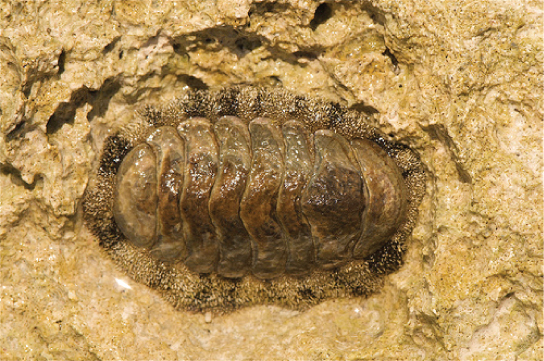
Figure 28.22図 28.22
A chiton. This chiton from the class Polyplacaphora has the eight-plated shell for which its class is named. (credit: Jerry Kirkhart)
ヒザラガイ。多板綱のこのヒザラガイには、綱名の由来となった8枚の板からなる殻がある。(提供:Jerry Kirkhart)
Class Bivalvia (“two-valves”) includes clams, oysters, mussels, scallops, geoducks, and shipworms. Some bivalves are almost microscopic, while others, in the genus Tridacna, may be one meter in length and weigh 225 kilograms. Members of this class are found in marine as well as freshwater habitats. As the name suggests, bivalves are enclosed in two-part valves or shells (Figure 28.23a) fused on the dorsal side by hinge ligaments as well as shell teeth on the ventral side that keep the two halves aligned. The two shells, which consist of an outer organic layer, a middle prismatic layer, and a very smooth nacreous layer, are joined at the oldest part of the shell called the umbo. Anterior and posterior adductor and abductor muscles close and open the shell respectively.
英語のヒント
二枚貝綱(「二つの殻」の意)には、アサリなどの貝、カキ、イガイ、ホタテ、アメリカナミガイ、フナクイムシが含まれる。ほとんど顕微鏡サイズのものもあれば、シャコガイ属では長さ1 m、重さ225 kgに達するものもある。この綱は海と淡水の両方に生息する。名前のとおり、二枚貝は二つの殻で囲まれる(図28.23a)。背側では蝶番の靱帯で結合し、腹側では殻歯が両半分の位置をそろえる。二つの殻は、外側の有機質層、中央の稜柱層、非常に滑らかな真珠層からなり、殻頂という最も古い部分でつながっている。前方と後方の閉殻筋と開殻筋が、それぞれ殻を閉じたり開いたりする。
The overall body of the bivalve is laterally flattened; the foot is wedge-shaped; and the head region is poorly developed (with no obvious mouth). Bivalves are filter-feeders, and a radula is absent in this class of mollusks. The mantle cavity is fused along the edges except for openings for the foot and for the intake and expulsion of water, which is circulated through the mantle cavity by the actions of the incurrent and excurrent siphons. During water intake by the incurrent siphon, food particles are captured by the paired posterior gills (ctenidia) and then carried by the movement of cilia forward to the mouth. Excretion and osmoregulation are performed by a pair of nephridia. Eyespots and other sensory structures are located along the edge of the mantle in some species. The "eyes" are especially conspicuous in scallops (Figure 28.23b). Three pairs of connected ganglia regulate activity of different body structures.
英語のヒント
二枚貝の体全体は左右方向に扁平で、足はくさび形である。頭部の発達は乏しく、明瞭な口は見られない。二枚貝はろ過摂食者であり、この綱には歯舌がない。外套腔の縁は、足を出す開口部と、水の取り込み・排出のための開口部を除いて癒合している。水は入水管と出水管の働きによって外套腔を循環する。入水管から水を取り込む際、食物粒子は後方にある一対の櫛鰓に捕らえられ、繊毛運動によって前方の口へ運ばれる。排泄と浸透圧調節は一対の腎管が行う。一部の種では、眼点などの感覚構造が外套膜の縁に並ぶ。特にホタテでは「眼」が目立つ(図28.23b)。互いにつながる三対の神経節が、体の各構造の活動を調節する。
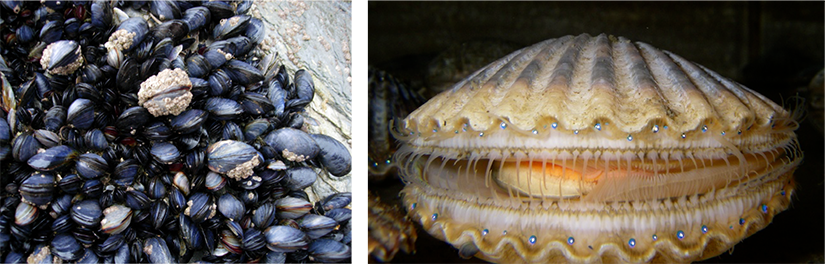
OpenStax, Rice University; Biology 2e. (credit (a): Mark A. Wilson. credit (b) Rachael Norris and Marina Freudzon. https://commons.wikimedia.org/w/index.php?curid=17251065) · CC BY 4.0 · Source出典
Figure 28.23図 28.23
Bivalves. These mussels (a), found in the intertidal zone in Cornwall, England, show the bivalve shell. The scallop Argopecten irradians (b) has a fluted shell and conspicuous eyespots. (credit (a): Mark A. Wilson. credit (b) Rachael Norris and Marina Freudzon. https://commons.wikimedia.org/w/index.php?curid=17251065)
二枚貝。イギリスのコーンウォールの潮間帯にいたイガイ(a)には、二枚の殻が見られる。ホタテの一種 Argopecten irradians(b)は、溝のある殻と目立つ眼点をもつ。(a:Mark A. Wilson。b:Rachael Norris、Marina Freudzon。https://commons.wikimedia.org/w/index.php?curid=17251065)
One of the functions of the mantle is to secrete the shell. Some bivalves, like oysters and mussels, possess the unique ability to secrete and deposit a calcareous nacre or “mother of pearl” around foreign particles that may enter the mantle cavity. This property has been commercially exploited to produce pearls.
英語のヒント
外套膜の機能の一つは、殻を分泌することである。カキやイガイなどの一部の二枚貝には、外套腔に入った異物の粒子の周囲へ、石灰質の真珠質、すなわち「真珠母」を分泌・沈着させる独特の能力がある。この性質は、真珠の商業的な生産に利用されてきた。
More than half of molluscan species are in the class Gastropoda (“stomach foot”), which includes well-known mollusks like snails, slugs, conchs, cowries, limpets, and whelks. Aquatic gastropods include both marine and freshwater species, and all terrestrial mollusks are gastropods. Gastropoda includes shell-bearing species as well as species without shells. Gastropod bodies are asymmetrical and usually present a coiled shell (Figure 28.24a). Shells may be planospiral (like a garden hose wound up), commonly seen in garden snails, or conispiral, (like a spiral staircase), commonly seen in marine conches. Cowrie shells have a polished surface because the mantle extends up over the top of the shell as it is secreted.
英語のヒント
軟体動物の半数を超える種は、腹足綱(「腹の足」の意)に属する。ここには、カタツムリ、ナメクジ、ソデボラ、タカラガイ、カサガイ、エゾバイなど、よく知られた軟体動物が含まれる。水生の腹足類には海産種と淡水種があり、陸生の軟体動物はすべて腹足類である。殻をもつ種も、もたない種も含まれる。腹足類の体は非対称で、通常は巻いた殻をもつ(図28.24a)。殻には、庭にいるカタツムリによく見られる平面らせん状(庭のホースを巻いたような形)と、海産の巻貝によく見られる円錐らせん状(らせん階段のような形)がある。タカラガイの殻の表面が磨かれたように見えるのは、殻が分泌される際に、外套膜が殻の上面まで広がって覆うためである。
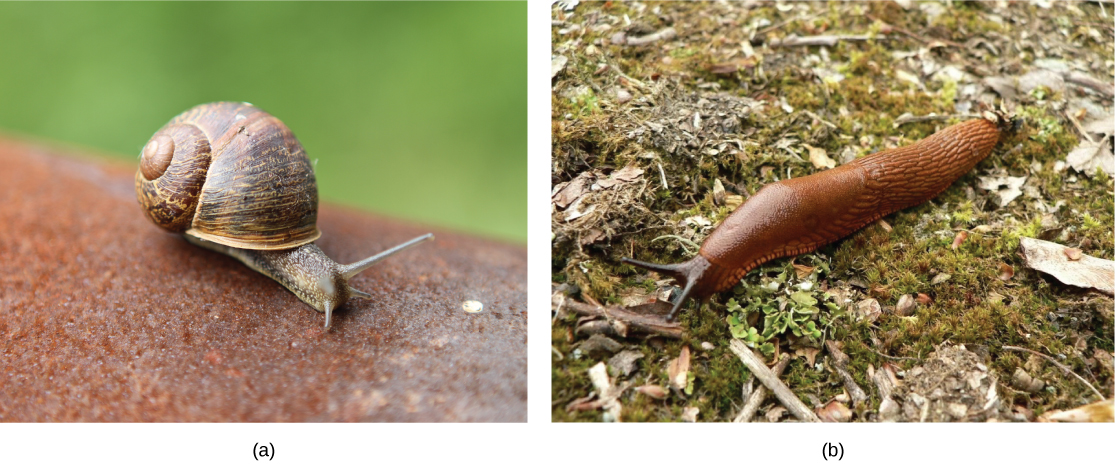
OpenStax, Rice University; Biology 2e. (credit a: modification of work by Murray Stevenson; credit b: modification of work by Rosendahl) · CC BY 4.0 · Source出典
Figure 28.24図 28.24
Gastropods. Snails (a) and slugs (b) are both gastropods, but slugs lack a shell. (credit a: modification of work by Murray Stevenson; credit b: modification of work by Rosendahl)
腹足類。カタツムリ(a)とナメクジ(b)はどちらも腹足類だが、ナメクジには殻がない。(a:Murray Stevensonの作品を改変。b:Rosendahlの作品を改変)
A key characteristic of some gastropods is the embryonic development of torsion. During this process, the mantle and visceral mass are rotated around the perpendicular axis over the center of the foot to bring the anal opening forward just behind the head (Figure 28.25), creating a very peculiar situation. The left gill, kidney, and heart atrium are now on the right side, whereas the original right gill, kidney, and heart atrium are on the left side. Even stranger, the nerve cords have been twisted and contorted into a figure-eight pattern. Because of the space made available by torsion in the mantle cavity, the animal’s sensitive head end can now be withdrawn into the protection of the shell, and the tougher foot (and sometimes the protective covering or operculum) forms a barrier to the outside. The strange arrangement that results from torsion poses a serious sanitation problem by creating the possibility of wastes being washed back over the gills, causing fouling. There is actually no really perfect explanation for the embryonic development of torsion, and some groups that formerly exhibited torsion in their ancestral groups are now known to have reversed the process.
英語のヒント
一部の腹足類の重要な特徴は、胚発生中に起こるねじれである。この過程では、外套膜と内臓塊が足の中央上方の垂直軸の周りを回転し、肛門の開口部が前方、頭のすぐ後ろへ移る(図28.25)。その結果、非常に奇妙な状態が生じる。左側だった鰓、腎臓、心房は右側へ移り、元の右側の鰓、腎臓、心房は左側へ移る。さらに奇妙なことに、神経索はねじれて8の字形になる。ねじれによって外套腔内に空間ができるため、敏感な頭部を殻の中に引き込んで保護できるようになる。そして、より頑丈な足と、場合によっては保護用の蓋が、外部への障壁となる。ねじれが生むこの奇妙な配置は、排泄物が鰓の上へ流れ戻り、汚染を起こす可能性があるという、深刻な衛生上の問題をもたらす。実際、胚発生中のねじれを完全に説明する説はない。祖先の群でねじれを示していた一部の群は、現在、この過程を逆転させたことが知られている。
Gastropods also have a foot that is modified for crawling. Most gastropods have a well-defined head with tentacles and eyes. A complex radula is used to scrape up food particles. In aquatic gastropods, the mantle cavity encloses the gills (ctenidia), but in land gastropods, the mantle itself is the major respiratory structure, acting as a kind of lung. Nephridia (“kidneys”) are also found in the mantle cavity.
英語のヒント
腹足類には、はい進むために改変された足もある。多くは、触角と眼を備えた明瞭な頭部をもつ。複雑な歯舌で食物粒子を削り取る。水生腹足類の外套腔は櫛鰓を収めるが、陸生腹足類では外套膜そのものが主要な呼吸構造となり、一種の肺として働く。外套腔には腎管(「腎臓」)もある。
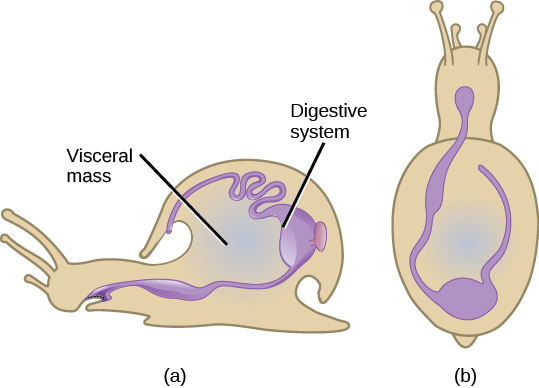
Figure 28.25図 28.25
Torsion in gastropods. During embryonic development of some gastropods, the visceral mass undergoes torsion, or counterclockwise rotation of the visceral anatomical features. As a result, the anus of the adult animal is located over the head. Although torsion is always counterclockwise, the shell may coil in either direction; thus coiling of a shell is not the same as torsion of the visceral mass.
腹足類のねじれ。一部の腹足類では胚発生中に、内臓塊がねじれ、内臓の構造が反時計回りに回転する。その結果、成体の肛門は頭の上方に位置する。ねじれは常に反時計回りだが、殻はどちら向きにも巻くことがある。したがって、殻の巻きと内臓塊のねじれは同じものではない。
Class Cephalopoda (“head foot” animals), includes octopuses, squids, cuttlefish, and nautiluses. Cephalopods include both animals with shells as well as animals in which the shell is reduced or absent. In the shell-bearing Nautilus, the spiral shell is multi-chambered. These chambers are filled with gas or water to regulate buoyancy. A siphuncle runs through the chambers, and it is this tube that regulates the amount of water and gases (nitrogen, carbon dioxide, and oxygen mixture) present in the chambers. Ammonites and other nautiloid shells are commonly seen in the fossil record. The shell structure in squids and cuttlefish is reduced and is present internally in the form of a squid pen and cuttlefish bone, respectively. Cuttle bone is sold in pet stores to help smooth the beaks of birds and also to provide birds such as egg-laying chickens and quail with an inexpensive natural source of calcium carbonate. Examples of cephalopods are shown in Figure 28.27.
英語のヒント
頭足綱(「頭と足をもつ動物」の意)には、タコ、イカ、コウイカ、オウムガイが含まれる。殻をもつ動物と、殻が縮小または消失した動物の両方がいる。殻をもつオウムガイでは、らせん状の殻が複数の部屋に分かれ、各室にガスや水を満たして浮力を調節する。連室細管が各室を貫き、この管が、室内の水とガス(窒素、二酸化炭素、酸素の混合物)の量を調節する。アンモナイトなどのオウムガイ型の殻は、化石記録によく見られる。イカやコウイカの殻は縮小し、内部に、それぞれ軟甲と石灰質の甲として存在する。コウイカの甲は、鳥のくちばしを滑らかにするため、また、産卵するニワトリやウズラなどへ安価で天然の炭酸カルシウム源を供給するため、ペットショップで販売されている。図28.27に頭足類の例を示す。
Cephalopods can display vivid and rapidly changing coloration, almost like flashing neon signs. Typically these flashing displays are seen in squids and octopuses, where they may be used for camouflage and possibly as signals for mating displays. We should note, however, that researchers are not entirely sure if squid can actually see color, or see color in the same way as we do. We know that pigments in the skin are contained in special pigment cells (chromatophores), which can expand or contract to produce different color patterns. But chromatophores can only make yellow, red, brown, and black pigmentation; however, underneath them is a whole different set of elements called iridophores and leucophores that reflect light and can make blue, green, and white. It is possible that squid skin might actually be able to detect some light on its own, without even needing its eyes!
英語のヒント
頭足類は、ネオンサインの点滅のように、鮮やかな色を急速に変えて見せることができる。こうした点滅は通常、イカやタコで見られ、カモフラージュや、おそらく求愛時の信号に使われる。ただし、イカが実際に色を見ることができるか、または私たちと同じように色を見るかについて、研究者は完全には確信していない。皮膚の色素は色素胞という特殊な色素細胞に含まれ、これが広がったり縮んだりして異なる模様をつくることが分かっている。しかし、色素胞が生み出せるのは黄色、赤色、褐色、黒色だけである。その下には、虹色素胞と白色素胞というまったく別の要素があり、光を反射して青色、緑色、白色を生み出せる。イカの皮膚は、眼を使わずに、それ自体で一部の光を検出できる可能性さえある。
All animals in this class are carnivorous predators and have beak-like jaws in addition to the radula. Cephalopods include the most intelligent of the mollusks, and have a well-developed nervous system along with image-forming eyes. Unlike other mollusks, they have a closed circulatory system, in which the blood is entirely contained in vessels rather than in a hemocoel.
英語のヒント
この綱の動物はすべて肉食の捕食者で、歯舌に加えてくちばし状の顎をもつ。頭足類には軟体動物の中で最も知能の高いものが含まれ、結像する眼とともに、よく発達した神経系をもつ。ほかの軟体動物と異なり、閉鎖血管系をもち、血液は血体腔ではなく、すべて血管内に収まっている。
The foot is lobed and subdivided into arms and tentacles. Suckers with chitinized rings are present on the arms and tentacles of octopuses and squid. Siphons are well developed and the expulsion of water is used as their primary mode of locomotion, which resembles jet propulsion. Gills (ctenidia) are attached to the wall of the mantle cavity and are serviced by large blood vessels, each with its own heart. A pair of nephridia is present within the mantle cavity for water balance and excretion of nitrogenous wastes. Cephalopods such as squids and octopuses also produce sepia or a dark ink, which contains melanin. The ink gland is located between the gills and can be released into the excurrent water stream. Ink clouds can be used either as a “smoke screen” to hide the animal from predators during a quick attempt at escape, or to create a fake image to distract predators.
英語のヒント
足は葉状に分かれ、さらに腕と触腕に分化している。タコとイカの腕や触腕には、キチン化した環を備えた吸盤がある。水管はよく発達し、水の排出が主要な移動方法となっており、ジェット推進に似ている。鰓(櫛鰓)は外套腔の壁に付着し、それぞれに独自の心臓を備えた大きな血管から血液を供給される。外套腔内には一対の腎管があり、水分収支と窒素性老廃物の排泄を担う。イカやタコなどの頭足類は、メラニンを含むセピア、すなわち暗い色の墨もつくる。墨腺は鰓の間にあり、流れ出る水へ墨を放出できる。墨の雲は、素早く逃げる際に捕食者から体を隠す「煙幕」として、または捕食者の注意をそらす偽の姿をつくるために使われる。
Cephalopods are dioecious. Members of a species mate, and the female then lays the eggs in a secluded and protected niche. Females of some species care for the eggs for an extended period of time and may end up dying during that time period. While most other aquatic mollusks produce trochophore larvae, cephalopod eggs develop directly into a juvenile without an intervening larval stage.
英語のヒント
頭足類は雌雄異体である。同種の個体同士が交尾し、その後、雌は人目につかない保護された場所に産卵する。一部の種の雌は、長い期間にわたって卵の世話をし、その間に死ぬこともある。ほかの水生軟体動物の多くがトロコフォア幼生を生じるのに対し、頭足類の卵は幼生期を挟まず、直接幼体へ発生する。
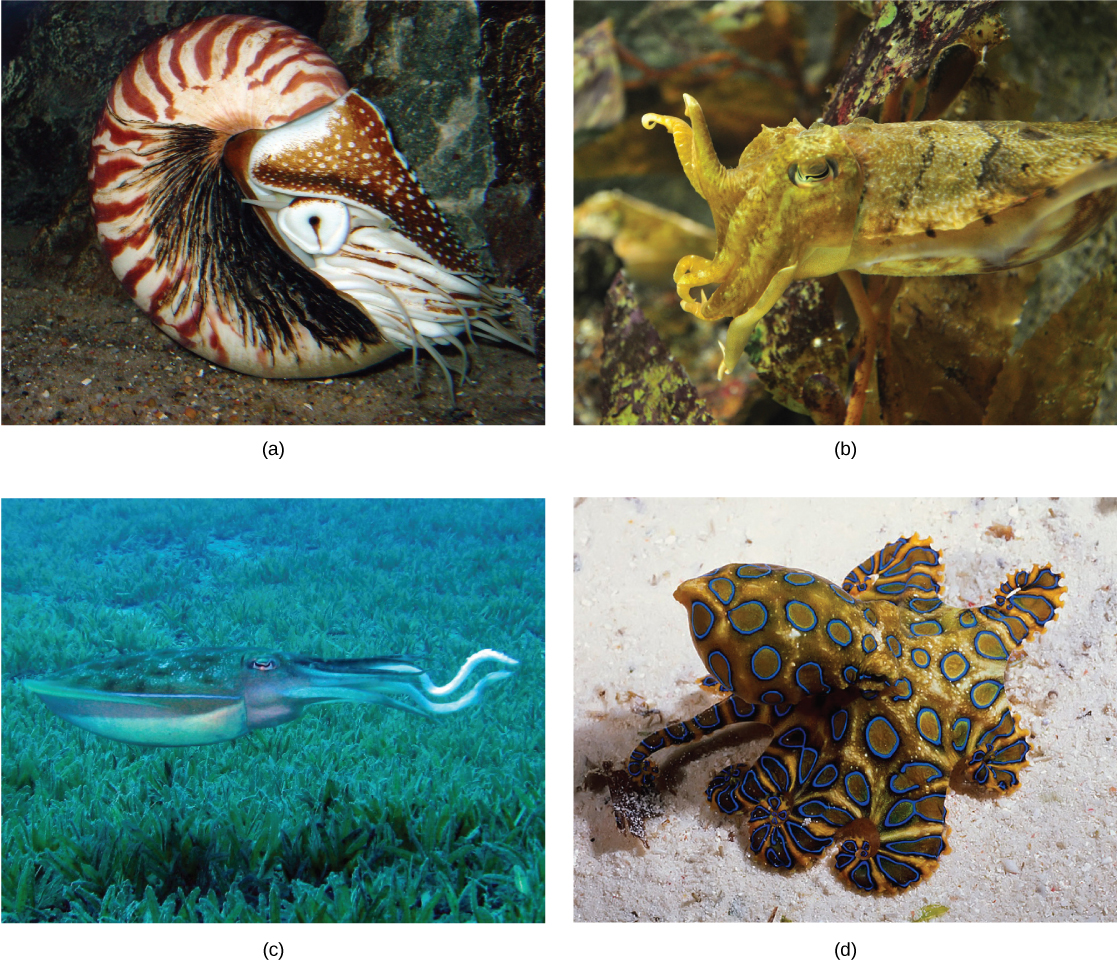
OpenStax, Rice University; Biology 2e. (credit a: modification of work by J. Baecker; credit b: modification of work by Adrian Mohedano; credit c: modification of work by Silke Baron; credit d: modification of work by Angell Williams) · CC BY 4.0 · Source出典
Figure 28.27図 28.27
Cephalopods. The (a) nautilus, (b) giant cuttlefish, (c) reef squid, and (d) blue-ring octopus are all members of the class Cephalopoda. (credit a: modification of work by J. Baecker; credit b: modification of work by Adrian Mohedano; credit c: modification of work by Silke Baron; credit d: modification of work by Angell Williams)
頭足類。(a)オウムガイ、(b)大型のコウイカ、(c)リーフ・スクイッド、(d)ヒョウモンダコは、すべて頭足綱の動物である。(a:J. Baecker、b:Adrian Mohedano、c:Silke Baron、d:Angell Williamsの各作品を改変)
Members of class Scaphopoda (“boat feet”) are known colloquially as “tusk shells” or “tooth shells,” as evident when examining Dentalium, one of the few remaining scaphopod genera (Figure 28.28). Scaphopods are usually buried in sand with the anterior opening exposed to water. These animals have a single conical shell, which is open on both ends. The head is not well developed, but the mouth, containing a radula, opens among a group of tentacles that terminate in ciliated bulbs used to catch and manipulate prey. Scaphopods also have a foot similar to that seen in bivalves. Ctenidia are absent in these animals; the mantle cavity forms a tube open at both ends and serves as the respiratory structure in these animals.
英語のヒント
掘足綱(「舟の足」の意)は、一般にツノガイ、または「牙の殻」「歯の殻」と呼ばれる。現存する数少ない属の一つ、Dentalium を見ると、その理由が分かる(図28.28)。掘足類は通常、前方の開口部を水中に出して砂に埋まっている。殻は一つの円錐形で、両端が開いている。頭部はあまり発達していないが、歯舌を含む口は触手の集まりの中に開く。触手の先端は繊毛のあるふくらみになっており、獲物を捕らえて扱うために使われる。二枚貝に似た足もある。櫛鰓はなく、両端が開いた管を形成する外套腔が呼吸構造として働く。
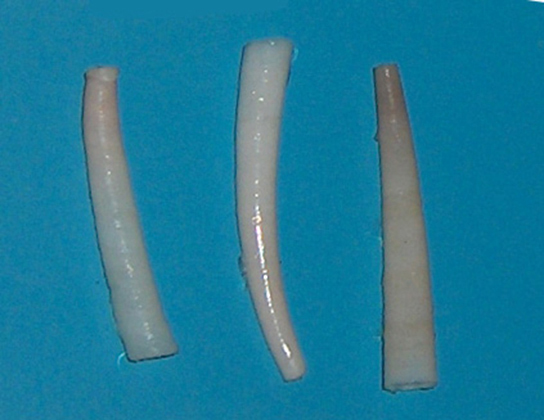


Figure 28.28図 28.28
Tooth shells. Antalis vulgaris shows the classic Dentaliidae shape that gives these animals their common name of "tusk shell." (credit: Georges Jansoone)
ツノガイ。Antalis vulgaris は、この動物が「牙の殻」と呼ばれる由来となった、ツノガイ科の典型的な形を示す。(提供:Georges Jansoone)