第15章遺伝子とタンパク質
Aminoacyl tRNA SynthetasesアミノアシルtRNA合成酵素
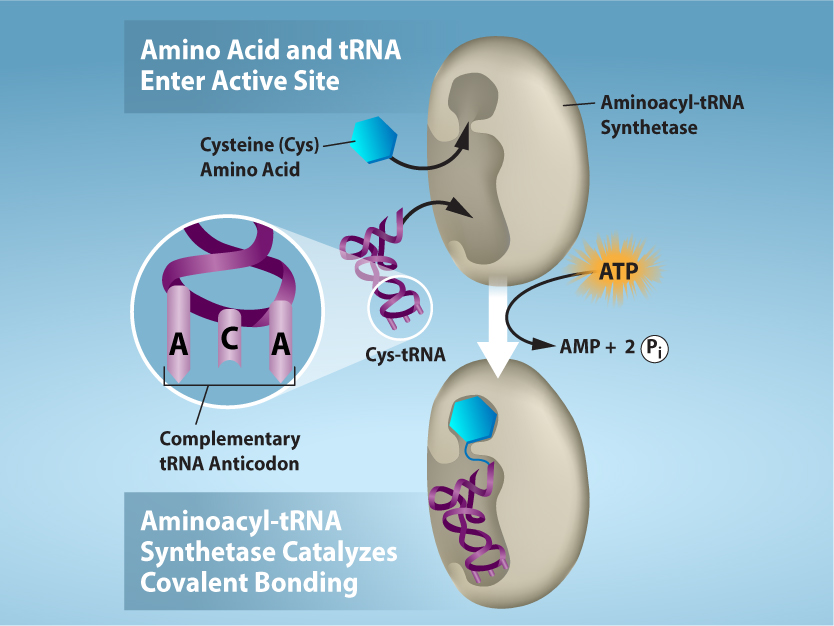
The process of pre-tRNA synthesis by RNA polymerase III only creates the RNA portion of the adaptor molecule. The corresponding amino acid must be added later, once the tRNA is processed and exported to the cytoplasm. Through the process of tRNA “charging,” each tRNA molecule is linked to its correct amino acid by one of a group of enzymes called aminoacyl tRNA synthetases. At least one type of aminoacyl tRNA synthetase exists for each of the 20 amino acids; the exact number of aminoacyl tRNA synthetases varies by species. These enzymes first bind and hydrolyze ATP to catalyze a high-energy bond between an amino acid and adenosine monophosphate (AMP); a pyrophosphate molecule is expelled in this reaction. The activated amino acid is then transferred to the tRNA, and AMP is released. The term "charging" is appropriate, since the high-energy bond that attaches an amino acid to its tRNA is later used to drive the formation of the peptide bond. Each tRNA is named for its amino acid.
英語のヒント
RNAポリメラーゼIIIによるpre-tRNAの合成では、アダプター分子のRNA部分だけが作られる。対応するアミノ酸は、tRNAが加工されて細胞質へ運ばれた後に付加しなければならない。tRNAの「チャージング」という過程で、各tRNA分子は、アミノアシルtRNA合成酵素と呼ばれる酵素群の1つによって、正しいアミノ酸と結びつけられる。20種類のアミノ酸それぞれに対し、少なくとも1種類のアミノアシルtRNA合成酵素が存在する。酵素の正確な数は種によって異なる。これらの酵素は、まずATPに結合して加水分解し、アミノ酸とアデノシン一リン酸(AMP)との間の高エネルギー結合の形成を触媒する。この反応では、ピロリン酸分子が放出される。次に、活性化されたアミノ酸がtRNAへ移され、AMPが放出される。アミノ酸とtRNAをつなぐ高エネルギー結合は、後でペプチド結合の形成を進めるために使われるので、「チャージング」という呼び方は適切である。各tRNAは、対応するアミノ酸にちなんで名づけられる。
OpenStax, Rice University; Biology 2e. Credit: Rao, A., Ryan, K. and Tag, A. Department of Biology, Texas A&M University. · CC BY 4.0 · Source出典

Figure 15.17図 15.17
Charging of tRNAs with correct amino acids. Aminoacyl-tRNA synthetases catalyze covalent bond formation between the tRNA and the correct amino acid in preparation for translation. Because there are multiple amino acids, there are multiple different tRNA synthetases. All of the synthetases require energy, in the form of ATP, to make sure the correct amino acid is attached to the tRNA with the correct anticodon sequence. Credit: Rao, A., Ryan, K. and Tag, A. Department of Biology, Texas A&M University.
正しいアミノ酸によるtRNAのチャージング。アミノアシルtRNA合成酵素は、翻訳の準備として、tRNAと正しいアミノ酸との間の共有結合形成を触媒する。アミノ酸には複数の種類があるため、tRNA合成酵素にも複数の種類がある。どの合成酵素も、正しいアンチコドン配列をもつtRNAに正しいアミノ酸を確実に結合させるため、ATPという形のエネルギーを必要とする。クレジット:Rao, A., Ryan, K. and Tag, A.、テキサスA&M大学生物学科。
The Mechanism of Protein Synthesisタンパク質合成の仕組み
As with mRNA synthesis, protein synthesis can be divided into three phases: initiation, elongation, and termination. The process of translation is similar in prokaryotes and eukaryotes. Here we’ll explore how translation occurs in E. coli, a representative prokaryote, and specify any differences between prokaryotic and eukaryotic translation.
英語のヒント
mRNA合成と同じく、タンパク質合成は、開始・伸長・終結の3段階に分けられる。翻訳の過程は、原核生物と真核生物で似ている。ここでは、代表的な原核生物である大腸菌の翻訳を調べ、原核生物と真核生物の翻訳に違いがあれば、それを明示する。
Initiation of Translation翻訳の開始
Protein synthesis begins with the formation of an initiation complex. In E. coli, this complex involves the small 30S ribosome, the mRNA template, three initiation factors (IFs; IF-1, IF-2, and IF-3), and a special initiator tRNA, called tRNAfMet.
タンパク質合成は、開始複合体の形成から始まる。大腸菌のこの複合体には、小さい30Sリボソーム、mRNA鋳型、3つの開始因子(IF:IF-1、IF-2、IF-3)、そしてtRNAfMetと呼ばれる特別な開始tRNAが含まれる。
In E. coli mRNA, a sequence upstream of the first AUG codon, called the Shine-Dalgarno sequence (AGGAGG), interacts with the rRNA molecules that compose the ribosome. This interaction anchors the 30S ribosomal subunit at the correct location on the mRNA template. Guanosine triphosphate (GTP), which is a purine nucleotide triphosphate, acts as an energy source during translation—both at the start of elongation and during the ribosome’s translocation. Binding of the mRNA to the 30S ribosome also requires IF-3.
英語のヒント
大腸菌のmRNAには、最初のAUGコドンの上流に、シャイン・ダルガノ配列(AGGAGG)という配列がある。これはリボソームを構成するrRNA分子と相互作用し、30SリボソームサブユニットをmRNA鋳型上の正しい位置に固定する。プリンヌクレオチド三リン酸の一種であるグアノシン三リン酸(GTP)は、翻訳において、伸長の開始時とリボソームの移動時の両方でエネルギー源となる。mRNAが30Sリボソームに結合するには、IF-3も必要である。
The initiator tRNA then interacts with the start codon AUG (or rarely, GUG). This tRNA carries the amino acid methionine, which is formylated after its attachment to the tRNA. The formylation creates a "faux" peptide bond between the formyl carboxyl group and the amino group of the methionine. Binding of the fMet-tRNAfMet is mediated by the initiation factor IF-2. The fMet begins every polypeptide chain synthesized by E. coli, but it is usually removed after translation is complete. When an in-frame AUG is encountered during translation elongation, a non-formylated methionine is inserted by a regular Met-tRNAMet. After the formation of the initiation complex, the 30S ribosomal subunit is joined by the 50S subunit to form the translation complex. In eukaryotes, a similar initiation complex forms, comprising mRNA, the 40S small ribosomal subunit, eukaryotic IFs, and nucleoside triphosphates (GTP and ATP). The methionine on the charged initiator tRNA, called Met-tRNAi, is not formylated. However, Met-tRNAi is distinct from other Met-tRNAs in that it can bind IFs.
英語のヒント
次に開始tRNAが、開始コドンAUG(まれにはGUG)と相互作用する。このtRNAはアミノ酸メチオニンを運ぶ。メチオニンはtRNAに付いた後でホルミル化される。ホルミル化によって、ホルミルのカルボキシ基とメチオニンのアミノ基の間に「擬似的な」ペプチド結合が作られる。fMet-tRNAfMetの結合は、開始因子IF-2が仲介する。大腸菌が合成するすべてのポリペプチド鎖はfMetから始まるが、これは通常、翻訳完了後に除去される。翻訳の伸長中に、読み枠に合ったAUGに出会うと、通常のMet-tRNAMetによって、ホルミル化されていないメチオニンが挿入される。開始複合体ができた後、30Sリボソームサブユニットに50Sサブユニットが加わり、翻訳複合体が形成される。真核生物でも、mRNA、40Sリボソーム小サブユニット、真核生物の開始因子、ヌクレオシド三リン酸(GTPとATP)からなる、同様の開始複合体ができる。Met-tRNAiと呼ばれる、アミノ酸を結合した開始tRNA上のメチオニンは、ホルミル化されていない。ただしMet-tRNAiは、開始因子に結合できる点で、ほかのMet-tRNAと異なる。
Instead of depositing at the Shine-Dalgarno sequence, the eukaryotic initiation complex recognizes the 7-methylguanosine cap at the 5' end of the mRNA. A cap-binding protein (CBP) and several other IFs assist the movement of the ribosome to the 5' cap. Once at the cap, the initiation complex tracks along the mRNA in the 5' to 3' direction, searching for the AUG start codon. Many eukaryotic mRNAs are translated from the first AUG, but this is not always the case. According to Kozak’s rules, the nucleotides around the AUG indicate whether it is the correct start codon. Kozak’s rules state that the following consensus sequence must appear around the AUG of vertebrate genes: 5'-gccRccAUGG-3'. The R (for purine) indicates a site that can be either A or G, but cannot be C or U. Essentially, the closer the sequence is to this consensus, the higher the efficiency of translation.
英語のヒント
真核生物の開始複合体は、シャイン・ダルガノ配列にとどまる代わりに、mRNAの5′末端の7-メチルグアノシンキャップを認識する。キャップ結合タンパク質(CBP)と、ほかのいくつかの開始因子が、リボソームの5′キャップへの移動を助ける。キャップに到達すると、開始複合体はmRNAに沿って5′から3′へ進み、AUG開始コドンを探す。多くの真核生物のmRNAは最初のAUGから翻訳されるが、必ずしもそうとは限らない。コザックの規則によると、AUGの周囲のヌクレオチドが、それが正しい開始コドンかどうかを示す。コザックの規則では、脊椎動物の遺伝子のAUGの周囲に、5′-gccRccAUGG-3′という共通配列が現れなければならない。Rはプリン塩基を表し、AまたはGであり、CやUではない位置を示す。要するに、この共通配列に近いほど、翻訳効率は高くなる。
Once the appropriate AUG is identified, the other proteins and CBP dissociate, and the 60S subunit binds to the complex of Met-tRNAi, mRNA, and the 40S subunit. This step completes the initiation of translation in eukaryotes.
適切なAUGが見つかると、ほかのタンパク質とCBPが解離し、Met-tRNAi、mRNA、40Sサブユニットからなる複合体に60Sサブユニットが結合する。この段階で、真核生物の翻訳開始が完了する。