15.4 RNA Processing in Eukaryotes15.4 真核生物におけるRNAの加工
Learning Objectives学習目標
By the end of this section, you will be able to do the following:
この節を学ぶと、次のことができるようになる。
Describe the different steps in RNA processing
RNA加工の各段階を説明する。
Understand the significance of exons, introns, and splicing for mRNAs
mRNAにとっての、エクソン、イントロン、スプライシングの意義を理解する。
Explain how tRNAs and rRNAs are processed
tRNAとrRNAがどのように加工されるかを説明する。
After transcription, eukaryotic pre-mRNAs must undergo several processing steps before they can be translated. Eukaryotic (and prokaryotic) tRNAs and rRNAs also undergo processing before they can function as components in the protein-synthesis machinery.
The eukaryotic pre-mRNA undergoes extensive processing before it is ready to be translated. Eukaryotic protein-coding sequences are not continuous, as they are in prokaryotes. The coding sequences (exons) are interrupted by noncoding introns, which must be removed to make a translatable mRNA. The additional steps involved in eukaryotic mRNA maturation also create a molecule with a much longer half-life than a prokaryotic mRNA. Eukaryotic mRNAs last for several hours, whereas the typical E. coli mRNA lasts no more than five seconds.
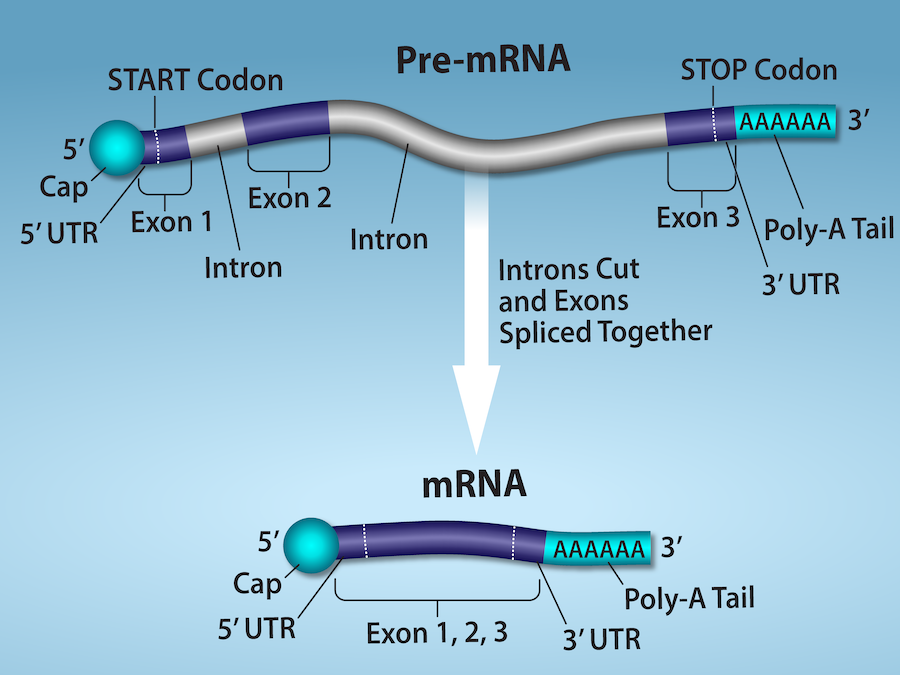
Pre-mRNAs are first coated in RNA-stabilizing proteins; these protect the pre-mRNA from degradation while it is processed and exported out of the nucleus. The three most important steps of pre-mRNA processing are the addition of stabilizing and signaling factors at the 5' and 3' ends of the molecule, and the removal of the introns (Figure 15.11). In rare cases, the mRNA transcript can be “edited” after it is transcribed.
OpenStax, Rice University; Biology 2e. Credit: Rao, A., Ryan, K. Fletcher, S. and Tag, A. Department of Biology, Texas A&M University. · CC BY 4.0 · Source出典
Figure 15.11図 15.11
Eukaryotic pre-mRNA processing. In addition to 5’ Cap and 3’ Poly-A Tail addition, introns must be precisely removed and exons joined to generate a functional mRNA. Nucleotides upstream (towards the 5’cap) of the translation START codon are part of the 5’ untranslated region (5’ UTR). Nucleotides downstream (towards 3’end) of the STOP codon form the 3’ UTR. Both 5’ and 3’ UTRs are important for regulating translation initiation and mRNA stability. Credit: Rao, A., Ryan, K. Fletcher, S. and Tag, A. Department of Biology, Texas A&M University.
英語のヒント
真核生物のpre-mRNAの加工。機能するmRNAを作るには、5′キャップと3′ポリAテールの付加に加え、イントロンを正確に取り除き、エクソンをつながなければならない。翻訳開始コドンより上流(5′キャップ側)のヌクレオチドは、5′非翻訳領域(5′ UTR)の一部である。終止コドンより下流(3′末端側)のヌクレオチドは、3′ UTRを形成する。5′ UTRと3′ UTRは、どちらも翻訳開始とmRNAの安定性の調節に重要である。クレジット:Rao, A., Ryan, K., Fletcher, S. and Tag, A.、テキサスA&M大学生物学科。