第15章遺伝子とタンパク質
Translation, Elongation, and Termination翻訳、伸長、終結
In prokaryotes and eukaryotes, the basics of elongation are the same, so we will review elongation from the perspective of E. coli. When the translation complex is formed, the tRNA binding region of the ribosome consists of three compartments. The A (aminoacyl) site binds incoming charged aminoacyl tRNAs. The P (peptidyl) site binds charged tRNAs carrying amino acids that have formed peptide bonds with the growing polypeptide chain but have not yet dissociated from their corresponding tRNA. The E (exit) site releases dissociated tRNAs so that they can be recharged with free amino acids. The initiating methionyl-tRNA, however, occupies the P site at the beginning of the elongation phase of translation in both prokaryotes and eukaryotes.
英語のヒント
伸長の基本は原核生物と真核生物で同じなので、大腸菌を例に復習しよう。翻訳複合体ができると、リボソームのtRNA結合領域には3つの区画がある。A(アミノアシル)部位には、新たに入ってくる、アミノ酸を結合したアミノアシルtRNAが結合する。P(ペプチジル)部位には、伸長中のポリペプチド鎖とペプチド結合を作ったものの、対応するtRNAからはまだ離れていないアミノ酸を運ぶtRNAが結合する。E(出口)部位は、アミノ酸が離れたtRNAを放出し、再び遊離アミノ酸を結合できるようにする。ただし、開始時のメチオニルtRNAは、原核生物でも真核生物でも、翻訳の伸長段階の初めにはP部位を占める。
During translation elongation, the mRNA template provides tRNA binding specificity. As the ribosome moves along the mRNA, each mRNA codon comes into register, and specific binding with the corresponding charged tRNA anticodon is ensured. If mRNA were not present in the elongation complex, the ribosome would bind tRNAs nonspecifically and randomly.
英語のヒント
翻訳の伸長中、mRNA鋳型がtRNA結合の特異性を与える。リボソームがmRNAに沿って進むにつれて、各mRNAコドンが所定の位置にそろい、対応するアミノ酸結合tRNAのアンチコドンとの特異的な結合が確保される。もし伸長複合体にmRNAがなければ、リボソームはtRNAを非特異的かつ無作為に結合してしまうだろう。
Elongation proceeds with charged tRNAs sequentially entering and leaving the ribosome as each new amino acid is added to the polypeptide chain. Movement of a tRNA from A to P to E site is induced by conformational changes that advance the ribosome by three bases in the 3' direction. The energy for each step along the ribosome is donated by elongation factors that hydrolyze GTP. GTP energy is required both for the binding of a new aminoacyl-tRNA to the A site and for its translocation to the P site after formation of the peptide bond. Peptide bonds form between the amino group of the amino acid attached to the A-site tRNA and the carboxyl group of the amino acid attached to the P-site tRNA. The formation of each peptide bond is catalyzed by peptidyl transferase, an RNA-based enzyme that is integrated into the 50S ribosomal subunit. The energy for each peptide bond formation is derived from the high-energy bond linking each amino acid to its tRNA. After peptide bond formation, the A-site tRNA that now holds the growing peptide chain moves to the P site, and the P-site tRNA that is now empty moves to the E site and is expelled from the ribosome (Figure 15.18). Amazingly, the E. coli translation apparatus takes only 0.05 seconds to add each amino acid, meaning that a 200-amino-acid protein can be translated in just 10 seconds.
英語のヒント
伸長は、アミノ酸を結合したtRNAがリボソームへ順に出入りし、そのたびに新しいアミノ酸がポリペプチド鎖へ加わることで進む。tRNAがA部位からP部位、さらにE部位へ移動するのは、リボソームを3′方向へ3塩基進める立体構造変化による。リボソームが1段階ずつ進むためのエネルギーは、GTPを加水分解する伸長因子によって供給される。GTPのエネルギーは、新しいアミノアシルtRNAのA部位への結合と、ペプチド結合形成後のP部位への移動の両方に必要である。ペプチド結合は、A部位のtRNAに付いたアミノ酸のアミノ基と、P部位のtRNAに付いたアミノ酸のカルボキシ基との間で形成される。各ペプチド結合の形成は、50Sリボソームサブユニットに組み込まれたRNA酵素、ペプチジルトランスフェラーゼが触媒する。ペプチド結合を作るエネルギーは、各アミノ酸とtRNAをつなぐ高エネルギー結合から得られる。ペプチド結合ができると、伸長中のペプチド鎖をもつようになったA部位のtRNAはP部位へ移る。空になったP部位のtRNAはE部位へ移り、リボソームから排出される(図15.18)。驚くべきことに、大腸菌の翻訳装置がアミノ酸を1個付加するのにかかる時間は、わずか0.05秒である。つまり、200アミノ酸のタンパク質をたった10秒で翻訳できる。
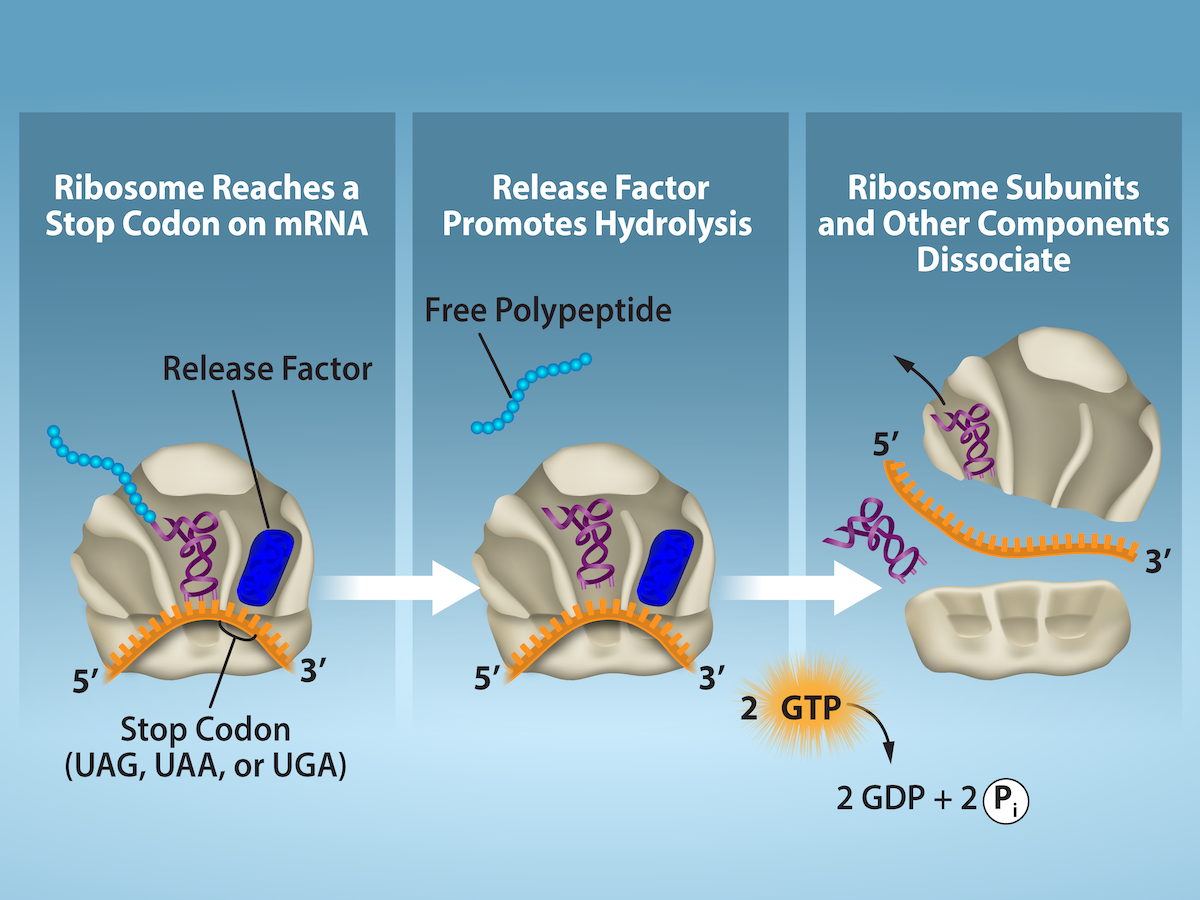
Termination of translation occurs when a nonsense codon (UAA, UAG, or UGA) is encountered. Upon aligning with the A site, these nonsense codons are recognized by protein release factors that resemble tRNAs. The releasing factors in both prokaryotes and eukaryotes instruct peptidyl transferase to add a water molecule to the carboxyl end of the P-site amino acid. This reaction forces the P-site amino acid to detach from its tRNA, and the newly made protein is released. The small and large ribosomal subunits dissociate from the mRNA and from each other; they are recruited almost immediately into another translation initiation complex. After many ribosomes have completed translation, the mRNA is degraded so the nucleotides can be reused in another transcription reaction.
英語のヒント
ナンセンスコドン(UAA、UAG、UGA)に出会うと、翻訳の終結が起こる。これらのコドンがA部位に位置すると、tRNAに似たタンパク質である解離因子が認識する。原核生物でも真核生物でも、解離因子は、P部位のアミノ酸のカルボキシ末端に水分子を付加するよう、ペプチジルトランスフェラーゼに指示する。この反応によって、P部位のアミノ酸がtRNAから離れ、新しくできたタンパク質が放出される。リボソームの大小サブユニットはmRNAからも互いからも解離し、ほぼ直ちに別の翻訳開始複合体へ呼び込まれる。多数のリボソームが翻訳を終えると、mRNAは分解され、ヌクレオチドは別の転写反応で再利用できるようになる。
OpenStax, Rice University; Biology 2e. Credit: Rao, A. and Ryan, K. Department of Biology, Texas A&M University. · CC BY 4.0 · Source出典

Figure 15.19図 15.19
Translation Termination is Active. Translation is terminated when a STOP codon is in the A-site of the ribosome. Since there are no tRNAs corresponding to the STOP codons, the Release Factor protein enters and catalyzes the hydrolysis between the last amino acid and its tRNA. This hydrolysis releases the free carboxyl terminus (C-term) of the protein. Additional factors use the energy in GTP hydrolysis to disassemble the large and small ribosomal subunits and mRNA. Credit: Rao, A. and Ryan, K. Department of Biology, Texas A&M University.
翻訳終結は能動的な過程である。リボソームのA部位に終止コドンが入ると、翻訳は終結する。終止コドンに対応するtRNAはないため、解離因子タンパク質が入り、最後のアミノ酸とtRNAとの間の加水分解を触媒する。この加水分解によって、タンパク質の遊離カルボキシ末端(C末端)が放出される。さらに別の因子が、GTP加水分解のエネルギーを使い、リボソームの大小サブユニットとmRNAを分離する。クレジット:Rao, A. and Ryan, K.、テキサスA&M大学生物学科。