第15章遺伝子とタンパク質
Protein Folding, Modification, and Targetingタンパク質の折りたたみ・修飾・輸送先の指定
During and after translation, individual amino acids may be chemically modified, signal sequences appended, and the new protein “folded” into a distinct three-dimensional structure as a result of intramolecular interactions. A signal sequence is a short sequence at the amino end of a protein that directs it to a specific cellular compartment. These sequences can be thought of as the protein’s “train ticket” to its ultimate destination, and are recognized by signal-recognition proteins that act as conductors. For instance, a specific signal sequence terminus will direct a protein to the mitochondria or chloroplasts (in plants). Once the protein reaches its cellular destination, the signal sequence is usually clipped off.
英語のヒント
翻訳中や翻訳後に、個々のアミノ酸が化学修飾を受けたり、シグナル配列が付加されたりすることがある。また、分子内相互作用の結果、新しいタンパク質は固有の立体構造へと「折りたたまれる」。シグナル配列は、タンパク質のアミノ末端にある短い配列で、特定の細胞内区画へタンパク質を導く。この配列は、最終目的地へ向かうタンパク質の「列車の切符」と考えられ、車掌の役を果たすシグナル認識タンパク質によって認識される。たとえば、末端の特定のシグナル配列が、タンパク質をミトコンドリアや、植物では葉緑体へ導く。タンパク質が細胞内の目的地に到達すると、シグナル配列は通常、切り取られる。
Many proteins fold spontaneously, but some proteins require helper molecules, called chaperones, to prevent them from aggregating during the complicated process of folding. Even if a protein is properly specified by its corresponding mRNA, it could take on a completely dysfunctional shape if abnormal temperature or pH conditions prevent it from folding correctly.
英語のヒント
多くのタンパク質は自発的に折りたたまれるが、一部は、複雑な折りたたみの過程で凝集しないよう、シャペロンという補助分子を必要とする。対応するmRNAによって正しく指定されたタンパク質でも、異常な温度やpH条件によって正しく折りたたまれなければ、まったく機能しない形になることがある。
OpenStax, Rice University; Biology 2e. Credit: Rao, A. and Ryan, K. Department of Biology, Texas A&M University. · CC BY 4.0 · Source出典

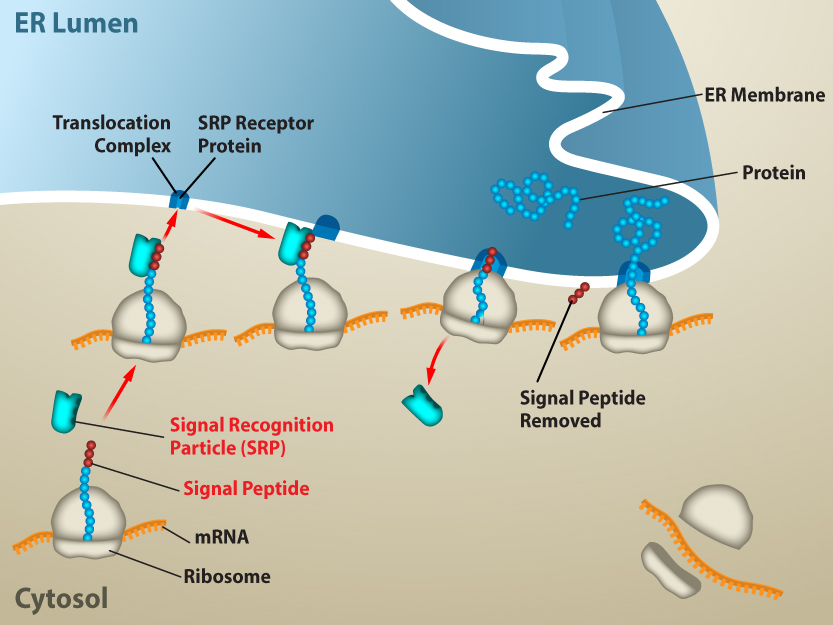
Figure 15.20図 15.20
Proteins are co-translationally targeted into the ER for secretion. Proteins that will be secreted from the cell will contain a signal sequence at the N-terminus. The signal will be recognized by SRP as soon as the amino acids emerge from the ribosome, and the ribosome will be targeted to the translocation channel in the ER membrane. The rest of the protein will go directly from the ribosome, across the ER membrane and into the ER lumen. From the ER, proteins can be secreted from the cell via vesicle trafficking. Credit: Rao, A. and Ryan, K. Department of Biology, Texas A&M University.
英語のヒント
分泌されるタンパク質は、翻訳と同時に小胞体内へ導かれる。細胞から分泌されるタンパク質には、N末端にシグナル配列がある。アミノ酸がリボソームから現れると、すぐにSRPがシグナルを認識し、リボソームを小胞体膜の膜透過チャネルへ導く。タンパク質の残りの部分は、リボソームから直接、小胞体膜を通って小胞体内腔へ入る。小胞体からは、小胞輸送を介してタンパク質を細胞外へ分泌できる。クレジット:Rao, A. and Ryan, K.、テキサスA&M大学生物学科。
Section Summary節のまとめ
The players in translation include the mRNA template, ribosomes, tRNAs, and various enzymatic factors. The small ribosomal subunit binds to the mRNA template either at the Shine-Dalgarno sequence (prokaryotes) or the 5' cap (eukaryotes). Translation begins at the initiating AUG on the mRNA, specifying methionine. The formation of peptide bonds occurs between sequential amino acids matched to the mRNA template by their tRNAs according to the genetic code. Charged tRNAs enter the ribosomal A site, and their amino acid bonds with the amino acid at the P site. The entire mRNA is translated in three-nucleotide “steps” of the ribosome. When a nonsense codon is encountered, a release factor binds and dissociates the components and frees the new protein. Folding of the protein occurs during and after translation.
翻訳に関わるのは、mRNA鋳型、リボソーム、tRNA、さまざまな酵素因子である。リボソーム小サブユニットは、原核生物ではシャイン・ダルガノ配列、真核生物では5′キャップでmRNA鋳型に結合する。翻訳は、メチオニンを指定するmRNA上の開始AUGから始まる。遺伝暗号に従い、tRNAによってmRNA鋳型に対応づけられたアミノ酸どうしの間に、順にペプチド結合が形成される。アミノ酸を結合したtRNAがリボソームのA部位に入り、そのアミノ酸がP部位のアミノ酸と結合する。リボソームが3ヌクレオチドずつ「歩く」ことで、mRNA全体が翻訳される。ナンセンスコドンに出会うと、解離因子が結合し、構成要素を解離させ、新しいタンパク質を放出する。タンパク質の折りたたみは、翻訳中と翻訳後に起こる。
Visual Connection Questions図を使った問題
Exercises 23練習問題 23
Exercise 23問題 23
Figure 15.18 Many antibiotics inhibit bacterial protein synthesis. For example, tetracycline blocks the A site on the bacterial ribosome, and chloramphenicol blocks peptidyl transfer. What specific effect would you expect each of these antibiotics to have on protein synthesis?
図15.18 多くの抗生物質は、細菌のタンパク質合成を阻害する。たとえば、テトラサイクリンは細菌リボソームのA部位をふさぎ、クロラムフェニコールはペプチジル転移を阻害する。それぞれがタンパク質合成に及ぼす具体的な影響を、どう予想するか。
Tetracycline would directly affect:
テトラサイクリンが直接影響するのは、次のうちどれか。
- tRNA binding to the ribosometRNAのリボソームへの結合
- ribosome assemblyリボソームの組立て
- growth of the protein chainタンパク質鎖の伸長
Chloramphenicol would directly affect
クロラムフェニコールが直接影響するのは、次のうちどれか。
- tRNA binding to the ribosometRNAのリボソームへの結合
- ribosome assemblyリボソームの組立て
- growth of the protein chainタンパク質鎖の伸長
Solution解き方
Figure 15.18 Tetracycline: a; Chloramphenicol: c.
図15.18 テトラサイクリン:a。クロラムフェニコール:c。
Review Questions確認問題
Exercises 24–26練習問題 24–26
Exercise 24問題 24
The RNA components of ribosomes are synthesized in the ________.
リボソームのRNA成分は、________で合成される。
- cytoplasm細胞質
- nucleus核
- nucleolus核小体
- endoplasmic reticulum小胞体
Solution解き方
C
C
Exercise 25問題 25
In any given species, there are at least how many types of aminoacyl tRNA synthetases?
どの種でも、アミノアシルtRNA合成酵素は少なくとも何種類あるか。
- 2020
- 4040
- 100100
- 200200
Solution解き方
A
A
Exercise 26問題 26
A scientist introduces a mutation that makes the 60S ribosomal subunit nonfunctional in a human cell line. What would be the predicted effect on translation?
ある科学者がヒトの細胞株に変異を導入し、60Sリボソームサブユニットを機能しなくした。翻訳には、どのような影響が予測されるか。
- Translation stalls after the initiation AUG codon is identified.開始AUGコドンが特定された後、翻訳が停止する。
- The ribosome cannot catalyze the formation of peptide bonds between the tRNAs in the A and P sites.リボソームは、A部位とP部位のtRNA間でのペプチド結合の形成を触媒できなくなる。
- The ribosome cannot interact with mRNAs.リボソームは、mRNAと相互作用できなくなる。
- tRNAs cannot exit the E site of the ribosome.tRNAは、リボソームのE部位から出られなくなる。
Solution解き方
A
A
Critical Thinking Questions考察問題
Exercises 27–29練習問題 27–29
Exercise 27問題 27
Transcribe and translate the following DNA sequence (nontemplate strand): 5'-ATGGCCGGTTATTAAGCA-3'
次のDNA配列(非鋳型鎖)を転写し、翻訳しなさい。5′-ATGGCCGGTTATTAAGCA-3′
Solution解き方
The mRNA would be: 5'-AUGGCCGGUUAUUAAGCA-3'. The protein would be: MAGY. Even though there are six codons, the fifth codon corresponds to a stop, so the sixth codon would not be translated.
mRNAは5′-AUGGCCGGUUAUUAAGCA-3′となり、タンパク質はMAGYとなる。コドンは6個あるが、5個目が終止コドンに対応するため、6個目は翻訳されない。
Exercise 28問題 28
Explain how single nucleotide changes can have vastly different effects on protein function.
英語のヒント
1ヌクレオチドの変化でも、タンパク質の機能への影響が大きく異なりうる理由を説明しなさい。
Solution解き方
Nucleotide changes in the third position of codons may not change the amino acid and would have no effect on the protein. Other nucleotide changes that change important amino acids or create or delete start or stop codons would have severe effects on the amino acid sequence of the protein.
コドンの3番目の位置のヌクレオチドが変わっても、アミノ酸は変わらず、タンパク質に影響しないことがある。一方、重要なアミノ酸を変えたり、開始コドンや終止コドンを作り出したり失わせたりする変化は、タンパク質のアミノ酸配列に重大な影響を及ぼす。
Exercise 29問題 29
A normal mRNA that reads 5’ – UGCCAUGGUAAUAACACAUGAGGCCUGAAC– 3’ has an insertion mutation that changes the sequence to 5’ -UGCCAUGGUUAAUAACACAUGAGGCCUGAAC– 3’. Translate the original mRNA and the mutated mRNA, and explain how insertion mutations can have dramatic effects on proteins. (Hint: Be sure to find the initiation site.)
正常なmRNAの配列5′–UGCCAUGGUAAUAACACAUGAGGCCUGAAC–3′に挿入変異が起こり、5′–UGCCAUGGUUAAUAACACAUGAGGCCUGAAC–3′に変わった。元のmRNAと変異したmRNAを翻訳し、挿入変異がタンパク質に大きな影響を及ぼしうる理由を説明しなさい。(ヒント:開始部位を必ず見つけること。)
Solution解き方
Original mRNA: 5’ –UGCC AUG GUA AUA ACA CAU GAG GCC UGA AC– 3’;
元のmRNA:5′–UGCC AUG GUA AUA ACA CAU GAG GCC UGA AC–3′。
Translation: Met – Val – Ile – Thr – His – Glu – Ala;
翻訳:Met–Val–Ile–Thr–His–Glu–Ala。
Mutated mRNA: 5’ –UGCC AUG GUU AAU AAC ACA UGA GGCCUGAAC– 3’;
変異したmRNA:5′–UGCC AUG GUU AAU AAC ACA UGA GGCCUGAAC–3′。
Translation: Met – Val – Asn – Asn – Thr;
翻訳:Met–Val–Asn–Asn–Thr。
Insertion mutations can have dramatic effects on proteins because they shift the reading frame for the codons. This changes the amino acids encoded by the mRNA, and can introduce premature start or stop sites.
挿入変異はコドンの読み枠をずらすため、タンパク質に大きな影響を及ぼしうる。mRNAがコードするアミノ酸が変わり、早すぎる位置に開始部位や終止部位が生じることもある。
aminoacyl tRNA synthetase
アミノアシルtRNA合成酵素
enzyme that “charges” tRNA molecules by catalyzing a bond between the tRNA and a corresponding amino acid
tRNAと対応するアミノ酸との結合を触媒し、tRNA分子を「チャージ」する酵素。
initiator tRNA
開始tRNA
in prokaryotes, called ; in eukaryotes, called tRNAi; a tRNA that interacts with a start codon, binds directly to the ribosome P site, and links to a special methionine to begin a polypeptide chain
原核生物では、真核生物ではtRNAiと呼ばれる。開始コドンと相互作用し、リボソームのP部位に直接結合し、特別なメチオニンとつながってポリペプチド鎖を開始するtRNA。
Kozak’s rules
コザックの規則
determines the correct initiation AUG in a eukaryotic mRNA; the following consensus sequence must appear around the AUG: 5’-GCC(purine)CCAUGG-3’; the bolded bases are most important
真核生物のmRNAで、正しい開始AUGを決める規則。AUGの周囲には、5′-GCC(プリン塩基)CCAUGG-3′という共通配列が現れなければならない。太字の塩基が最も重要である。
peptidyl transferase
ペプチジルトランスフェラーゼ
RNA-based enzyme that is integrated into the 50S ribosomal subunit and catalyzes the formation of peptide bonds
50Sリボソームサブユニットに組み込まれ、ペプチド結合の形成を触媒するRNA酵素。
polysome
ポリソーム
mRNA molecule simultaneously being translated by many ribosomes all going in the same direction
同じ方向へ進む多数のリボソームによって、同時に翻訳されているmRNA分子。
Shine-Dalgarno sequence
シャイン・ダルガノ配列
(AGGAGG); initiates prokaryotic translation by interacting with rRNA molecules comprising the 30S ribosome
AGGAGGという配列。30Sリボソームを構成するrRNA分子と相互作用し、原核生物の翻訳を開始する。
signal sequence
シグナル配列
short tail of amino acids that directs a protein to a specific cellular compartment
タンパク質を特定の細胞内区画へ導く、アミノ酸の短い尾部。
start codon
開始コドン
AUG (or rarely, GUG) on an mRNA from which translation begins; always specifies methionine
翻訳が始まる、mRNA上のAUG(まれにはGUG)。常にメチオニンを指定する。