第15章遺伝子とタンパク質
15.1 The Genetic Code15.1 遺伝暗号
Learning Objectives学習目標
By the end of this section, you will be able to do the following:
この節を学ぶと、次のことができるようになる。
- Explain the “central dogma” of DNA-protein synthesisDNAからタンパク質を合成する「セントラルドグマ」を説明する。
- Describe the genetic code and how the nucleotide sequence prescribes the amino acid and the protein sequence遺伝暗号と、ヌクレオチド配列がどのようにアミノ酸とタンパク質の配列を指定するかを説明する。
The cellular process of transcription generates messenger RNA (mRNA), a mobile molecular copy of one or more genes with an alphabet of A, C, G, and uracil (U). Translation of the mRNA template on ribosomes converts nucleotide-based genetic information into a protein product. That is the central dogma of DNA-protein synthesis. Protein sequences consist of 20 commonly occurring amino acids; therefore, it can be said that the protein alphabet consists of 20 “letters” (Figure 15.2). Different amino acids have different chemistries (such as acidic versus basic, or polar and nonpolar) and different structural constraints. Variation in amino acid sequence is responsible for the enormous variation in protein structure and function.
英語のヒント
細胞内の転写という過程によって、メッセンジャーRNA(mRNA)が作られる。これは、A、C、G、ウラシル(U)を文字として用いる、1つまたは複数の遺伝子の、移動可能な分子コピーである。リボソーム上でmRNA鋳型を翻訳すると、ヌクレオチドに基づく遺伝情報がタンパク質産物に変換される。これが、DNAからタンパク質を合成するセントラルドグマである。タンパク質の配列は、一般的に存在する20種類のアミノ酸からなる。したがって、タンパク質のアルファベットは20の「文字」でできていると言える(図15.2)。アミノ酸ごとに化学的な性質(酸性か塩基性か、極性か非極性かなど)や、構造上の制約が異なる。アミノ酸配列の違いが、タンパク質の構造と機能のきわめて大きな多様性を生み出している。
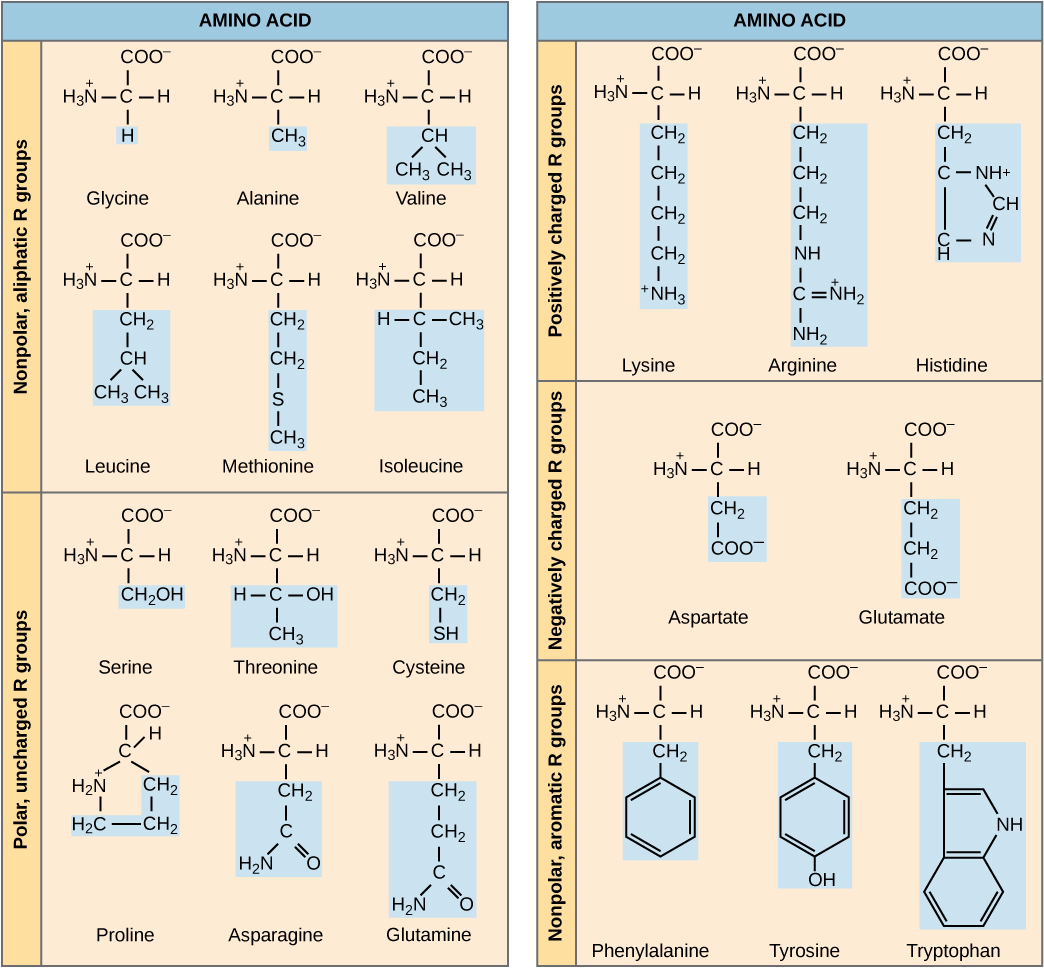
Figure 15.2図 15.2
Structures of the 20 amino acids found in proteins are shown. Each amino acid is composed of an amino group (), a carboxyl group (COO-), and a side chain (blue). The side chain may be nonpolar, polar, or charged, as well as large or small. It is the variety of amino acid side chains that gives rise to the incredible variation of protein structure and function.
英語のヒント
タンパク質に含まれる20種類のアミノ酸の構造を示す。各アミノ酸は、アミノ基()、カルボキシ基(COO-)、側鎖(青色)からなる。側鎖には非極性、極性、帯電したものがあり、大きいものも小さいものもある。このアミノ酸側鎖の多様性こそが、タンパク質の構造と機能の驚くほど大きな多様性を生み出している。
The Central Dogma: DNA Encodes RNA; RNA Encodes Proteinセントラルドグマ:DNAがRNAをコードし、RNAがタンパク質をコードする
The flow of genetic information in cells from DNA to mRNA to protein is described by the central dogma (Figure 15.3), which states that genes specify the sequence of mRNAs, which in turn specify the sequence of amino acids making up all proteins. The decoding of one molecule to another is performed by specific proteins and RNAs. Because the information stored in DNA is so central to cellular function, it makes intuitive sense that the cell would make mRNA copies of this information for protein synthesis, while keeping the DNA itself intact and protected. The copying of DNA to RNA is relatively straightforward, with one nucleotide being added to the mRNA strand for every nucleotide read in the DNA strand. The translation to protein is a bit more complex because three mRNA nucleotides correspond to one amino acid in the polypeptide sequence. However, the translation to protein is still systematic and colinear, such that nucleotides 1 to 3 correspond to amino acid 1, nucleotides 4 to 6 correspond to amino acid 2, and so on.
英語のヒント
細胞内でDNAからmRNAへ、そしてタンパク質へと進む遺伝情報の流れは、セントラルドグマで表される(図15.3)。遺伝子がmRNAの配列を指定し、そのmRNAがさらに、すべてのタンパク質を構成するアミノ酸の配列を指定するという考え方である。ある分子の情報を別の分子へ解読する過程は、特定のタンパク質とRNAによって行われる。DNAに保存された情報は、細胞の機能にとってきわめて重要である。そのため、DNA自体は損なわずに保護しながら、タンパク質合成のためにその情報のmRNAコピーを作ることは、直感的にも理にかなっている。DNAからRNAへのコピーは比較的単純で、DNA鎖のヌクレオチドを1つ読むたびに、mRNA鎖へヌクレオチドを1つ加える。タンパク質への翻訳は少し複雑である。mRNAの3個のヌクレオチドが、ポリペプチド配列の1個のアミノ酸に対応するからだ。それでも、タンパク質への翻訳は規則的で、並び順を保っている。ヌクレオチド1〜3がアミノ酸1に、ヌクレオチド4〜6がアミノ酸2に対応するというように進む。
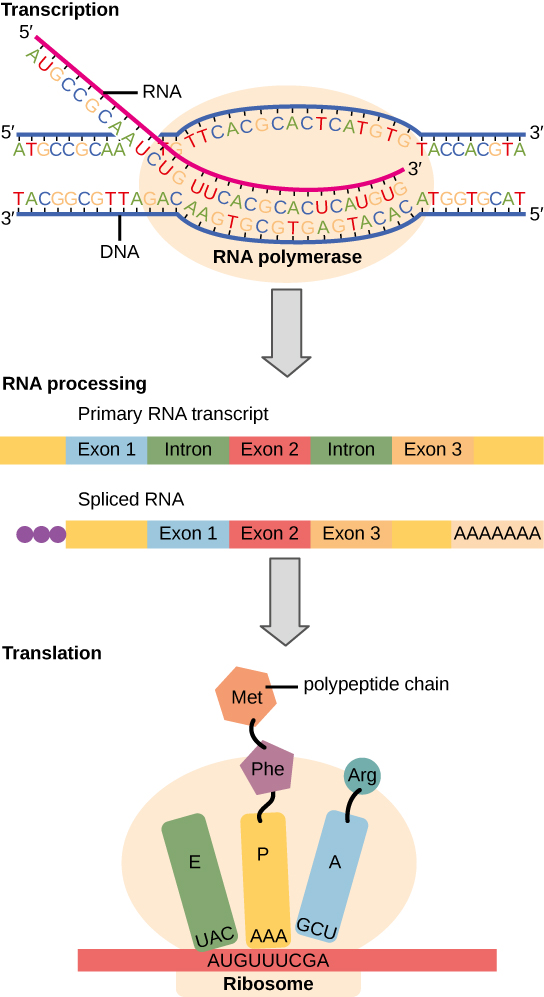
Figure 15.3図 15.3
Instructions on DNA are transcribed onto messenger RNA. Ribosomes are able to read the genetic information inscribed on a strand of messenger RNA and use this information to string amino acids together into a protein.
英語のヒント
DNAに書かれた指示は、メッセンジャーRNAへ転写される。リボソームは、メッセンジャーRNAの鎖に記された遺伝情報を読み、その情報を使ってアミノ酸をつなぎ、タンパク質にすることができる。
The Genetic Code Is Degenerate and Universal遺伝暗号は縮重しており、普遍的である
Each amino acid is defined by a three-nucleotide sequence called the triplet codon. Given the different numbers of “letters” in the mRNA and protein “alphabets,” scientists theorized that single amino acids must be represented by combinations of nucleotides. Nucleotide doublets would not be sufficient to specify every amino acid because there are only 16 possible two-nucleotide combinations (42). In contrast, there are 64 possible nucleotide triplets (43), which is far more than the number of amino acids. Scientists theorized that amino acids were encoded by nucleotide triplets and that the genetic code was “degenerate.” In other words, a given amino acid could be encoded by more than one nucleotide triplet. This was later confirmed experimentally: Francis Crick and Sydney Brenner used the chemical mutagen proflavin to insert one, two, or three nucleotides into the gene of a virus. When one or two nucleotides were inserted, the normal proteins were not produced. When three nucleotides were inserted, the protein was synthesized and functional. This demonstrated that the amino acids must be specified by groups of three nucleotides. These nucleotide triplets are called codons. The insertion of one or two nucleotides completely changed the triplet reading frame, thereby altering the message for every subsequent amino acid (Figure 15.5). Though insertion of three nucleotides caused an extra amino acid to be inserted during translation, the integrity of the rest of the protein was maintained.
英語のヒント
各アミノ酸は、トリプレットコドンと呼ばれる3ヌクレオチドの配列によって指定される。mRNAとタンパク質の「アルファベット」では「文字」の数が異なるため、科学者たちは、各アミノ酸がヌクレオチドの組み合わせで表されるはずだと考えた。2個のヌクレオチドの組では、すべてのアミノ酸を指定できない。可能な組み合わせが16通り(42)しかないからである。これに対し、3個のヌクレオチドの組では64通り(43)の組み合わせがあり、アミノ酸の数を大きく上回る。科学者たちは、アミノ酸は3個のヌクレオチドの組によってコードされ、遺伝暗号には「縮重」があると考えた。つまり、あるアミノ酸は、複数の異なる3ヌクレオチドの組でコードできるということである。これは後に実験で確認された。フランシス・クリックとシドニー・ブレナーは、化学変異原のプロフラビンを使い、ウイルスの遺伝子に1個、2個、または3個のヌクレオチドを挿入した。1個または2個を挿入すると、正常なタンパク質は作られなかった。3個を挿入した場合には、機能をもつタンパク質が合成された。これにより、アミノ酸は3個ずつのヌクレオチドによって指定されるはずだと示された。この3個のヌクレオチドの組を、コドンという。1個または2個のヌクレオチドを挿入すると、3つずつ読む読み枠が完全に変わり、その後のすべてのアミノ酸を指定する情報が変化した(図15.5)。3個のヌクレオチドを挿入すると、翻訳時にアミノ酸が1個余分に入るが、タンパク質の残りの部分は損なわれずに保たれた。
Scientists painstakingly solved the genetic code by translating synthetic mRNAs in vitro and sequencing the proteins they specified (Figure 15.4).
英語のヒント
科学者たちは、試験管内で合成mRNAを翻訳し、それが指定するタンパク質の配列を決定するという骨の折れる作業を通じて、遺伝暗号を解明した(図15.4)。
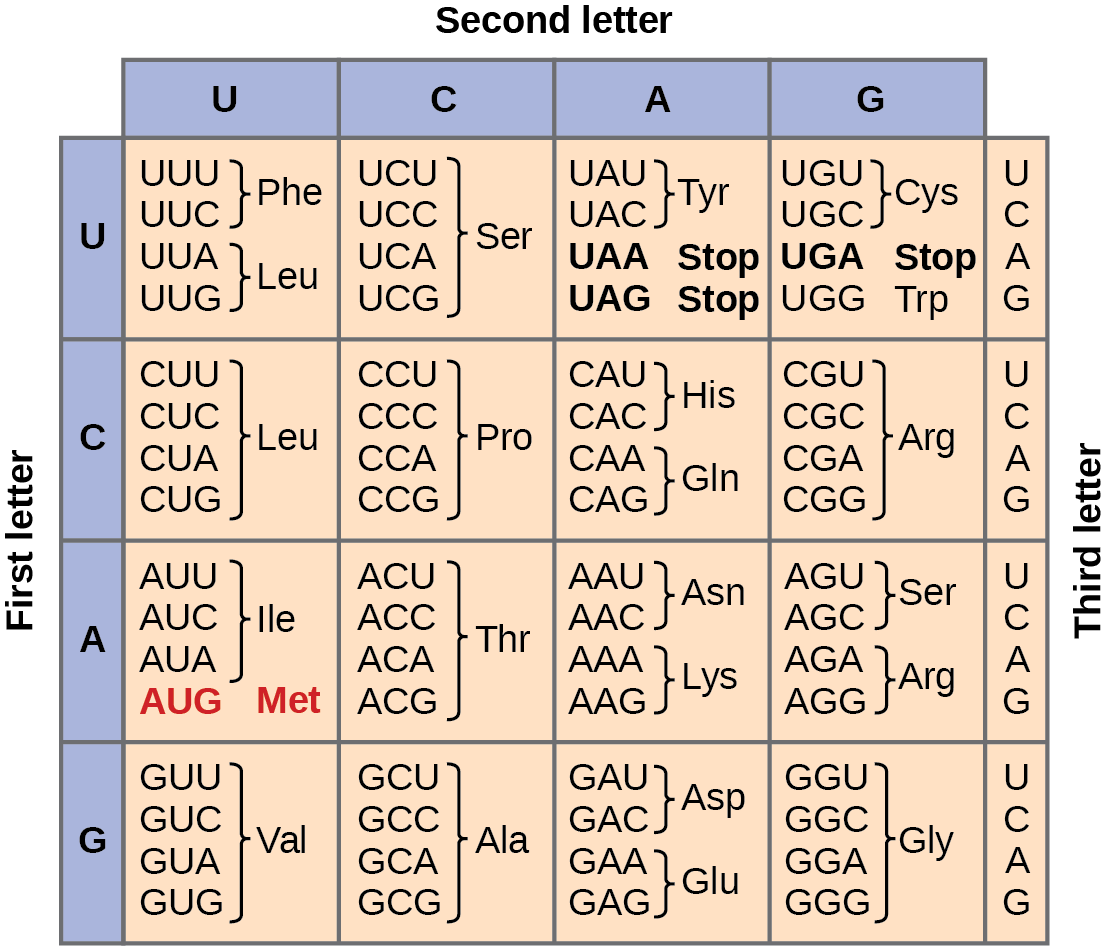
Figure 15.4図 15.4
This figure shows the genetic code for translating each nucleotide triplet in mRNA into an amino acid or a termination signal in a protein. (credit: modification of work by NIH)
mRNAの各3ヌクレオチドの組を、タンパク質のアミノ酸または終止の合図へ翻訳する遺伝暗号を示す。(クレジット:NIHの作品を改変)
In addition to codons that instruct the addition of a specific amino acid to a polypeptide chain, three of the 64 codons terminate protein synthesis and release the polypeptide from the translation machinery. These triplets are called nonsense codons, or stop codons. Another codon, AUG, also has a special function. In addition to specifying the amino acid methionine, it also serves as the start codon to initiate translation. The reading frame for translation is set by the AUG start codon near the 5' end of the mRNA. Following the start codon, the mRNA is read in groups of three until a stop codon is encountered.
英語のヒント
特定のアミノ酸をポリペプチド鎖に加えるよう指示するコドンに加え、64種類のうち3種類のコドンは、タンパク質合成を終わらせ、翻訳装置からポリペプチドを放出させる。これらの3塩基配列を、ナンセンスコドン、または終止コドンという。別のコドンであるAUGも、特別な働きをもつ。アミノ酸のメチオニンを指定するだけでなく、翻訳を開始させる開始コドンとしても働く。翻訳の読み枠は、mRNAの5′末端近くにあるAUG開始コドンによって決まる。開始コドンの後、mRNAは終止コドンに達するまで、3つずつのまとまりで読まれる。
The arrangement of the coding table reveals the structure of the code. There are sixteen "blocks" of codons, each specified by the first and second nucleotides of the codons within the block, e.g., the "AC*" block that corresponds to the amino acid threonine (Thr). Some blocks are divided into a pyrimidine half, in which the codon ends with U or C, and a purine half, in which the codon ends with A or G. Some amino acids get a whole block of four codons, like alanine (Ala), threonine (Thr) and proline (Pro). Some get the pyrimidine half of their block, like histidine (His) and asparagine (Asn). Others get the purine half of their block, like glutamate (Glu) and lysine (Lys). Note that some amino acids get a block and a half-block for a total of six codons.
英語のヒント
コドン表の配置からは、暗号の構造がわかる。コドンには16の「ブロック」があり、各ブロックはコドンの1番目と2番目のヌクレオチドによって決まる。たとえば、「AC*」ブロックはアミノ酸のトレオニン(Thr)に対応する。一部のブロックは、コドンがUまたはCで終わるピリミジン側の半分と、AまたはGで終わるプリン側の半分に分かれる。アラニン(Ala)、トレオニン(Thr)、プロリン(Pro)のように、4コドンからなるブロック全体を割り当てられたアミノ酸もある。ヒスチジン(His)やアスパラギン(Asn)のように、ブロックのピリミジン側の半分を割り当てられたものもあれば、グルタミン酸(Glu)やリシン(Lys)のように、プリン側の半分を割り当てられたものもある。1ブロックと半ブロック、合計6コドンを割り当てられたアミノ酸もあることに注目しよう。
The specification of a single amino acid by multiple similar codons is called "degeneracy." Degeneracy is believed to be a cellular mechanism to reduce the negative impact of random mutations. Codons that specify the same amino acid typically only differ by one nucleotide. In addition, amino acids with chemically similar side chains are encoded by similar codons. For example, aspartate (Asp) and glutamate (Glu), which occupy the GA* block, are both negatively charged. This nuance of the genetic code ensures that a single-nucleotide substitution mutation might specify the same amino acid but have no effect or specify a similar amino acid, preventing the protein from being rendered completely nonfunctional.
英語のヒント
1つのアミノ酸を、複数の似たコドンが指定することを「縮重」という。縮重は、無作為に起こる変異の悪影響を減らす細胞の仕組みだと考えられている。同じアミノ酸を指定するコドンは、通常、ヌクレオチドが1つ違うだけである。また、化学的に似た側鎖をもつアミノ酸は、似たコドンでコードされている。たとえば、GA*ブロックを占めるアスパラギン酸(Asp)とグルタミン酸(Glu)は、どちらも負に帯電している。遺伝暗号のこうした細かな性質により、1ヌクレオチドの置換変異が起きても、同じアミノ酸が指定されて影響がなかったり、似たアミノ酸が指定されたりする可能性がある。そのため、タンパク質が完全に機能を失うのを防げる。
The genetic code is nearly universal. With a few minor exceptions, virtually all species use the same genetic code for protein synthesis. Conservation of codons means that a purified mRNA encoding the globin protein in horses could be transferred to a tulip cell, and the tulip would synthesize horse globin. That there is only one genetic code is powerful evidence that all of life on Earth shares a common origin, especially considering that there are about 1084 possible combinations of 20 amino acids and 64 triplet codons.
英語のヒント
遺伝暗号は、ほぼ普遍的である。わずかな例外を除き、実質的にすべての種が、タンパク質合成に同じ遺伝暗号を使う。コドンが保存されているということは、ウマのグロビンタンパク質をコードする精製mRNAをチューリップの細胞へ移せば、チューリップがウマのグロビンを合成するということである。遺伝暗号が1つしかないことは、地球上のすべての生命が共通の起源をもつという強力な証拠となる。特に、20種類のアミノ酸と64種類の3塩基コドンとの対応には、約1084通りの組み合わせがありうることを考えると、その意味は大きい。
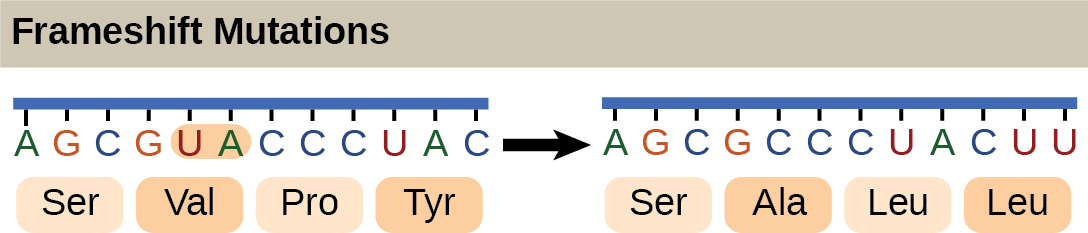


Figure 15.5図 15.5
The deletion of two nucleotides shifts the reading frame of an mRNA and changes the entire protein message, creating a nonfunctional protein or terminating protein synthesis altogether.
英語のヒント
2個のヌクレオチドが欠失すると、mRNAの読み枠がずれ、タンパク質全体の情報が変わる。その結果、機能のないタンパク質ができたり、タンパク質合成が完全に終わってしまったりする。