第11章減数分裂と有性生殖
Prophase I第一分裂前期
Early in prophase I, before the chromosomes can be seen clearly with a microscope, the homologous chromosomes are attached at their tips to the nuclear envelope by proteins. As the nuclear envelope begins to break down, the proteins associated with homologous chromosomes bring the pair closer together. Recall that in mitosis, homologous chromosomes do not pair together. The synaptonemal complex, a lattice of proteins between the homologous chromosomes, first forms at specific locations and then spreads outward to cover the entire length of the chromosomes. The tight pairing of the homologous chromosomes is called synapsis. In synapsis, the genes on the chromatids of the homologous chromosomes are aligned precisely with each other. The synaptonemal complex supports the exchange of chromosomal segments between homologous nonsister chromatids—a process called crossing over. Crossing over can be observed visually after the exchange as chiasmata (singular = chiasma) (Figure 11.3).
英語のヒント
第一分裂前期の早い段階、染色体が顕微鏡ではっきり見えるようになる前に、相同染色体は先端でタンパク質を介して核膜に付着する。核膜が分解し始めると、染色体に結び付くタンパク質が相同な対を近づける。有糸分裂では相同染色体が対を作らないことを思い出そう。相同染色体の間のタンパク質格子であるシナプトネマ複合体は、まず特定の場所にでき、外へ広がって染色体の全長を覆う。相同染色体が密に対を作ることを対合という。対合では相同染色体の染色分体上の遺伝子が、互いに正確に対応して並ぶ。シナプトネマ複合体は、相同な非姉妹染色分体どうしで染色体の一部を交換する乗換えを支える。乗換え後、その場所はキアズマ(複数形chiasmata、単数形chiasma)として目で観察できる(図11.3)。
In humans, even though the X and Y sex chromosomes are not completely homologous (that is, most of their genes differ), there is a small region of homology that allows the X and Y chromosomes to pair up during prophase I. A partial synaptonemal complex develops only between the regions of homology.
英語のヒント
ヒトのXとYの性染色体は完全には相同ではなく、大部分の遺伝子は異なる。それでも小さな相同領域があるため、第一分裂前期に対を作れる。部分的なシナプトネマ複合体は、この相同領域の間にだけ形成される。
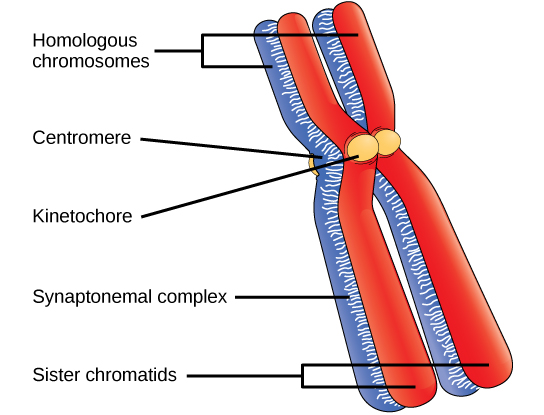
Figure 11.3図 11.3
Early in prophase I, homologous chromosomes come together to form a synapse. The chromosomes are bound tightly together and in perfect alignment by a protein lattice called a synaptonemal complex and by cohesin proteins at the centromere.
第一分裂前期の初期に相同染色体が近づき、対合する。シナプトネマ複合体というタンパク質格子と、セントロメアのコヒーシンが、染色体を密に、完全に対応するように結び付ける。
Located at intervals along the synaptonemal complex are large protein assemblies called recombination nodules. These assemblies mark the points of later chiasmata and mediate the multistep process of crossover—or genetic recombination—between the nonsister chromatids. Near the recombination nodule, the double-stranded DNA of each chromatid is cleaved, the cut ends are modified, and a new connection is made between the nonsister chromatids. As prophase I progresses, the synaptonemal complex begins to break down and the chromosomes begin to condense. When the synaptonemal complex is gone, the homologous chromosomes remain attached to each other at the centromere and at chiasmata. The chiasmata remain until anaphase I. The number of chiasmata varies according to the species and the length of the chromosome. There must be at least one chiasma per chromosome for proper separation of homologous chromosomes during meiosis I, but there may be as many as 25. Following crossover, the synaptonemal complex breaks down and the cohesin connection between homologous pairs is removed. At the end of prophase I, the pairs are held together only at the chiasmata (Figure 11.4). These pairs are called tetrads because a total of four sister chromatids of each pair of homologous chromosomes are now visible.
英語のヒント
シナプトネマ複合体に沿って一定の間隔で、組換え結節という大きなタンパク質集合体がある。これは後にキアズマになる地点を示し、非姉妹染色分体の間の乗換え、すなわち遺伝的組換えの複数段階を仲介する。結節の近くでは各染色分体の二本鎖DNAが切断され、切断端が修飾されて、非姉妹染色分体の間に新たなつながりができる。第一分裂前期が進むと、シナプトネマ複合体が分解し始め、染色体が凝縮し始める。複合体がなくなっても、相同染色体はセントロメアとキアズマでつながっている。キアズマは第一分裂後期まで残る。その数は種や染色体の長さによって異なる。第一分裂で相同染色体を正しく分離するには、1本の染色体につき少なくとも1個必要だが、25個もある場合がある。乗換え後、シナプトネマ複合体は分解され、相同な対をつなぐコヒーシンも除去される。第一分裂前期の終わりには、対はキアズマでだけ結び付いている(図11.4)。相同染色体の各対について計4本の姉妹染色分体が見えるため、これを四分染色体という。
The crossover events are the first source of genetic variation in the nuclei produced by meiosis. A single crossover event between homologous nonsister chromatids leads to a reciprocal exchange of equivalent DNA between an egg-derived chromosome and a sperm-derived chromosome. When a recombinant sister chromatid is moved into a gamete cell it will carry a combination of maternal and paternal genes that did not exist before the crossover. Crossover events can occur almost anywhere along the length of the synapsed chromosomes. Different cells undergoing meiosis will therefore produce different recombinant chromatids, with varying combinations of maternal and parental genes. Multiple crossovers in an arm of the chromosome have the same effect, exchanging segments of DNA to produce genetically recombined chromosomes.
英語のヒント
乗換えは、減数分裂でできる核に遺伝的変異を生む第一の原因である。相同な非姉妹染色分体の間で乗換えが1回起こると、卵由来と精子由来の染色体の間で、対応するDNAが相互に交換される。組換えられた姉妹染色分体が配偶子に入ると、乗換え前にはなかった母親由来・父親由来の遺伝子の組み合わせを持つ。乗換えは対合した染色体のほぼどこでも起こりうる。そのため、減数分裂する細胞が異なれば、母親由来と親由来の遺伝子のさまざまな組み合わせを持つ、異なる組換え染色分体ができる。染色体の腕で複数回の乗換えが起こる場合も効果は同じで、DNA区間の交換によって遺伝的に組換えられた染色体ができる。
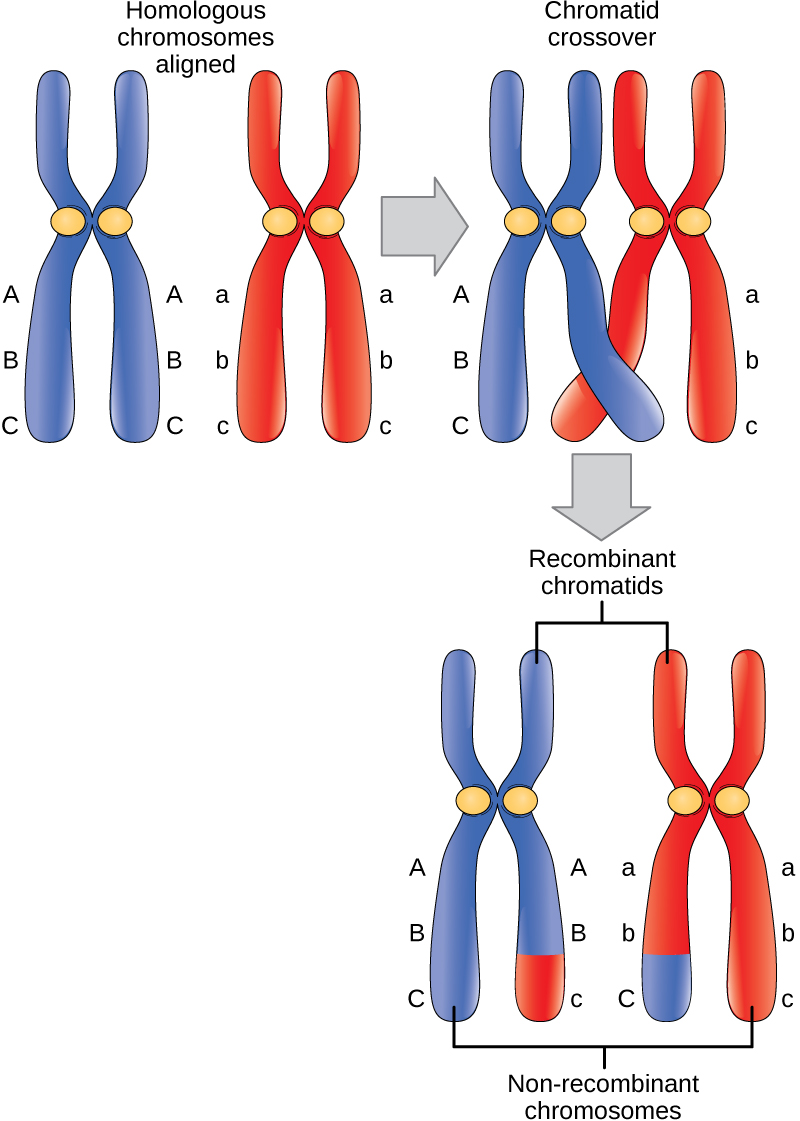


Figure 11.4図 11.4
Crossover occurs between nonsister chromatids of homologous chromosomes. The result is an exchange of genetic material between homologous chromosomes (for clarity, only one recombination event between two of the four chromatids is represented).
乗換えは相同染色体の非姉妹染色分体の間で起こり、相同染色体どうしで遺伝物質を交換する。(分かりやすくするため、4本の染色分体のうち2本で起こる1回の組換えだけを示す。)
Prometaphase I第一分裂前中期
The key event in prometaphase I is the attachment of the spindle fiber microtubules to the kinetochore proteins at the centromeres. Kinetochore proteins are multiprotein complexes that bind the centromeres of a chromosome to the microtubules of the mitotic spindle. Microtubules grow from microtubule-organizing centers (MTOCs). In animal cells, MTOCs are centrosomes located at opposite poles of the cell. The microtubules from each pole move toward the middle of the cell and attach to one of the kinetochores of the two fused homologous chromosomes. Each member of the homologous pair attaches to a microtubule extending from opposite poles of the cell so that in the next phase, the microtubules can pull the homologous pair apart. A spindle fiber that has attached to a kinetochore is called a kinetochore microtubule. At the end of prometaphase I, each tetrad is attached to microtubules from both poles, with one homologous chromosome facing each pole. The homologous chromosomes are still held together at the chiasmata. In addition, the nuclear membrane has broken down entirely.
英語のヒント
第一分裂前中期の主要な出来事は、紡錘糸の微小管がセントロメアの動原体タンパク質に付着することである。動原体は複数のタンパク質からなる複合体で、染色体のセントロメアを紡錘体微小管へ結び付ける。微小管は微小管形成中心(MTOC)から伸びる。動物細胞のMTOCは、細胞の両極にある中心体である。各極から伸びる微小管は中央へ向かい、結合した2本の相同染色体の動原体の一つに付着する。相同な対のそれぞれが反対側の極から来る微小管に付着するため、次の段階で微小管が対を引き離せる。動原体に付着した紡錘糸を動原体微小管という。第一分裂前中期の終わりには各四分染色体が両極からの微小管に付着し、相同染色体は1本ずつそれぞれの極を向く。相同染色体どうしはまだキアズマで結ばれている。また核膜は完全に分解されている。