第21章ウイルス
Viral Morphologyウイルスの形態
Viruses are noncellular, meaning they are biological entities that do not have a cellular structure. They therefore lack most of the components of cells, such as organelles, ribosomes, and the plasma membrane. A virion consists of a nucleic acid core, an outer protein coating or capsid, and sometimes an outer envelope made of protein and phospholipid membranes derived from the host cell. Viruses may also contain additional proteins, such as enzymes, within the capsid or attached to the viral genome. The most obvious difference between members of different viral families is the variation in their morphology, which is quite diverse. An interesting feature of viral complexity is that the complexity of the host does not necessarily correlate with the complexity of the virion. In fact, some of the most complex virion structures are found in the bacteriophages—viruses that infect the simplest living organisms, bacteria.
英語のヒント
ウイルスは非細胞性であり、細胞構造をもたない生物学的存在である。したがって、細胞小器官、リボソーム、細胞膜など、細胞の構成要素の大半を欠く。ビリオンは、核酸の芯と、その外側を覆うタンパク質の殻であるカプシドからなり、ときにはさらに、宿主細胞由来のタンパク質とリン脂質膜でできた外側のエンベロープをもつ。カプシド内やウイルスゲノムに結合した形で、酵素などのタンパク質をさらに含むこともある。異なるウイルス科の間で最も明らかな違いは形態であり、その形は非常に多様である。ウイルスの複雑さについて興味深いのは、宿主の複雑さがビリオンの複雑さと必ずしも対応しないことである。実際、とくに複雑なビリオン構造の一部は、最も単純な生物である細菌に感染するバクテリオファージに見られる。
Morphology形態
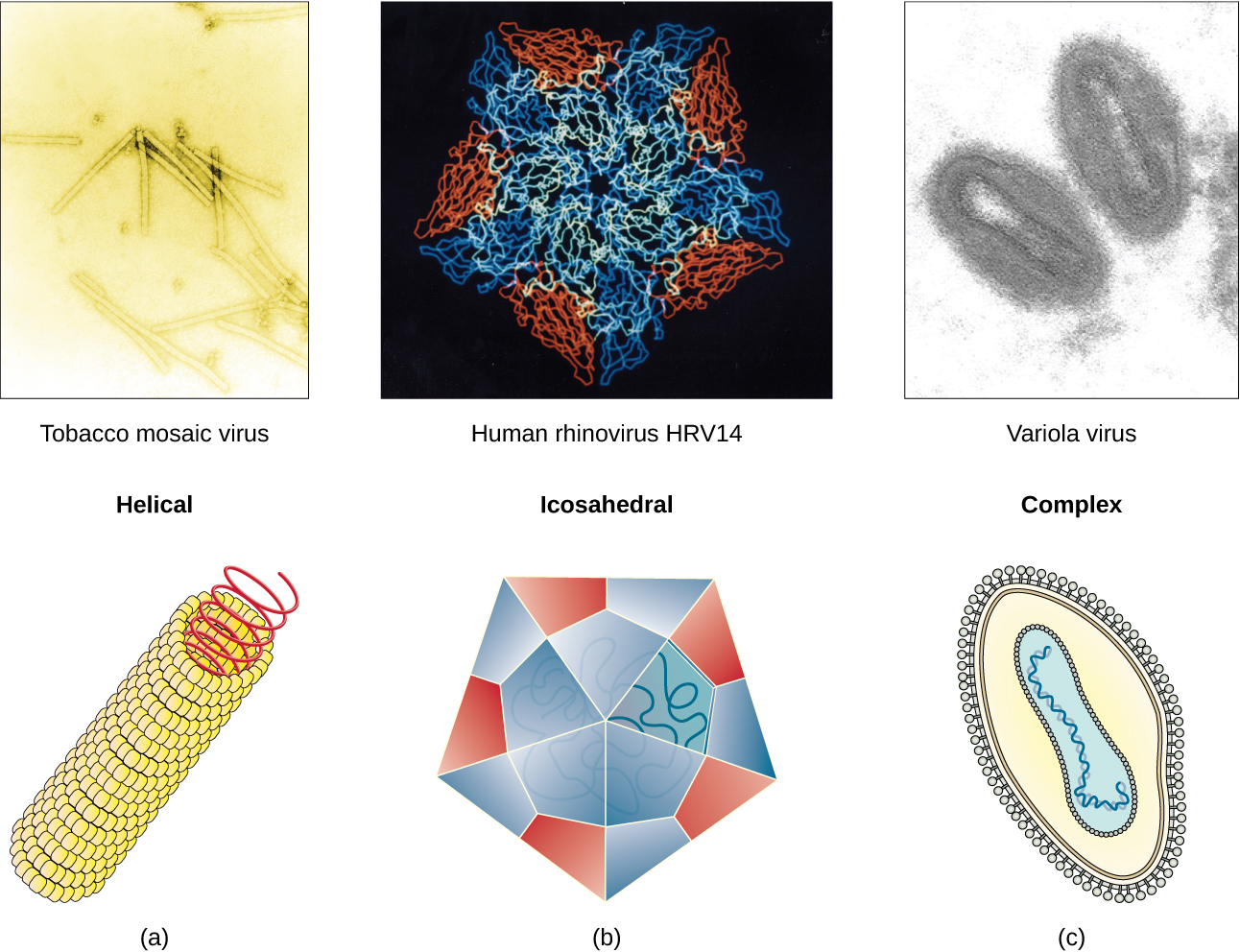
Viruses come in many shapes and sizes, but these features are consistent for each viral family. As we have seen, all virions have a nucleic acid genome covered by a protective capsid. The proteins of the capsid are encoded in the viral genome, and are called capsomeres. Some viral capsids are simple helices or polyhedral “spheres,” whereas others are quite complex in structure (Figure 21.3).
英語のヒント
ウイルスには多くの形と大きさがあるが、これらの特徴は各ウイルス科では一定している。すでに見たように、すべてのビリオンは、保護するカプシドに覆われた核酸ゲノムをもつ。カプシドのタンパク質はウイルスゲノムにコードされ、カプソメアと呼ばれる。カプシドには、単純ならせんや多面体の「球」に近いものもあれば、非常に複雑な構造をもつものもある(図21.3)。
OpenStax, Rice University; Biology 2e. (credit a “micrograph”: modification of work by USDA ARS; credit b “micrograph”: modification of work by U.S. Department of Energy) · CC BY 4.0 · Source出典

Figure 21.3図 21.3
Viral capsids can be (a) helical, (b) polyhedral, or (c) have a complex shape. (credit a “micrograph”: modification of work by USDA ARS; credit b “micrograph”: modification of work by U.S. Department of Energy)
ウイルスのカプシドには、(a)らせん型、(b)多面体型、(c)複雑な形がある。(a「顕微鏡写真」:USDA ARSの作品を改変。b「顕微鏡写真」:米国エネルギー省の作品を改変。)
In general, the capsids of viruses are classified into four groups: helical, icosahedral, enveloped, and head-and-tail. Helical capsids are long and cylindrical. Many plant viruses are helical, including TMV. Icosahedral viruses have shapes that are roughly spherical, such as those of poliovirus or herpesviruses. Enveloped viruses have membranes derived from the host cell that surrounds the capsids. Animal viruses, such as HIV, are frequently enveloped. Head-and-tail viruses infect bacteria and have a head that is similar to icosahedral viruses and a tail shaped like helical viruses.
英語のヒント
一般に、ウイルスのカプシドは、らせん型、正二十面体型、エンベロープ型、頭尾型の4群に分類される。らせん型カプシドは細長い円筒形であり、TMVを含む多くの植物ウイルスがこの型である。正二十面体型ウイルスは、ポリオウイルスやヘルペスウイルスのように、ほぼ球形をしている。エンベロープ型では、宿主細胞由来の膜がカプシドを囲む。HIVなどの動物ウイルスは、エンベロープをもつことが多い。頭尾型ウイルスは細菌に感染し、正二十面体型ウイルスに似た頭部と、らせん型ウイルスに似た形の尾部をもつ。
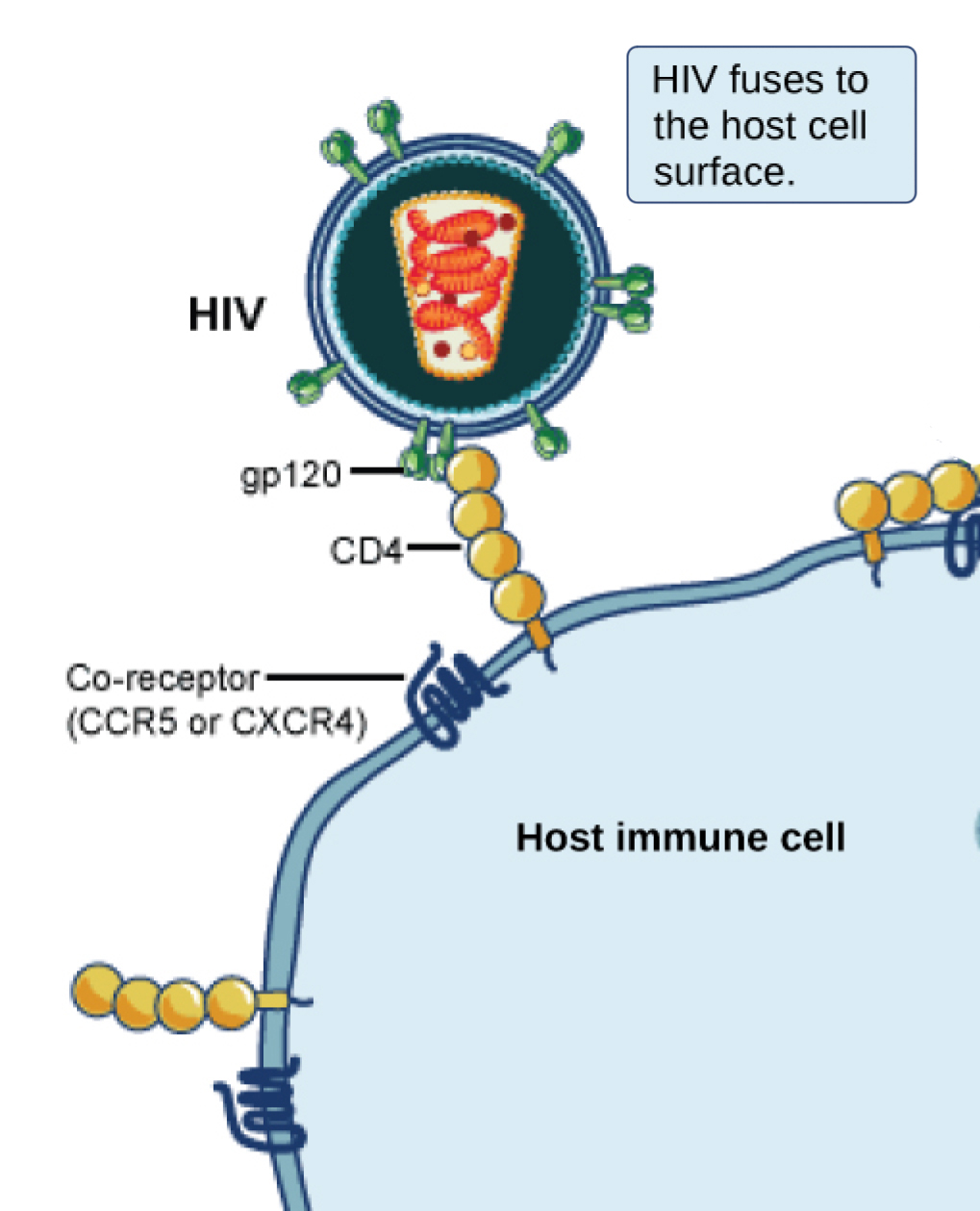
Many viruses use some sort of glycoprotein to attach to their host cells via molecules on the cell called viral receptors. For these viruses, attachment is required for later penetration of the cell membrane; only after penetration takes place can the virus complete its replication inside the cell. The receptors that viruses use are molecules that are normally found on cell surfaces and have their own physiological functions. It appears that viruses have simply evolved to make use of these molecules for their own replication. For example, HIV uses the CD4 molecule on T lymphocytes as one of its receptors (Figure 21.4). CD4 is a type of molecule called a cell adhesion molecule, which functions to keep different types of immune cells in close proximity to each other during the generation of a T lymphocyte immune response.
英語のヒント
多くのウイルスは、糖タンパク質の一種を使い、細胞上のウイルス受容体と呼ばれる分子を介して宿主細胞へ付着する。これらのウイルスでは、その後に細胞膜を通って侵入するために付着が必要であり、侵入が起こって初めて細胞内で複製を完了できる。ウイルスが使う受容体は、通常から細胞表面に存在し、独自の生理機能をもつ分子である。ウイルスは、それらを自分の複製に利用するよう進化したと考えられる。たとえばHIVは、Tリンパ球上のCD4分子を受容体の1つとして使う(図21.4)。CD4は細胞接着分子と呼ばれる分子の一種で、Tリンパ球の免疫応答が生じる際に、異なる種類の免疫細胞を互いに近接させておく働きをもつ。
OpenStax, Rice University; Biology 2e. (credit: modification of work by NIAID, NIH) · CC BY 4.0 · Source出典

Figure 21.4図 21.4
A virus and its host receptor protein. The HIV virus binds the CD4 receptor on the surface of human cells. CD4 receptors help white blood cells to communicate with other cells of the immune system when producing an immune response. (credit: modification of work by NIAID, NIH)
ウイルスと、その宿主受容体タンパク質。HIVはヒト細胞の表面のCD4受容体に結合する。CD4受容体は、免疫応答が起こる際に、白血球が免疫系の他の細胞と情報を伝え合うのを助ける。(クレジット:NIAID、NIHの作品を改変)
One of the most complex virions known, the T4 bacteriophage (which infects the Escherichia coli) bacterium, has a tail structure that the virus uses to attach to host cells and a head structure that houses its DNA.
英語のヒント
知られている中で最も複雑なビリオンの1つであるT4バクテリオファージは、大腸菌(Escherichia coli)に感染する。宿主細胞への付着に使う尾部構造と、DNAを収める頭部構造をもつ。
Adenovirus, a non-enveloped animal virus that causes respiratory illnesses in humans, uses glycoprotein spikes protruding from its capsomeres to attach to host cells. Non-enveloped viruses also include those that cause polio (poliovirus), plantar warts (papillomavirus), and hepatitis A (hepatitis A virus).
英語のヒント
ヒトに呼吸器疾患を起こすアデノウイルスは、エンベロープをもたない動物ウイルスで、カプソメアから突き出た糖タンパク質のスパイクを使って宿主細胞へ付着する。エンベロープをもたないウイルスには、ポリオを起こすポリオウイルス、足底疣贅を起こすパピローマウイルス、A型肝炎を起こすA型肝炎ウイルスも含まれる。
Enveloped virions, such as the influenza virus, consist of nucleic acid (RNA in the case of influenza) and capsid proteins surrounded by a phospholipid bilayer envelope that contains virus-encoded proteins. Glycoproteins embedded in the viral envelope are used to attach to host cells. Other envelope proteins are the matrix proteins that stabilize the envelope and often play a role in the assembly of progeny virions. Chicken pox, HIV, and mumps are other examples of diseases caused by viruses with envelopes. Because of the fragility of the envelope, non-enveloped viruses are more resistant to changes in temperature, pH, and some disinfectants than enveloped viruses.
英語のヒント
インフルエンザウイルスなどのエンベロープをもつビリオンは、核酸(インフルエンザではRNA)とカプシドタンパク質からなり、ウイルスにコードされたタンパク質を含むリン脂質二重層のエンベロープに囲まれている。エンベロープに埋め込まれた糖タンパク質は、宿主細胞への付着に使われる。他のエンベロープタンパク質としてマトリックスタンパク質があり、エンベロープを安定させ、子孫ビリオンの組み立てにも関わることが多い。水痘、HIV感染症、流行性耳下腺炎も、エンベロープをもつウイルスによる病気の例である。エンベロープは壊れやすいため、エンベロープをもたないウイルスのほうが、温度やpHの変化、一部の消毒薬に対して強い。
Overall, the shape of the virion and the presence or absence of an envelope tell us little about what disease the virus may cause or what species it might infect, but they are still useful means to begin viral classification (Figure 21.5).
英語のヒント
全体として、ビリオンの形やエンベロープの有無からは、どのような病気を起こすか、どの種に感染するかについて、ほとんど分からない。それでも、ウイルスの分類を始める有用な手がかりにはなる(図21.5)。