第21章ウイルス
Egress放出
The last stage of viral replication is the release of the new virions produced in the host organism, where they are able to infect adjacent cells and repeat the replication cycle. As you’ve learned, some viruses are released when the host cell dies, and other viruses can leave infected cells by budding through the membrane without directly killing the cell.
英語のヒント
ウイルス複製の最終段階は、宿主生物内で作られた新しいビリオンの放出である。放出されたビリオンは隣接する細胞に感染し、複製サイクルを繰り返せる。すでに学んだように、宿主細胞が死ぬと放出されるウイルスもあれば、膜を通って出芽し、細胞を直接殺さずに感染細胞から出るウイルスもある。
Different Hosts and Their Virusesさまざまな宿主とそのウイルス
As you’ve learned, viruses often infect very specific hosts, as well as specific cells within the host. This feature of a virus makes it specific to one or a few species of life on Earth. On the other hand, so many different types of viruses exist on Earth that nearly every living organism has its own set of viruses trying to infect its cells. Even prokaryotes, the smallest and simplest of cells, may be attacked by specific types of viruses. In the following section, we will look at some of the features of viral infection of prokaryotic cells. As we have learned, viruses that infect bacteria are called bacteriophages (Figure 21.9). Archaea have their own similar viruses.
英語のヒント
すでに学んだように、ウイルスは非常に限定された宿主と、その中の特定の細胞に感染することが多い。この性質のため、あるウイルスの感染先は地球上の1種または少数の種に限られる。一方、地球上には非常に多くの種類のウイルスが存在するため、ほぼすべての生物に、その細胞へ感染しようとする固有のウイルス群がある。最も小さく単純な細胞である原核生物も、特定のウイルスの攻撃を受ける。次は、原核細胞へのウイルス感染の特徴を見ていく。細菌に感染するウイルスは、すでに学んだとおりバクテリオファージと呼ぶ(図21.9)。古細菌にも、それに対応する独自のウイルスがある。
Bacteriophagesバクテリオファージ
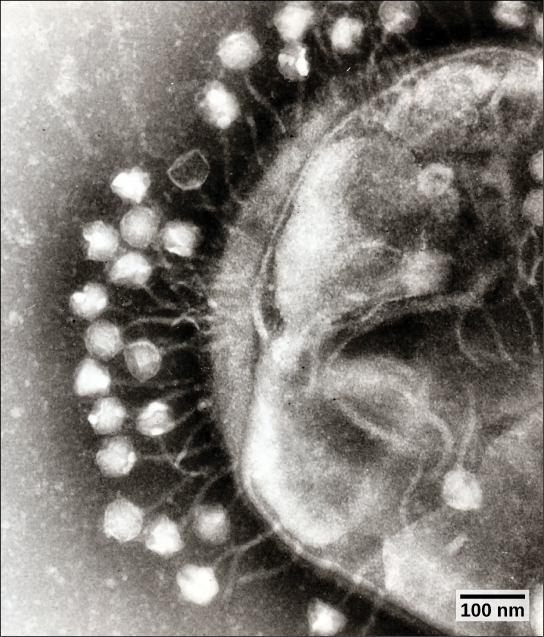
OpenStax, Rice University; Biology 2e. (credit: modification of work by Dr. Graham Beards; scale-bar data from Matt Russell) · CC BY 4.0 · Source出典

Figure 21.9図 21.9
Bacteriophages attached to a host cell (transmission electron micrograph). In bacteriophage with tails, like the one shown here, the tails serve as a passageway for transmission of the phage genome. (credit: modification of work by Dr. Graham Beards; scale-bar data from Matt Russell)
英語のヒント
宿主細胞へ付着したバクテリオファージの透過型電子顕微鏡写真。ここに示すような尾部をもつファージでは、尾部がゲノムを送り込む通路として働く。(クレジット:Dr. Graham Beardsの作品を改変。スケールバーのデータ:Matt Russell)
Most bacteriophages are dsDNA viruses, which use host enzymes for DNA replication and RNA transcription. Phage particles must bind to specific surface receptors and actively insert the genome into the host cell. (The complex tail structures seen in many bacteriophages are actively involved in getting the viral genome across the prokaryotic cell wall.) When infection of a cell by a bacteriophage results in the production of new virions, the infection is said to be productive. If the virions are released by bursting the cell, the virus replicates by means of a lytic cycle (Figure 21.10). An example of a lytic bacteriophage is T4, which infects Escherichia coli found in the human intestinal tract. Sometimes, however, a virus can remain within the cell without being released. For example, when a temperate bacteriophage infects a bacterial cell, it replicates by means of a lysogenic cycle (Figure 21.10), and the viral genome is incorporated into the genome of the host cell. When the phage DNA is incorporated into the host-cell genome, it is called a prophage. An example of a lysogenic bacteriophage is the λ (lambda) virus, which also infects the E. coli bacterium. Viruses that infect plant or animal cells may sometimes undergo infections where they are not producing virions for long periods. An example is the animal herpesviruses, including herpes simplex viruses, the cause of oral and genital herpes in humans. In a process called latency, these viruses can exist in nervous tissue for long periods of time without producing new virions, only to leave latency periodically and cause lesions in the skin where the virus replicates. Even though there are similarities between lysogeny and latency, the term lysogenic cycle is usually reserved to describe bacteriophages. Latency will be described in more detail in the next section.
英語のヒント
大半のバクテリオファージは二本鎖DNAウイルスで、DNA複製とRNA転写に宿主の酵素を使う。ファージ粒子は特定の表面受容体へ結合し、ゲノムを宿主細胞内へ能動的に送り込まなければならない。多くのファージに見られる複雑な尾部構造は、原核細胞の細胞壁を越えてゲノムを送る働きに関わる。ファージの感染によって新しいビリオンが作られるとき、その感染は産生性感染と呼ばれる。細胞の破裂によってビリオンが放出されるなら、ウイルスは溶菌サイクルで複製している(図21.10)。その例がT4で、ヒトの腸管にいる大腸菌Escherichia coliに感染する。しかし、ウイルスは放出されずに細胞内へとどまることもある。たとえば温和ファージが細菌に感染すると、溶原サイクルで複製し(図21.10)、ウイルスゲノムが宿主ゲノムへ組み込まれる。宿主細胞のゲノムに組み込まれたファージDNAは、プロファージと呼ばれる。溶原性ファージの例はλ(ラムダ)ウイルスで、これも大腸菌に感染する。植物や動物の細胞に感染するウイルスにも、長い間ビリオンを作らない感染がある。例は動物のヘルペスウイルスで、ヒトの口唇ヘルペスや性器ヘルペスを起こす単純ヘルペスウイルスも含まれる。潜伏という過程では、新しいビリオンを作らずに神経組織へ長期間存在し、周期的に潜伏状態を離れて、増殖する皮膚に病変を起こす。溶原性と潜伏には類似点があるが、「溶原サイクル」は通常、バクテリオファージに対して使う。潜伏については次の節で詳しく説明する。