第44章生態学と生物圏
Savannasサバンナ
Savannas are grasslands with scattered trees, and they are located in Africa, South America, and northern Australia (Figure 44.12). Savannas are usually hot, tropical areas with temperatures averaging from 24 °C to 29 °C (75 °F to 84 °F) and an annual rainfall of 10–40 cm (3.9–15.7 in). Savannas have an extensive dry season; for this reason, forest trees do not grow as well as they do in the tropical wet forest (or other forest biomes). As a result, within the grasses and forbs (herbaceous flowering plants) that dominate the savanna, there are relatively few trees (Figure 44.14). Since fire is an important source of disturbance in this biome, plants have evolved well-developed root systems that allow them to quickly resprout after a fire.
英語のヒント
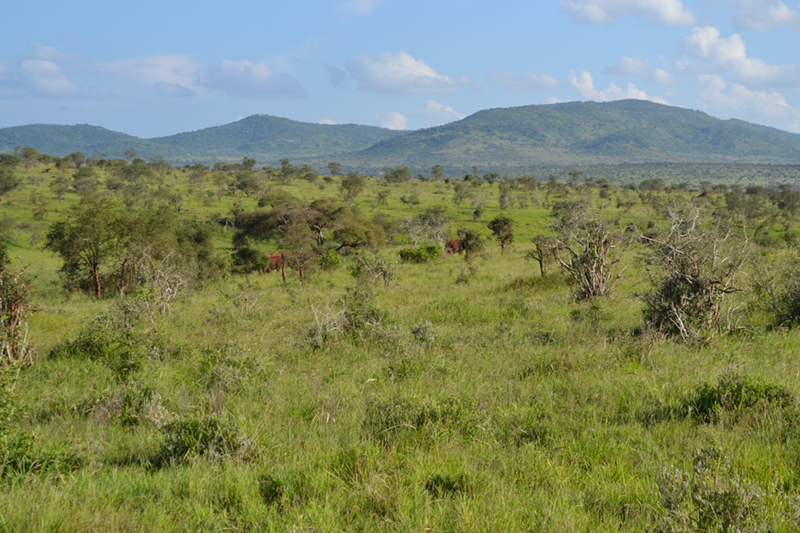
Figure 44.14図 44.14
Savannas, like this one in Taita Hills Wildlife Sanctuary in Kenya, are dominated by grasses. (credit: Christopher T. Cooper)
ケニアのタイタ・ヒルズ野生生物保護区にあるこの例のように、サバンナでは草本が優勢である。(出典:Christopher T. Cooper)
Subtropical Deserts亜熱帯砂漠
Subtropical deserts exist between 15° and 30° north and south latitude and are centered on the Tropics of Cancer and Capricorn (Figure 44.12). This biome is very dry; in some years, evaporation exceeds precipitation. Subtropical hot deserts can have daytime soil surface temperatures above 60 °C (140 °F) and nighttime temperatures approaching 0 °C (32 °F). This is largely due to the lack of atmospheric water. In cold deserts, temperatures can be as high as 25 °C and can drop below -30 °C (-22 °F). Subtropical deserts are characterized by low annual precipitation of fewer than 30 cm (12 in) with little monthly variation and lack of predictability in rainfall. In some cases, the annual rainfall can be as low as 2 cm (0.8 in) in subtropical deserts located in central Australia (“the Outback”) and northern Africa.
英語のヒント
亜熱帯砂漠は、北回帰線と南回帰線を中心に、南北緯15~30度の間に分布する(図44.12)。非常に乾燥し、年によっては蒸発量が降水量を上回る。高温の亜熱帯砂漠では、昼の地表温度が60℃(140℉)を超え、夜には0℃(32℉)近くになることがある。主に、大気中の水分が乏しいためである。寒冷砂漠では、温度が25℃に達することも、−30℃(−22℉)未満になることもある。亜熱帯砂漠は、年間降水量が30 cm(12インチ)未満と少なく、月ごとの変化は小さいが、雨の予測が難しいことを特徴とする。オーストラリア中央部の「アウトバック」や北アフリカの亜熱帯砂漠では、年間降水量がわずか2 cm(0.8インチ)の場合もある。
The vegetation and low animal diversity of this biome is closely related to low and unpredictable precipitation. Very dry deserts lack perennial vegetation that lives from one year to the next; instead, many plants are annuals that grow quickly and reproduce when rainfall does occur, and then die. Many other plants in these areas are characterized by having a number of adaptations that conserve water, such as deep roots, reduced foliage, and water-storing stems (Figure 44.15). Seed plants in the desert produce seeds that can be in dormancy for extended periods between rains. Adaptations in desert animals include nocturnal behavior and burrowing.
英語のヒント
このバイオームの植生と動物の多様性の低さは、少なく予測しにくい降水に密接に関係する。極めて乾燥した砂漠には、年を越して生きる多年生の植生がない。その代わり、多くの植物は一年生で、実際に雨が降ると急速に成長して繁殖し、その後枯れる。ほかの多くの植物は、深い根、少ない葉、水を蓄える茎など、水を保つ適応をいくつも備える(図44.15)。砂漠の種子植物は、雨と雨の間の長期間、休眠できる種子を作る。砂漠の動物の適応には、夜行性の行動や穴を掘ることが含まれる。
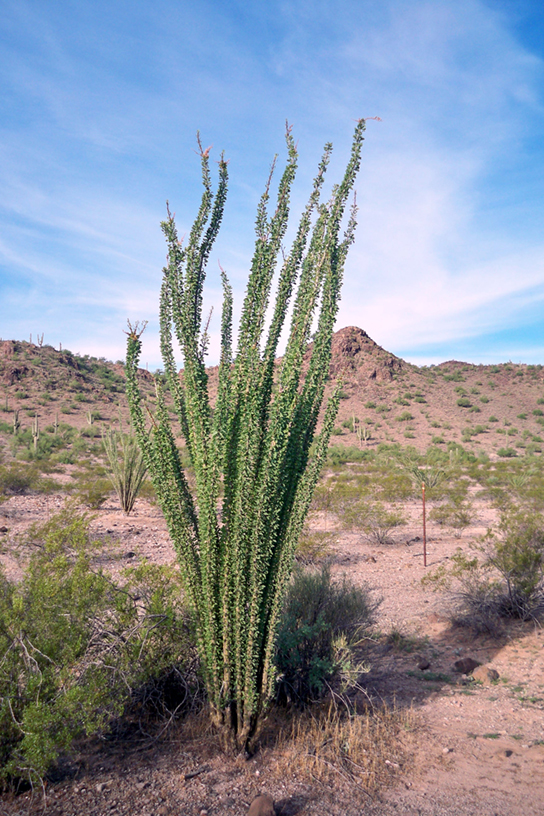
Figure 44.15図 44.15
To reduce water loss, many desert plants have tiny leaves or no leaves at all. The leaves of ocotillo (Fouquieria splendens), shown here in the Sonora Desert near Gila Bend, Arizona, appear only after rainfall, and then are shed.
水の損失を減らすため、多くの砂漠植物はごく小さい葉をもつか、葉をまったくもたない。アリゾナ州ヒラ・ベンド近郊のソノラ砂漠にある、このオコティロ(Fouquieria splendens)の葉は、雨の後にだけ現れ、その後落ちる。
Chaparralチャパラル
The chaparral is also called the scrub forest and is found in California, along the Mediterranean Sea, and along the southern coast of Australia (Figure 44.12). The annual rainfall in this biome ranges from 65 cm to 75 cm (25.6–29.5 in), and the majority of the rain falls in the winter. Summers are very dry and many chaparral plants are dormant during the summertime. The chaparral vegetation, shown in Figure 44.16, is dominated by shrubs adapted to periodic fires, with some plants producing seeds that only germinate after a hot fire. The ashes left behind after a fire are rich in nutrients like nitrogen that fertilize the soil and promote plant regrowth.
英語のヒント
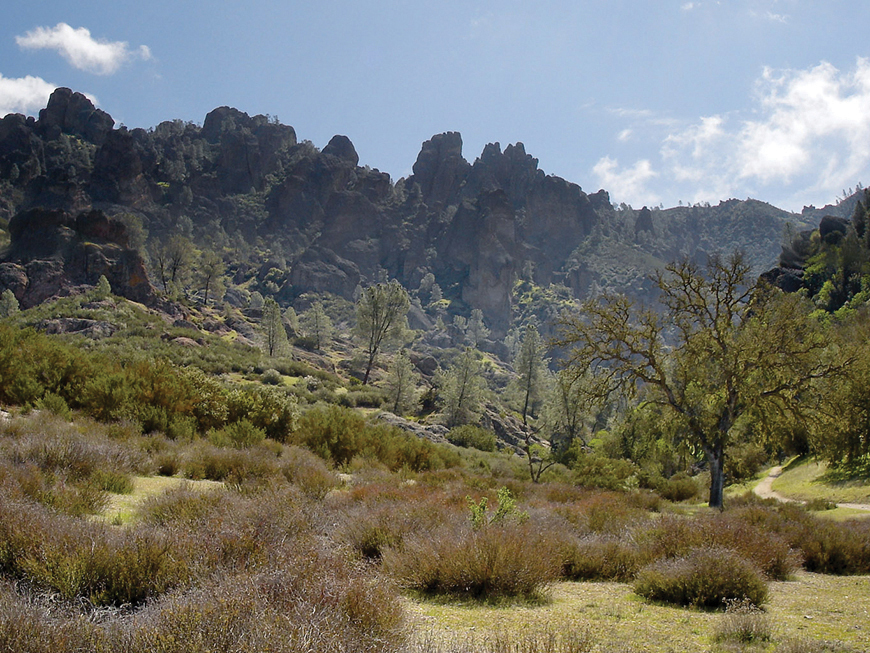


Figure 44.16図 44.16
The chaparral is dominated by shrubs. (credit: Miguel Vieira)
チャパラルでは低木が優勢である。(出典:Miguel Vieira)
Temperate Grasslands温帯草原
Temperate grasslands are found throughout central North America, where they are also known as prairies; they are also in Eurasia, where they are known as steppes (Figure 44.12). Temperate grasslands have pronounced annual fluctuations in temperature with hot summers and cold winters. The annual temperature variation produces specific growing seasons for plants. Plant growth is possible when temperatures are warm enough to sustain plant growth and when ample water is available, which occurs in the spring, summer, and fall. During much of the winter, temperatures are low, and water, which is stored in the form of ice, is not available for plant growth.
英語のヒント
温帯草原は北米中央部に広く分布し、プレーリーとも呼ばれる。ユーラシアにもあり、そこではステップと呼ばれる(図44.12)。暑い夏と寒い冬があり、年間の温度変動が大きい。温度の年変化によって、植物の生育期が定まる。成長を支えられるほど暖かく、十分な水が得られる春・夏・秋に、植物は成長できる。冬の大部分は温度が低く、水は氷として蓄えられているため、成長に利用できない。
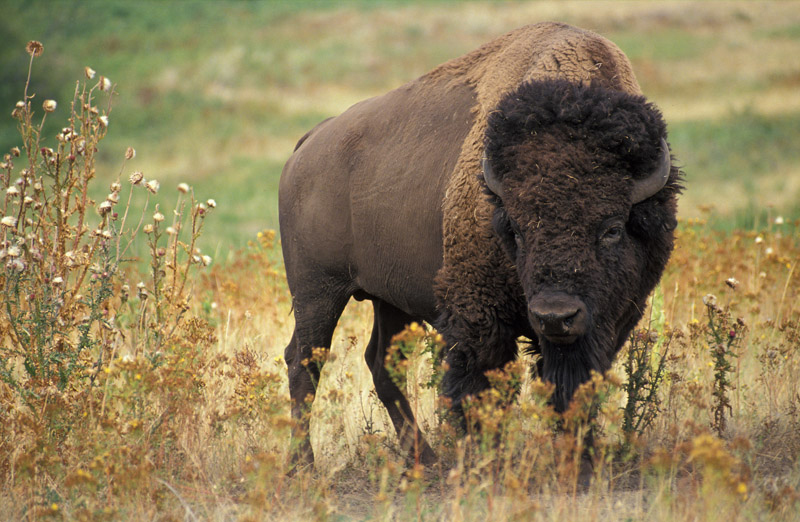
Annual precipitation ranges from 25 cm to 75 cm (9.8–29.5 in). Because of relatively lower annual precipitation in temperate grasslands, there are few trees except for those found growing along rivers or streams. The dominant vegetation tends to consist of grasses dense enough to sustain populations of grazing animals Figure 44.17. The vegetation is very dense and the soils are fertile because the subsurface of the soil is packed with the roots and rhizomes (underground stems) of these grasses. The roots and rhizomes act to anchor plants into the ground and replenish the organic material (humus) in the soil when they die and decay.
英語のヒント
年間降水量は25~75 cm(9.8~29.5インチ)である。温帯草原では雨が比較的少ないため、河川や小川の沿いを除いて、樹木はほとんどない。優占する植生は通常、草食動物の個体群を支えられるほど密なイネ科草本からなる(図44.17)。植生は非常に密で、土壌は肥沃である。地表下が、これらの草本の根と根茎(地下茎)で埋まっているためである。根と根茎は植物を地面に固定し、枯れて分解すると、土壌の有機物(腐植)を補う。
OpenStax, Rice University; Biology 2e. (credit: Jack Dykinga, USDA Agricultural Research Service) · CC BY 4.0 · Source出典

Figure 44.17図 44.17
The American bison (Bison bison), more commonly called the buffalo, is a grazing mammal that once populated American prairies in huge numbers. (credit: Jack Dykinga, USDA Agricultural Research Service)
一般にはバッファローとも呼ばれるアメリカバイソン(Bison bison)は、草を食べる哺乳類で、かつてアメリカのプレーリーに膨大な数が生息していた。(出典:Jack Dykinga、USDA Agricultural Research Service)
Fires, mainly caused by lightning, are a natural disturbance in temperate grasslands. When fire is suppressed in temperate grasslands, the vegetation eventually converts to scrub and sometimes dense forests with drought-tolerant tree species. Often, the restoration or management of temperate grasslands requires the use of controlled burns to suppress the growth of trees and maintain the grasses.
英語のヒント
主に落雷で生じる火災は、温帯草原の自然な撹乱である。火災を抑えると、植生はやがて低木林へ、ときには乾燥に強い樹種からなる密な森林へ変わる。温帯草原の復元や管理には、樹木の成長を抑えて草本を維持するため、計画的な火入れが必要になることが多い。