第44章生態学と生物圏
Temperate Forests温帯林
Temperate forests are the most common biome in eastern North America, Western Europe, Eastern Asia, Chile, and New Zealand (Figure 44.12). This biome is found throughout mid-latitude regions. Temperatures range between -30 °C and 30 °C (-22 °F to 86 °F) and drop to below freezing periodically during cold winters. These temperatures mean that temperate forests have defined growing seasons during the spring, summer, and early fall. Precipitation is relatively constant throughout the year and ranges between 75 cm and 150 cm (29.5–59 in).
英語のヒント
温帯林は、北米東部、西ヨーロッパ、東アジア、チリ、ニュージーランドで最も一般的なバイオームであり、中緯度地域に広く分布する(図44.12)。温度は−30~30℃(−22~86℉)で、寒い冬には定期的に氷点下となる。この温度条件によって、春・夏・初秋という明確な生育期が生じる。降水は年間を通じて比較的一定し、年間降水量は75~150 cm(29.5~59インチ)である。
Because of the moderate annual rainfall and temperatures, deciduous trees are the dominant plant in this biome (Figure 44.18). Deciduous trees lose their leaves each fall and remain leafless in the winter. Thus, no photosynthesis occurs in the deciduous trees during the dormant winter period. Each spring, new leaves appear as the temperature increases. Because of the dormant period, the net primary productivity of temperate forests is less than that of tropical wet forests. In addition, temperate forests show less diversity of tree species than tropical wet forest biomes.
英語のヒント
年間降水量と温度が適度であるため、このバイオームでは落葉樹が優勢である(図44.18)。落葉樹は毎秋葉を落とし、冬には葉がない。したがって、冬の休眠期には光合成を行わない。春になると、温度の上昇に伴って新しい葉が現れる。休眠期があるため、温帯林の純一次生産力は熱帯湿潤林より低い。また、樹種の多様性も熱帯湿潤林より低い。
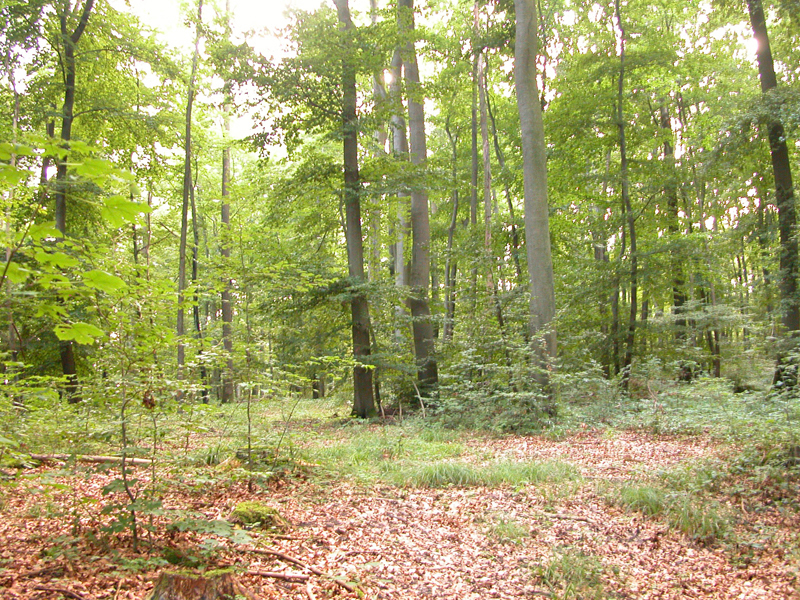
Figure 44.18図 44.18
Deciduous trees are the dominant plant in the temperate forest. (credit: Oliver Herold)
温帯林では落葉樹が優勢である。(出典:Oliver Herold)
The trees of the temperate forests leaf out and shade much of the ground; however, this biome is more open than tropical wet forests because most trees in the temperate forests do not grow as tall as the trees in tropical wet forests. The soils of the temperate forests are rich in inorganic and organic nutrients. This is due to the thick layer of leaf litter on forest floors, which does not develop in tropical rainforests. As this leaf litter decays, nutrients are returned to the soil. The leaf litter also protects soil from erosion, insulates the ground, and provides habitats for invertebrates (such as the pill bug or roly-poly, Armadillidium vulgare) and their predators, such as the red-backed salamander (Plethodon cinereus).
英語のヒント
温帯林の樹木が葉を広げると、地面の多くが日陰になる。それでも、ほとんどの樹木は熱帯湿潤林ほど高くならないため、このバイオームは熱帯湿潤林より開けている。温帯林の土壌は、無機・有機の栄養物質に富む。これは林床に厚い落葉の層ができるためで、熱帯雨林ではこのような層は発達しない。落葉が分解すると、栄養物質が土壌へ戻る。落葉の層は土壌を侵食から守り、地面を断熱し、オカダンゴムシ(Armadillidium vulgare)などの無脊椎動物や、アカセサンショウウオ(Plethodon cinereus)のような捕食者の生息場所にもなる。
Boreal Forests北方林
The boreal forest, also known as taiga or coniferous forest, is found south of the Arctic Circle and across most of Canada, Alaska, Russia, and northern Europe (Figure 44.12). This biome has cold, dry winters and short, cool, wet summers. The annual precipitation is from 40 cm to 100 cm (15.7–39 in) and usually takes the form of snow. Little evaporation occurs because of the cold temperatures.
英語のヒント
北方林はタイガまたは針葉樹林とも呼ばれ、北極圏の南に位置し、カナダ、アラスカ、ロシア、北ヨーロッパの大部分に広がる(図44.12)。寒く乾燥した冬と、短く涼しく湿った夏がある。年間降水量は40~100 cm(15.7~39インチ)で、多くは雪として降る。温度が低いため、蒸発はほとんど起こらない。
The long and cold winters in the boreal forest have led to the predominance of cold-tolerant cone-bearing (coniferous) plants. These are evergreen coniferous trees like pines, spruce, and fir, which retain their needle-shaped leaves year-round. Evergreen trees can photosynthesize earlier in the spring than deciduous trees because less energy from the sun is required to warm a needle-like leaf than a broad leaf. This benefits evergreen trees, which grow faster than deciduous trees in the boreal forest. In addition, soils in boreal forest regions tend to be acidic with little available nitrogen. Leaves are a nitrogen-rich structure and deciduous trees must produce a new set of these nitrogen-rich structures each year. Therefore, coniferous trees that retain nitrogen-rich needles may have a competitive advantage over the broad-leafed deciduous trees.
英語のヒント
北方林の長く寒い冬によって、寒さに強く球果をつける針葉樹が優勢となってきた。マツ、トウヒ、モミなどの常緑針葉樹で、針状の葉を一年中保つ。針状の葉を暖めるのに必要な太陽エネルギーは、広い葉より少ないため、常緑樹は落葉樹より早春から光合成できる。これは、北方林で落葉樹より速く成長する常緑樹に有利に働く。さらに、北方林の土壌は酸性で、利用できる窒素が少ない傾向がある。葉は窒素に富む構造で、落葉樹は毎年そのような葉を一から作らなければならない。そのため、窒素に富む針葉を保持する針葉樹は、広葉の落葉樹より競争上有利になる可能性がある。
The net primary productivity of boreal forests is lower than that of temperate forests and tropical wet forests. The above-ground biomass of boreal forests is high because these slow-growing tree species are long-lived and accumulate a large standing biomass over time. Plant species diversity is less than that seen in temperate forests and tropical wet forests. Boreal forests lack the pronounced elements of the layered forest structure seen in tropical wet forests. The structure of a boreal forest is often only a tree layer and a ground layer (Figure 44.19). When conifer needles are dropped, they decompose more slowly than broad leaves; therefore, fewer nutrients are returned to the soil to fuel plant growth.
英語のヒント
北方林の純一次生産力は、温帯林や熱帯湿潤林より低い。しかし、成長の遅い樹種が長寿で、時間とともに多くの現存バイオマスを蓄えるため、地上部バイオマスは多い。植物の種多様性は、温帯林や熱帯湿潤林より低い。北方林には、熱帯湿潤林に見られるような明瞭な階層構造がない。樹木層と地表層だけという場合が多い(図44.19)。針葉が落ちると、広い葉より分解が遅いため、植物の成長を支えるために土壌へ戻る栄養物質も少なくなる。
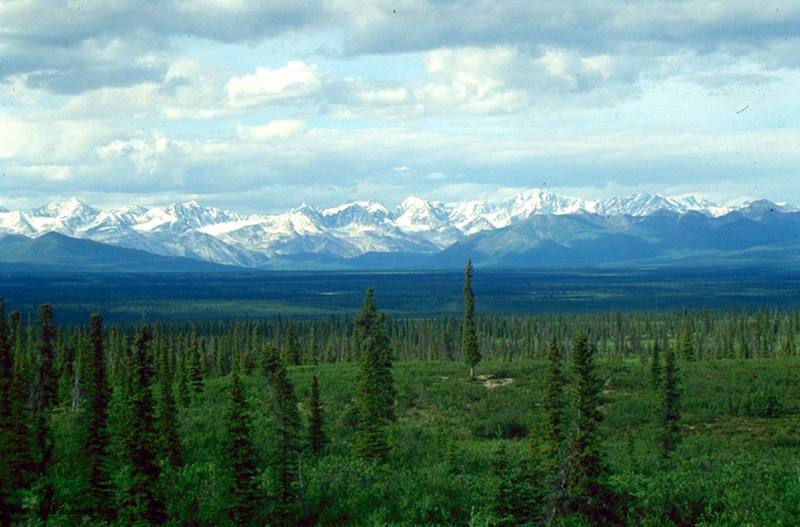


Figure 44.19図 44.19
The boreal forest (taiga) has low lying plants and conifer trees. (credit: L.B. Brubaker)
北方林(タイガ)には、背の低い植物と針葉樹がある。(出典:L.B. Brubaker)
Arctic Tundra北極ツンドラ
The Arctic tundra lies north of the subarctic boreal forest and is located throughout the Arctic regions of the northern hemisphere (Figure 44.12). The average winter temperature is –34 °C (–29.2 °F) and the average summer temperature is from 3 °C to 12 °C (37 °F–52 °F). Plants in the arctic tundra have a very short growing season of approximately 10–12 weeks.
英語のヒント
北極ツンドラは亜寒帯の北方林の北に位置し、北半球の北極地域に広く分布する(図44.12)。冬の平均気温は−34℃(−29.2℉)、夏の平均気温は3~12℃(37~52℉)である。植物の生育期は約10~12週間と非常に短い。
However, during this time, there are almost 24 hours of daylight and plant growth is rapid. The annual precipitation of the Arctic tundra is very low with little annual variation in precipitation. And, as in the boreal forests, there is little evaporation due to the cold temperatures.
英語のヒント
しかし、この時期にはほぼ24時間日光があり、植物は急速に成長する。北極ツンドラの年間降水量は非常に少なく、年ごとの変動も小さい。北方林と同じく、低温のため蒸発もほとんど起こらない。
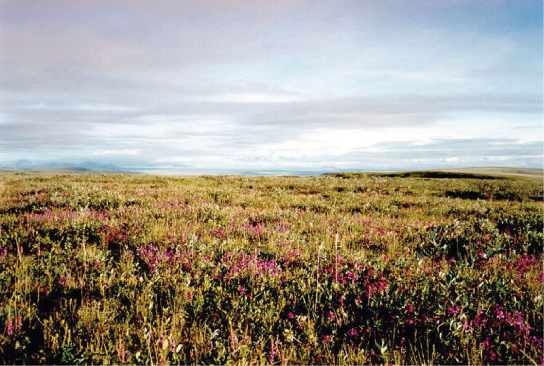
Plants in the Arctic tundra are generally low to the ground (Figure 44.20). There is little species diversity, low net primary productivity, and low above-ground biomass. The soils of the Arctic tundra may remain in a perennially frozen state referred to as permafrost. The permafrost makes it impossible for roots to penetrate deep into the soil and slows the decay of organic matter, which inhibits the release of nutrients from organic matter. During the growing season, the ground of the Arctic tundra can be completely covered with plants or lichens.
英語のヒント
北極ツンドラの植物は、一般に地面近くに低く生える(図44.20)。種多様性は低く、純一次生産力も地上部バイオマスも少ない。土壌は、永久凍土と呼ばれる、長年凍った状態を保つことがある。永久凍土によって根は土壌の深くまで入れず、有機物の分解も遅くなるため、有機物からの栄養物質の放出が抑えられる。生育期には、地面が植物や地衣類に完全に覆われることがある。
OpenStax, Rice University; Biology 2e. (credit: USFWS Arctic National Wildlife Refuge) · CC BY 4.0 · Source出典

Figure 44.20図 44.20
Low-growing plants such as shrub willow dominate the tundra landscape, shown here in the Arctic National Wildlife Refuge. (credit: USFWS Arctic National Wildlife Refuge)
北極圏国立野生生物保護区のこの景観のように、ツンドラでは低木のヤナギなど、背の低い植物が優勢である。(出典:USFWS Arctic National Wildlife Refuge)