第44章生態学と生物圏
44.1 The Scope of Ecology44.1 生態学の範囲
Learning Objectives学習目標
By the end of this section, you will be able to do the following:
この節を学ぶと、次のことができるようになる。
- Define ecology and the four basic levels of ecological research生態学と、生態学研究の基本的な4つの階層を定義する。
- Describe examples of the ways in which ecology requires the integration of different scientific disciplines生態学で異なる科学分野の統合が必要になる例を説明する。
- Distinguish between abiotic and biotic components of the environment環境の非生物的要素と生物的要素を区別する。
- Recognize the relationship between abiotic and biotic components of the environment環境の非生物的要素と生物的要素の関係を理解する。
Ecology is the study of the interactions of living organisms with their environment. One core goal of ecology is to understand the distribution and abundance of living things in the physical environment. Attainment of this goal requires the integration of scientific disciplines inside and outside of biology, such as mathematics, statistics, biochemistry, molecular biology, physiology, evolution, biodiversity, geology, and climatology.
英語のヒント
生態学は、生物と環境の相互作用を研究する学問である。中心的な目標の1つは、物理的環境における生物の分布と多さを理解することである。この目標を達成するには、数学、統計学、生化学、分子生物学、生理学、進化、生物多様性、地質学、気候学など、生物学の内外にある科学分野を統合する必要がある。
Levels of Ecological Study生態学で研究する階層
When a discipline such as biology is studied, it is often helpful to subdivide it into smaller, related areas. For instance, cell biologists interested in cell signaling need to understand the chemistry of the signal molecules (which are usually proteins) as well as the result of cell signaling. Ecologists interested in the factors that influence the survival of an endangered species might use mathematical models to predict how current conservation efforts affect endangered organisms.
英語のヒント
生物学のような学問を研究するとき、関連するより小さな領域へ細分すると役立つことが多い。例えば、細胞のシグナル伝達に関心をもつ細胞生物学者は、伝達の結果だけでなく、シグナル分子(通常はタンパク質)の化学も理解する必要がある。絶滅危惧種の生存に影響する要因に関心をもつ生態学者は、現在の保全活動が絶滅の危機にある生物へどう影響するかを予測するために、数学的モデルを使うことがある。
To produce a sound set of management options, a conservation biologist needs to collect accurate data, including current population size, factors affecting reproduction (like physiology and behavior), habitat requirements (such as plants and soils), and potential human influences on the endangered population and its habitat (which might be derived through studies in sociology and urban ecology). Within the discipline of ecology, researchers work at four general levels, which sometimes overlap. These levels are organism, population, community, and ecosystem (Figure 44.2).
英語のヒント
妥当な管理方策をまとめるために、保全生物学者は正確なデータを集める必要がある。現在の個体群サイズ、生殖に影響する要因(生理や行動など)、生息地の必要条件(植物や土壌など)、そして絶滅危惧個体群とその生息地への人間の潜在的な影響が含まれる。最後の情報は、社会学や都市生態学の研究から得られる場合もある。生態学の研究者は、おおむね4つの階層で研究する。これらはときに重なり合う。個体、個体群、群集、生態系という階層である(図44.2)。
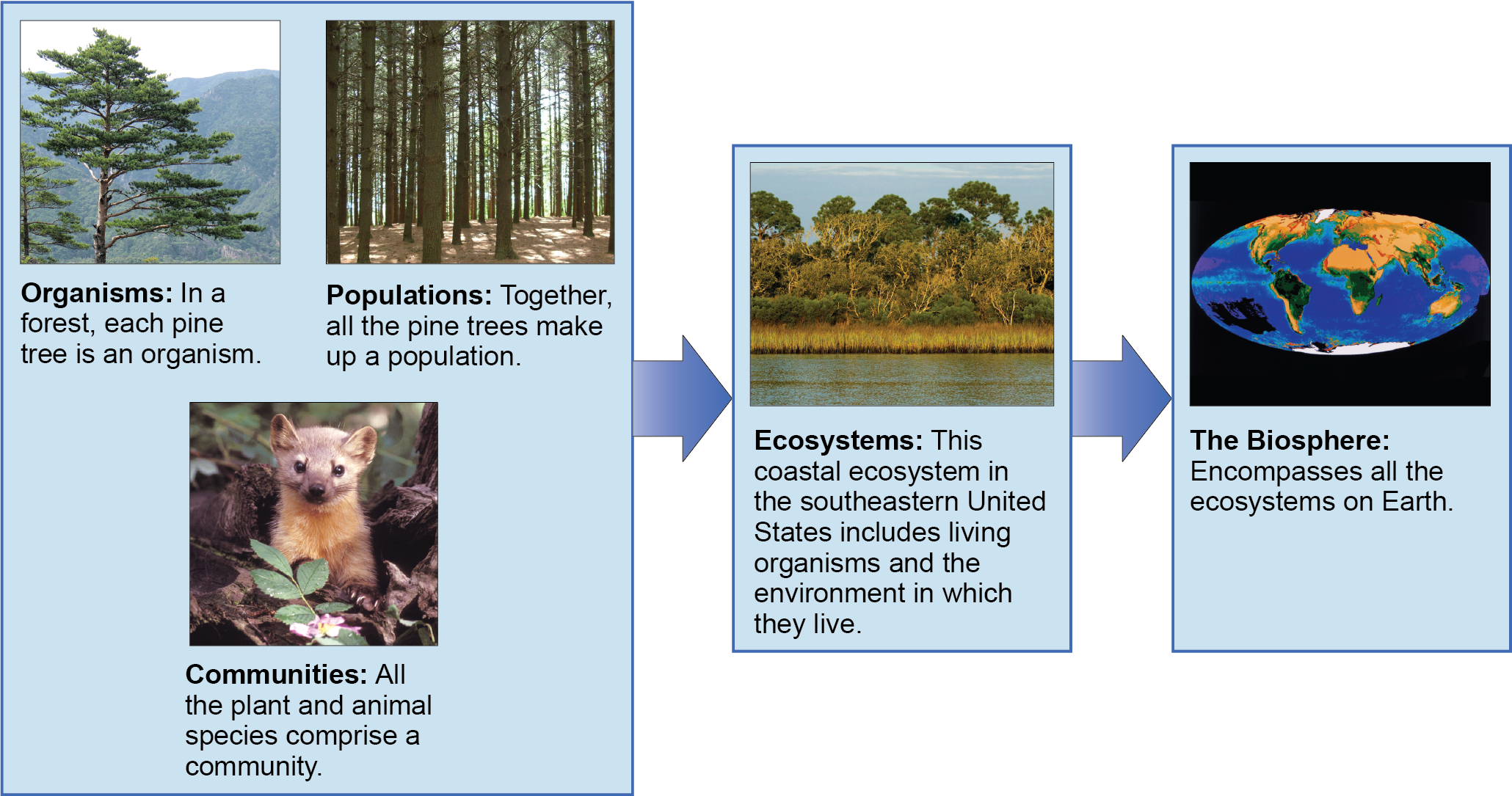
OpenStax, Rice University; Biology 2e. (credit “organisms”: modification of work by yeowatzup”/Flickr; credit “populations”: modification of work by "Crystl"/Flickr; credit “communities”: modification of work by US Fish and Wildlife Service; credit “ecosystems”: modification of work by Tom Carlisle, US Fish and Wildlife Service Headquarters; credit “biosphere”: NASA) · CC BY 4.0 · Source出典
Figure 44.2図 44.2
Ecologists study within several biological levels of organization. (credit “organisms”: modification of work by yeowatzup”/Flickr; credit “populations”: modification of work by "Crystl"/Flickr; credit “communities”: modification of work by US Fish and Wildlife Service; credit “ecosystems”: modification of work by Tom Carlisle, US Fish and Wildlife Service Headquarters; credit “biosphere”: NASA)
生態学者は、生物の組織化の複数の階層を研究する。(「個体」の出典:「yeowatzup」/Flickrの作品を改変。「個体群」の出典:「Crystl」/Flickrの作品を改変。「群集」の出典:US Fish and Wildlife Serviceの作品を改変。「生態系」の出典:Tom Carlisle、US Fish and Wildlife Service Headquartersの作品を改変。「生物圏」の出典:NASA)
Organismal Ecology個体生態学
Researchers studying ecology at the organismal level are interested in the adaptations that enable individuals to live in specific habitats. These adaptations can be morphological, physiological, and behavioral. For instance, the Karner blue butterfly (Lycaeides melissa samuelis) (Figure 44.3) is considered a specialist because the females only oviposit (that is, lay eggs) on wild lupine (Lupinus perennis). This specific requirement and adaptation means that the Karner blue butterfly is completely dependent on the presence of wild lupine plants for its survival.
英語のヒント
個体の階層で生態学を研究する人は、個体が特定の生息地で暮らせるようにする適応に関心をもつ。適応には、形態的、生理的、行動的なものがある。例えば、カーナーブルーというチョウ(Lycaeides melissa samuelis、図44.3)は、雌が野生のルピナス(Lupinus perennis)にしか産卵しないため、特殊化した生物とみなされる。この特有の必要条件と適応は、カーナーブルーの生存が、そのルピナスの存在に完全に依存することを意味する。
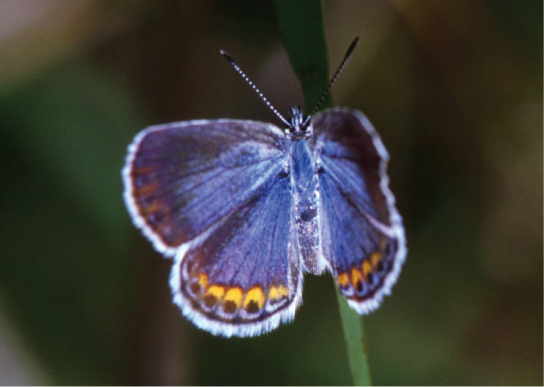
OpenStax, Rice University; Biology 2e. (credit: modification of work by J & K Hollingsworth, USFWS) · CC BY 4.0 · Source出典
Figure 44.3図 44.3
The Karner blue butterfly (Lycaeides melissa samuelis) is a rare butterfly that lives only in open areas with few trees or shrubs, such as pine barrens and oak savannas. It can only lay its eggs on lupine plants. (credit: modification of work by J & K Hollingsworth, USFWS)
カーナーブルー(Lycaeides melissa samuelis)は、マツの荒原やオークのサバンナなど、樹木や低木の少ない開けた場所だけに暮らす、まれなチョウである。ルピナスにしか産卵できない。(出典:J & K Hollingsworth、USFWSの作品を改変)
After hatching, the (first instar) caterpillars emerge and spend four to six weeks feeding solely on wild lupine (Figure 44.4). The caterpillars pupate as a chrysalis to undergo the final stage of metamorphosis and emerge as butterflies after about four weeks. The adult butterflies feed on the nectar of flowers of wild lupine and other plant species, such as milkweeds. Generally there are two broods of the Karner blue each year.
英語のヒント
孵化すると初齢幼虫が現れ、4~6週間、野生のルピナスだけを食べて過ごす(図44.4)。幼虫は蛹となって変態の最終段階を経て、約4週間後にチョウとして羽化する。成虫は、野生のルピナスやトウワタ類など、ほかの植物の花蜜を食べる。カーナーブルーは通常、年に2世代発生する。
A researcher interested in studying Karner blue butterflies at the organismal level might, in addition to asking questions about egg laying requirements, ask questions about the butterflies’ preferred thoracic flight temperature (a physiological question), or the behavior of the caterpillars when they are at different larval stages (a behavioral question).
英語のヒント
個体の階層でカーナーブルーを研究する人は、産卵の必要条件に加え、このチョウが飛ぶときに好む胸部の温度という生理学的な問いや、さまざまな幼虫齢での行動という行動学的な問いを立てるかもしれない。
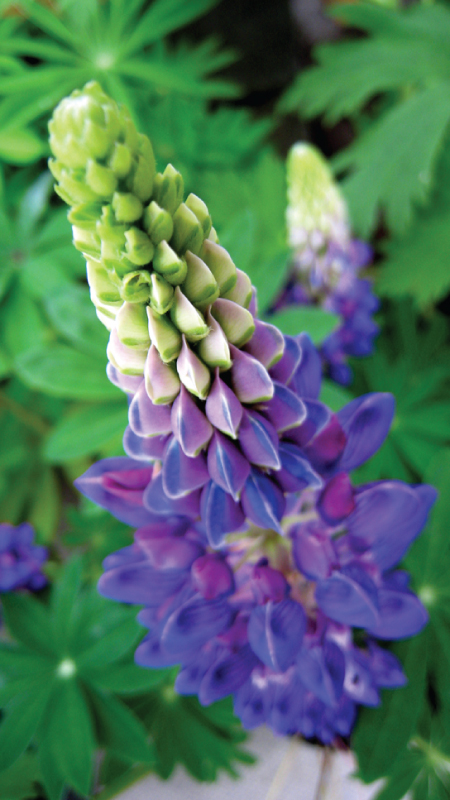


Figure 44.4図 44.4
The wild lupine (Lupinus perennis) is the only known host plant for the Karner blue butterfly.
野生のルピナス(Lupinus perennis)は、カーナーブルーの唯一知られている食草である。
Population Ecology個体群生態学
A population is a group of interbreeding organisms that are members of the same species living in the same area at the same time. (Organisms that are all members of the same species are called conspecifics.) A population is identified, in part, by where it lives, and its area of population may have natural or artificial boundaries. Natural boundaries might be rivers, mountains, or deserts, while artificial boundaries may be mowed grass, manmade structures, or roads. The study of population ecology focuses on the number of individuals in an area and how and why population size changes over time.
英語のヒント
個体群とは、同じ時に同じ地域に暮らし、互いに交配する、同じ種の生物の集まりである。同じ種に属する生物同士を同種個体という。個体群は、その生息場所によっても区別され、生息域には自然または人工の境界がある場合がある。自然の境界には河川、山、砂漠などが、人工の境界には刈られた草地、人工構造物、道路などがある。個体群生態学は、ある地域の個体数と、個体群サイズが時間とともにどのように、またなぜ変わるかに注目する。
For example, population ecologists are particularly interested in counting the Karner blue butterfly because it is classified as a federally endangered species. However, the distribution and density of this species is highly influenced by the distribution and abundance of wild lupine, and the biophysical environment around it. Researchers might ask questions about the factors leading to the decline of wild lupine and how these affect Karner blue butterflies. For example, ecologists know that wild lupine thrives in open areas where trees and shrubs are largely absent. In natural settings, intermittent wildfires regularly remove trees and shrubs, helping to maintain the open areas that wild lupine requires. Mathematical models can be used to understand how wildfire suppression by humans has led to the decline of this important plant for the Karner blue butterfly.
英語のヒント
例えば、カーナーブルーは連邦政府の絶滅危惧種に指定されているため、個体群生態学者はその個体数を数えることに特に関心をもつ。しかし、この種の分布と密度は、野生のルピナスの分布と多さ、およびその周囲の生物的・物理的環境に強く影響される。研究者は、野生のルピナスが減る原因と、それがカーナーブルーへどう影響するかを調べるかもしれない。ルピナスは、樹木や低木がほぼない開けた場所でよく育つ。自然環境では、間欠的な山火事が定期的に樹木や低木を取り除き、ルピナスに必要な開けた場所を維持する。数学的モデルを使えば、人間による山火事の抑制が、カーナーブルーにとって重要なこの植物の減少にどうつながったかを理解できる。