第44章生態学と生物圏
Energy Sourcesエネルギー源
Energy from the sun is captured by green plants, algae, cyanobacteria, and photosynthetic protists. These organisms convert solar energy into the chemical energy needed by all living things. Light availability can be an important force directly affecting the evolution of adaptations in photosynthesizers. For instance, plants in the understory of a temperate forest are shaded when the trees above them in the canopy completely leaf out in the late spring. Not surprisingly, understory plants have adaptations to successfully capture available light that passes through the canopy. One such adaptation is the rapid growth of spring ephemeral plants such as the spring beauty (Claytonia virginica) (Figure 44.8). These spring flowers achieve much of their growth and finish their life cycle (reproduce) early in the season before the trees in the canopy develop leaves.
英語のヒント
太陽のエネルギーは、緑色植物、藻類、シアノバクテリア、光合成をする原生生物によって取り込まれる。これらは太陽エネルギーを、すべての生物に必要な化学エネルギーへ変換する。利用できる光の量は、光合成生物の適応の進化に直接影響する重要な要因となり得る。例えば温帯林の林床の植物は、晩春に上の林冠の樹木が葉を完全に広げると、日陰になる。当然ながら、林床植物には、林冠を通過する利用可能な光をうまく取り込む適応がある。その1つは、スプリングビューティー(Claytonia virginica、図44.8)のような春植物の急速な成長である。こうした春の花は、林冠の樹木が葉を広げる前の季節の早い時期に、成長の多くを済ませ、生活環を終えて繁殖する。
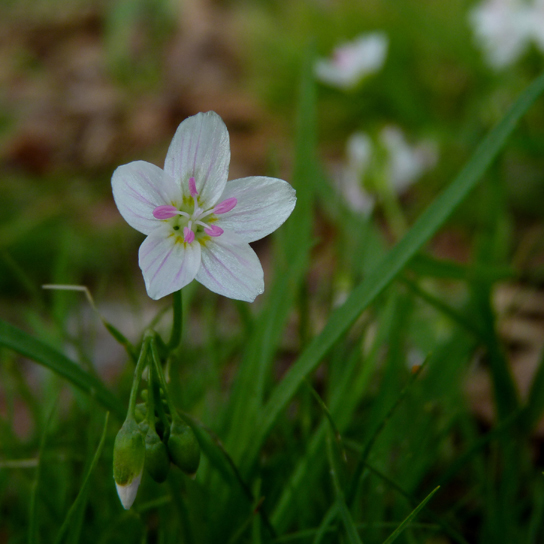
Figure 44.8図 44.8
The spring beauty is an ephemeral spring plant that flowers early in the spring to avoid competing with larger forest trees for sunlight. (credit: John Beetham)
スプリングビューティーは春の短期間だけ活動する植物で、日光をめぐって大きな森林樹木と競争するのを避けるため、早春に花を咲かせる。(出典:John Beetham)
In aquatic ecosystems, the availability of light may be limited because sunlight is absorbed by water, plants, suspended particles, and resident microorganisms. Toward the bottom of a lake, pond, or ocean, there is a zone that light cannot reach (because most wavelengths except for the shortest blues are absorbed by the water column). Photosynthesis cannot take place there and, as a result, a number of adaptations have evolved that enable living things to survive without light. For instance, aquatic plants have photosynthetic tissue near the surface of the water. You can think of the broad, floating leaves of a water lily—water lilies cannot survive without light. In environments such as hydrothermal vents, some bacteria extract energy from inorganic chemicals because there is no light for photosynthesis.
英語のヒント
水界生態系では、日光が水、植物、懸濁粒子、生息する微生物に吸収されるため、利用できる光が限られる場合がある。湖、池、海の底の方には、光が届かない層がある。短波長の青色光を除き、ほとんどの波長が水柱に吸収されるためである。そこでは光合成ができないので、生物が光なしで生存できるさまざまな適応が進化してきた。例えば、水生植物は水面近くに光合成組織をもつ。スイレンの広く浮かぶ葉を思い浮かべるとよい。スイレンは光なしでは生存できない。熱水噴出孔のような環境では、光合成に使える光がないため、一部の細菌は無機化合物からエネルギーを得る。
The availability of nutrients in aquatic systems such as oceans is also an important aspect of energy or photosynthesis. Many organisms sink to the bottom of the ocean when they die in the open water; when this occurs, the energy and nutrients found in that living organism are sequestered for some time unless ocean upwelling occurs. Ocean upwelling is the rising of deep ocean waters that occurs when prevailing winds blow along surface waters near a coastline (Figure 44.9). As the wind pushes ocean waters offshore, water from the bottom of the ocean moves up to replace this water. As a result, the energy and nutrients once contained in dead organisms become available for reuse by other living organisms.
英語のヒント
海のような水界での栄養物質の利用可能性も、エネルギーや光合成の重要な側面である。多くの生物は外洋で死ぬと海底へ沈む。その生物に含まれていたエネルギーと栄養物質は、海洋の湧昇が起こらない限り、しばらく隔離される。海洋の湧昇とは、海岸近くの表面水に沿って卓越風が吹くときに起こる、深層水の上昇である(図44.9)。風が海水を沖へ押し出すと、海底の水が上昇して入れ替わる。その結果、死んだ生物に含まれていたエネルギーと栄養物質が、ほかの生物に再び利用されるようになる。
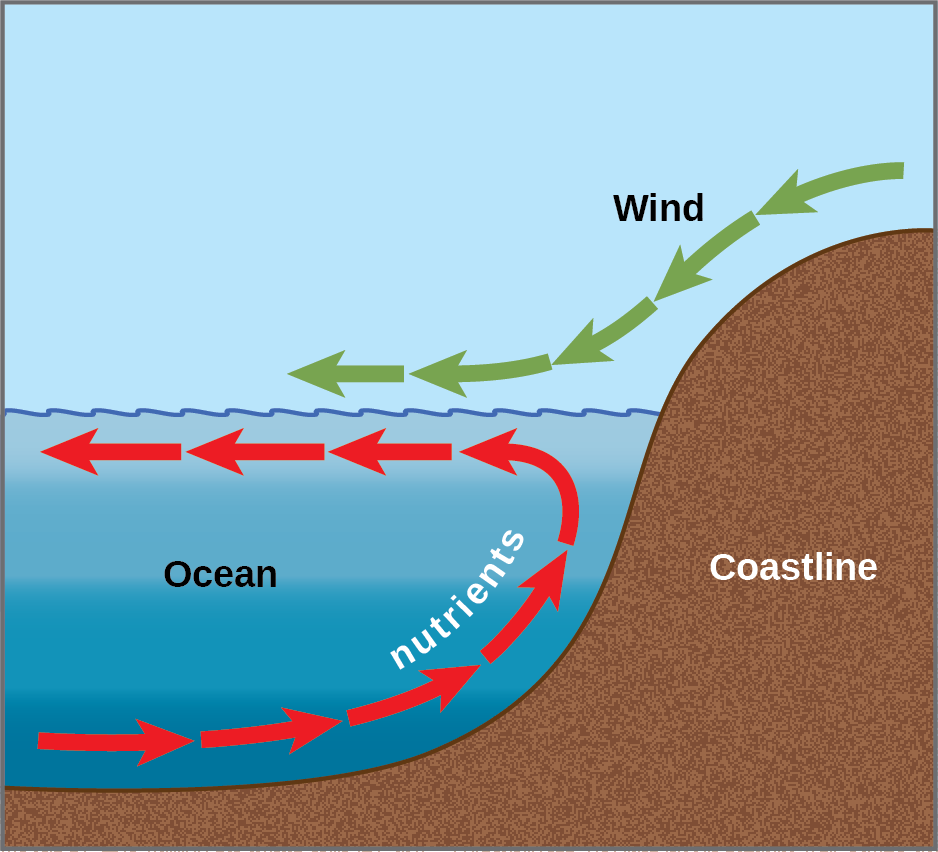


Figure 44.9図 44.9
Ocean upwelling is an important process that recycles nutrients and energy in the ocean. As wind (green arrows) pushes offshore, it causes water from the ocean bottom (red arrows) to move to the surface, bringing up nutrients from the ocean depths.
海洋の湧昇は、海で栄養物質とエネルギーを循環させる重要な過程である。風(緑の矢印)が沖へ押すと、海底の水(赤の矢印)が表層へ移り、深海の栄養物質を運び上げる。
In freshwater systems, such as lakes, the recycling of nutrients occurs in response to air temperature and wind changes. The nutrients at the bottom of lakes are recycled twice each year: in the spring and fall turnover. The spring-and-fall turnover are seasonal processes that recycle nutrients and oxygen from the bottom of a freshwater lake to the top of the lake (Figure 44.10). These turnovers are caused by the formation of a thermocline: layers of water with temperatures that are significantly different from those above and below it.
英語のヒント
湖などの淡水系では、気温と風の変化に応じて栄養物質が再循環する。湖底の栄養物質は、毎年2回、春と秋の全循環で再循環する。春と秋の全循環は、淡水湖の底から表層へ、栄養物質と酸素を循環させる季節的な過程である(図44.10)。この循環は、上下の水と温度が大きく異なる水の層、すなわち水温躍層の形成によって起こる。
In wintertime, the surface of lakes found in many northern regions is frozen. However, the water under the ice is slightly warmer, and the water at the bottom of the lake is warmer yet at 4 °C to 5 °C (39.2 °F to 41 °F). Water is densest at about 4 °C; therefore, the deepest water is also the densest. The deepest water is oxygen-poor because the decomposition of organic material at the bottom of the lake uses up available oxygen that cannot be replaced by means of oxygen diffusion into the surface of the water, due to the surface ice layer.
英語のヒント
冬には、北方の多くの地域で湖面が凍る。しかし氷の下の水はやや暖かく、湖底の水はさらに暖かい4~5℃(39.2~41℉)である。水は約4℃で最も密度が高いため、最深部の水が最も高密度になる。最深部の水は酸素に乏しい。湖底の有機物の分解が利用可能な酸素を使い尽くし、表面の氷の層のため、水面からの酸素の拡散によって補えないからである。
In springtime, air temperatures increase and surface ice melts. When the temperature of the surface water begins to approach 4 °C, the water becomes heavier and sinks to the bottom. The water at the bottom of the lake is then displaced by the heavier and denser surface water and, thus, rises to the top. As that water rises to the top, the sediments and nutrients from the lake bottom are brought along with it. This is called the spring turnover. During the summer months, the lake water stratifies, or forms layers, with the warmest water at the lake surface.
英語のヒント
春に気温が上がると、表面の氷が融ける。表面水の温度が4℃に近づき始めると、水は重くなって底へ沈む。湖底の水は、より重く密度の高い表面水によって押しのけられ、上へ上がる。その際、湖底の堆積物と栄養物質も一緒に運ばれる。これを春の全循環という。夏の間、湖水は成層し、つまり層に分かれ、湖面に最も暖かい水が位置する。
As air temperatures drop in the fall, the temperature of the lake water cools to 4 °C; therefore, this causes fall turnover as the heavy cold water sinks and displaces the water at the bottom. The oxygen-rich water at the surface of the lake then moves to the bottom of the lake, while the nutrients at the bottom of the lake rise to the surface (Figure 44.10). During the winter, the oxygen at the bottom of the lake is used by decomposers and other organisms requiring oxygen, such as fish. It is important to note, however, that the relative transparency of ice also allows the penetration of the shorter wavelengths of visible light so that photosynthesis, especially by algae can continue.
英語のヒント
秋に気温が下がると、湖水は4℃まで冷える。重い冷水が沈んで湖底の水を押しのけるため、秋の全循環が起こる。湖面の酸素に富む水が湖底へ移り、湖底の栄養物質は表層へ上がる(図44.10)。冬の間、湖底の酸素は、分解者や、魚など酸素を必要とするほかの生物に使われる。ただし、氷は比較的透明なので、可視光の短い波長も透過し、特に藻類の光合成が続けられる点に注意することが重要である。