第44章生態学と生物圏
Current and Past Drivers of Global Climate Change現在と過去の、地球規模の気候変動を引き起こす要因
Because it is not possible to go back in time to directly observe and measure climate, scientists must use indirect evidence to determine the drivers, or factors, that may be responsible for climate change. The indirect evidence includes data collected using ice cores, boreholes (a narrow shaft bored into the ground), tree rings, glacier lengths, pollen remains, and ocean sediments. The data shows a correlation between the timing of temperature changes and drivers of climate change. Before the Industrial Era (pre-1780), there were three drivers of climate change that were not related to human activity or atmospheric gases. The first of these is the Milankovitch cycles. The Milankovitch cycles describe the effects of slight changes in the Earth’s orbit on Earth’s climate. The length of the Milankovitch cycles ranges between 19,000 and 100,000 years. In other words, one could expect to see some predictable changes in the Earth’s climate associated with changes in the Earth’s orbit at a minimum of every 19,000 years.
英語のヒント
過去に戻って気候を直接観測・測定することはできないため、科学者は間接的な証拠から、気候変動の原因となりうる要因を特定しなければならない。証拠には、氷床コア、ボーリング孔(地面に掘った細い縦穴)、年輪、氷河の長さ、花粉の遺存体、海底堆積物から得られたデータがある。これらは、気温変化の時期と、気候変動を引き起こす要因との相関を示している。工業化時代以前(1780年より前)には、人間活動や大気中の気体とは関係しない、3つの気候変動要因があった。1つ目はミランコビッチ・サイクルである。これは、地球の軌道のわずかな変化が気候に与える影響を表す。周期の長さは19,000〜100,000年である。つまり、少なくとも19,000年ごとに、軌道の変化に伴う予測可能な気候の変化が起こると考えられる。
The variation in the sun’s intensity is the second natural factor responsible for climate change. Solar intensity is the amount of solar power or energy the sun emits in a given amount of time. There is a direct relationship between solar intensity and temperature. As solar intensity increases (or decreases), the Earth’s temperature correspondingly increases (or decreases). Changes in solar intensity have been proposed as one of several possible explanations for the Little Ice Age.
英語のヒント
太陽放射の強さの変動が、気候変動の2つ目の自然要因である。太陽放射の強さとは、一定時間に太陽が放出する放射エネルギーの量をいう。これは気温と直接関係する。太陽放射が強くなる(または弱くなる)と、地球の気温もそれに応じて上がる(または下がる)。太陽放射の強さの変化は、小氷期の原因として考えられるいくつかの説明の1つとして提案されている。
Finally, volcanic eruptions are a third natural driver of climate change. Volcanic eruptions can last a few days, but the solids and gases released during an eruption can influence the climate over a period of a few years, causing short-term climate changes. The gases and solids released by volcanic eruptions can include carbon dioxide, water vapor, sulfur dioxide, hydrogen sulfide, hydrogen, and carbon monoxide. Generally, volcanic eruptions cool the climate. This occurred in 1783 when volcanoes in Iceland erupted and caused the release of large volumes of sulfuric oxide. This led to haze-effect cooling, a global phenomenon that occurs when dust, ash, or other suspended particles block out sunlight and trigger lower global temperatures as a result; haze-effect cooling usually extends for one or more years before dissipating in intensity. In Europe and North America, haze-effect cooling produced some of the lowest average winter temperatures on record in 1783 and 1784.
英語のヒント
最後に、火山噴火が3つ目の自然要因である。噴火自体は数日で終わることもあるが、放出された固体や気体は数年間にわたって気候に影響し、短期的な気候変動を起こしうる。放出物には二酸化炭素、水蒸気、二酸化硫黄、硫化水素、水素、一酸化炭素などが含まれる。一般に、火山噴火は気候を寒冷化させる。1783年にはアイスランドの火山が噴火し、大量の硫黄酸化物を放出した。その結果、もやによる寒冷化が起こった。これは、塵、火山灰、その他の浮遊粒子が日光を遮り、世界の気温を低下させる現象で、通常は1年以上続いたのちに弱まる。ヨーロッパと北米では、この作用によって、1783年と1784年の冬の平均気温が、記録上最も低い水準の一部となった。
Greenhouse gases are probably the most significant drivers of the climate. When heat energy from the sun strikes the Earth, gases known as greenhouse gases trap the heat in the atmosphere, in a similar manner as do the glass panes of a greenhouse keep heat from escaping. The greenhouse gases that affect Earth include carbon dioxide, methane, water vapor, nitrous oxide, and ozone. Approximately half of the radiation from the sun passes through these gases in the atmosphere and strikes the Earth. This radiation is converted into thermal (infrared) radiation on the Earth’s surface, and then a portion of that energy is re-radiated back into the atmosphere. Greenhouse gases, however, reflect much of the thermal energy back to the Earth’s surface. The more greenhouse gases there are in the atmosphere, the more thermal energy is reflected back to the Earth’s surface, heating it up and the atmosphere immediately above it. Greenhouse gases absorb and emit radiation and are an important factor in the greenhouse effect: the warming of Earth due to carbon dioxide and other greenhouse gases in the atmosphere.
英語のヒント
温室効果ガスは、おそらく気候を左右する最も重要な要因である。太陽の熱エネルギーが地球へ届くと、温室効果ガスと呼ばれる気体が大気中に熱を閉じ込める。温室のガラス板が熱の流出を防ぐのと似ている。地球に影響する温室効果ガスには、二酸化炭素、メタン、水蒸気、亜酸化窒素、オゾンがある。太陽からの放射の約半分は、大気中のこれらの気体を通過して地球へ届く。地表で熱放射(赤外線)に変わり、そのエネルギーの一部は大気へ再放射される。しかし、温室効果ガスは熱エネルギーの多くを地表へ反射して戻す。大気中の温室効果ガスが多いほど、地表へ戻る熱エネルギーも多くなり、地表とそのすぐ上の大気を暖める。温室効果ガスは放射を吸収・放出し、温室効果の重要な要因となる。温室効果とは、大気中の二酸化炭素やその他の温室効果ガスによって地球が暖められることである。
Direct evidence supports the relationship between atmospheric concentrations of carbon dioxide and temperature: as carbon dioxide rises, global temperature rises. Since 1950, the concentration of atmospheric carbon dioxide has increased from about 280 ppm to 382 ppm in 2006. In 2011, the atmospheric carbon dioxide concentration was 392 ppm. However, the planet would not be inhabitable by current life forms if water vapor did not produce its drastic greenhouse warming effect.
英語のヒント
直接的な証拠は、大気中の二酸化炭素濃度と気温の関係を裏付けている。二酸化炭素が増えるにつれて、世界の気温も上がる。1950年以降、大気中の二酸化炭素濃度は約280 ppmから、2006年には382 ppmへ増えた。2011年には392 ppmだった。もっとも、水蒸気による強い温室効果がなければ、現在の生命体が地球に生息することはできない。
Scientists look at patterns in data and try to explain differences or deviations from these patterns. The atmospheric carbon dioxide data reveal a historical pattern of carbon dioxide increasing and decreasing, cycling between a low of 180 ppm and a high of 300 ppm. Scientists have concluded that it took around 50,000 years for the atmospheric carbon dioxide level to increase from its low minimum concentration to its higher maximum concentration. However, beginning only a few centuries ago, atmospheric carbon dioxide concentrations have increased beyond the historical maximum of 300 ppm. The current increases in atmospheric carbon dioxide have happened very quickly—in a matter of hundreds of years rather than thousands of years. What is the reason for this difference in the rate of change and the amount of increase in carbon dioxide? A key factor that must be recognized when comparing the historical data and the current data is the presence and industrial activities of modern human society; no other driver of climate change has yielded changes in atmospheric carbon dioxide levels at this rate or to this magnitude.
英語のヒント
科学者はデータのパターンを調べ、それと異なる点や、そこからのずれを説明しようとする。大気中の二酸化炭素のデータは、過去に180 ppmの低値から300 ppmの高値まで増減を繰り返してきたことを示す。科学者は、最低濃度から最高濃度への増加には約5万年かかったと結論付けている。ところが、ほんの数世紀前から、大気中の二酸化炭素濃度は、過去の最大値である300 ppmを超えて増加している。現在の増加は非常に速く、数千年ではなく、わずか数百年で起こった。変化の速さと増加量がこれほど異なる理由は何か。過去と現在のデータを比較するときに認識すべき重要な要因は、現代の人間社会の存在と、その産業活動である。ほかの気候変動要因は、これほどの速度や規模で大気中の二酸化炭素濃度を変化させてはいない。
Human activity releases carbon dioxide and methane, two of the most important greenhouse gases, into the atmosphere in several ways. The primary mechanism that releases carbon dioxide is the burning of fossil fuels, such as gasoline, coal, and natural gas (Figure 44.29). Deforestation, cement manufacture, animal agriculture, the clearing of land, and the burning of forests are other human activities that release carbon dioxide. Methane (CH4) is produced when bacteria break down organic matter under anaerobic conditions. Anaerobic conditions can happen when organic matter is trapped underwater (such as in rice paddies) or in the intestines of herbivores. Methane can also be released from natural gas fields and the decomposition of animal and plant material that occurs in landfills. Another source of methane is the melting of clathrates. Clathrates are frozen chunks of ice and methane found at the bottom of the ocean. When water warms, these chunks of ice melt and methane is released. As the ocean’s water temperature increases, the rate at which clathrates melt is increasing, releasing even more methane. This leads to increased levels of methane in the atmosphere, which further accelerates the rate of global warming. This is an example of the positive feedback loop that is leading to the rapid rate of increase of global temperatures.
英語のヒント
人間活動は、特に重要な2つの温室効果ガスである二酸化炭素とメタンを、いくつかの方法で大気中へ放出する。二酸化炭素を放出する主要な仕組みは、ガソリン、石炭、天然ガスなどの化石燃料の燃焼である(図44.29)。森林伐採、セメント製造、畜産、土地の開墾、森林の焼却も、二酸化炭素を放出する人間活動である。メタン(CH4)は、嫌気条件下で細菌が有機物を分解すると生じる。水田のように有機物が水中に閉じ込められた場合や、草食動物の腸内で、嫌気条件が生じうる。メタンは天然ガス田から、また埋立地での動植物の分解からも放出される。もう1つの発生源は、クラスレートの融解である。クラスレートは海底にある、氷とメタンが凍った塊である。水が温まると塊が融け、メタンが放出される。海水温が上がるにつれて融ける速度が増し、さらに多くのメタンが放出される。これにより大気中のメタンが増え、地球温暖化がさらに加速する。これは、世界の気温の急速な上昇につながる正のフィードバックの例である。
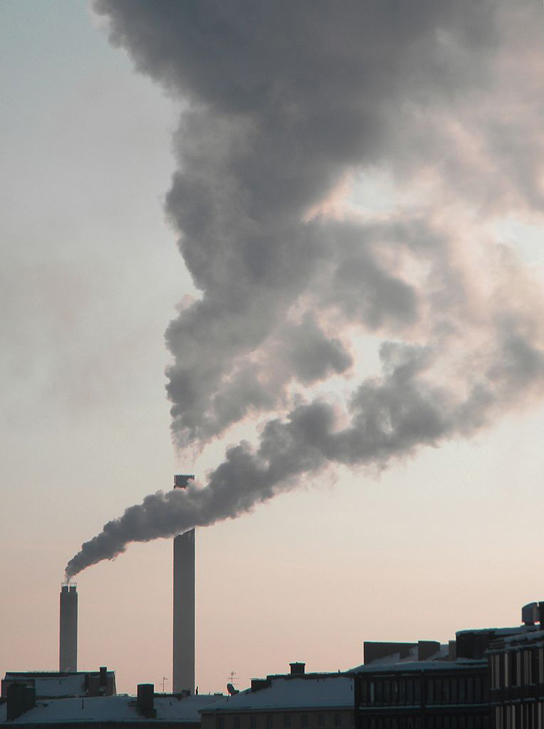

Figure 44.29図 44.29
The burning of fossil fuels in industry and by vehicles releases carbon dioxide and other greenhouse gases into the atmosphere. (credit: “Pöllö”/Wikimedia Commons)
産業活動や車両での化石燃料の燃焼は、二酸化炭素やその他の温室効果ガスを大気中へ放出する。(出典:“Pöllö”/Wikimedia Commons)