第10章細胞の増殖
10.3 Control of the Cell Cycle10.3 細胞周期の制御
Learning Objectives学習目標
By the end of this section, you will be able to do the following:
この節を学び終えると、次のことができるようになる。
- Understand how the cell cycle is controlled by mechanisms that are both internal and external to the cell細胞内外のしくみによって細胞周期が制御されることを理解する。
- Explain how the three internal “control checkpoints” occur at the end of G1, at the G2/M transition, and during metaphaseG1期の終わり、G2/M移行時、中期にある三つの内部チェックポイントの働きを説明する。
- Describe the molecules that control the cell cycle through positive and negative regulation正と負の調節によって細胞周期を制御する分子を説明する。
The length of the cell cycle is highly variable, even within the cells of a single organism. In humans, the frequency of cell turnover ranges from a few hours in early embryonic development, to an average of two to five days for epithelial cells, and to an entire human lifetime spent in G0 by specialized cells, such as cortical neurons or cardiac muscle cells.
英語のヒント
細胞周期の長さは、同じ生物の体内の細胞でも大きく異なる。ヒトの細胞の入れ替わりの間隔は、胚発生初期の数時間から、上皮細胞の平均2〜5日までさまざまである。大脳皮質のニューロンや心筋細胞などの特殊化した細胞は、ヒトの一生を通じてG0期にとどまる。
There is also variation in the time that a cell spends in each phase of the cell cycle. When rapidly dividing mammalian cells are grown in a culture (outside the body under optimal growing conditions), the length of the cell cycle is about 24 hours. In rapidly dividing human cells with a 24-hour cell cycle, the G1 phase lasts approximately nine hours, the S phase lasts 10 hours, the G2 phase lasts about four and one-half hours, and the M phase lasts approximately one-half hour. By comparison, in fertilized eggs (and early embryos) of fruit flies, the cell cycle is completed in about eight minutes. This is because the nucleus of the fertilized egg divides many times by mitosis but does not go through cytokinesis until a multinucleate “zygote” has been produced, with many nuclei located along the periphery of the cell membrane, thereby shortening the time of the cell division cycle. The timing of events in the cell cycle of both “invertebrates” and “vertebrates” is controlled by mechanisms that are both internal and external to the cell.
英語のヒント
各段階に費やす時間にも違いがある。速く分裂する哺乳類の細胞を、体外の最適な条件で培養すると、細胞周期は約24時間となる。24時間周期で速く分裂するヒトの細胞では、G1期は約9時間、S期は10時間、G2期は約4時間半、M期は約30分続く。対照的に、ショウジョウバエの受精卵と初期胚では、細胞周期は約8分で完了する。受精卵の核が有糸分裂を何度も繰り返す一方、細胞膜周辺に多数の核が並ぶ多核の「接合子」ができるまで細胞質分裂が起こらないため、分裂周期の時間が短くなる。「無脊椎動物」と「脊椎動物」のどちらでも、細胞周期の出来事の時期は、細胞内外のしくみによって制御される。
Regulation of the Cell Cycle by External Events細胞外の出来事による細胞周期の調節
Both the initiation and inhibition of cell division are triggered by events external to the cell when it is about to begin the replication process. An event may be as simple as the death of nearby cells or as sweeping as the release of growth-promoting hormones, such as human growth hormone (HGH or hGH). A lack of HGH can inhibit cell division, resulting in dwarfism, whereas too much HGH can result in gigantism. Crowding of cells can also inhibit cell division. In contrast, a factor that can initiate cell division is the size of the cell: As a cell grows, it becomes physiologically inefficient due to its decreasing surface-to-volume ratio. The solution to this problem is to divide.
英語のヒント
細胞が複製を始めようとしているとき、細胞外の出来事が細胞分裂の開始と抑制のどちらも引き起こす。出来事は、近隣細胞の死のように単純なものから、ヒト成長ホルモン(HGHまたはhGH)のような成長促進ホルモンの放出という広範なものまである。HGHが不足すると細胞分裂が抑えられて小人症を生じることがあり、多すぎると巨人症を生じうる。細胞が密集していることも分裂を抑える。逆に、分裂の開始要因となりうるのが細胞の大きさである。細胞が成長すると、体積に対する表面積の比が低下し、生理的な効率が悪くなる。この問題の解決方法が分裂である。
Whatever the source of the message, the cell receives the signal, and a series of events within the cell allows it to proceed into interphase. Moving forward from this initiation point, every parameter required during each cell cycle phase must be met or the cycle cannot progress.
英語のヒント
情報の出所が何であれ、細胞がシグナルを受け取り、内部の一連の出来事によって間期へ進めるようになる。この開始点から先へ進むには、細胞周期の各段階で必要なすべての条件を満たさなければならず、満たさなければ周期は進まない。
Regulation at Internal Checkpoints内部のチェックポイントでの調節
It is essential that the daughter cells produced be exact duplicates of the parent cell. Mistakes in the duplication or distribution of the chromosomes lead to mutations that may be passed forward to every new cell produced from an abnormal cell. To prevent a compromised cell from continuing to divide, there are internal control mechanisms that operate at three main cell-cycle checkpoints: A checkpoint is one of several points in the eukaryotic cell cycle at which the progression of a cell to the next stage in the cycle can be halted until conditions are favorable. These checkpoints occur near the end of G1, at the G2/M transition, and during metaphase (Figure 10.11).
英語のヒント
作られる娘細胞が親細胞の正確な複製であることは不可欠である。染色体の複製や分配の誤りは変異につながり、異常な細胞から作られるすべての新しい細胞へ受け継がれることがある。問題を抱えた細胞が分裂し続けるのを防ぐため、細胞周期の三つの主要なチェックポイントで内部制御のしくみが働く。チェックポイントは、真核生物の細胞周期で、条件が整うまで次の段階への進行を止められる複数の地点の一つである。これらはG1期の終わり近く、G2/M移行時、そして中期にある(図10.11)。
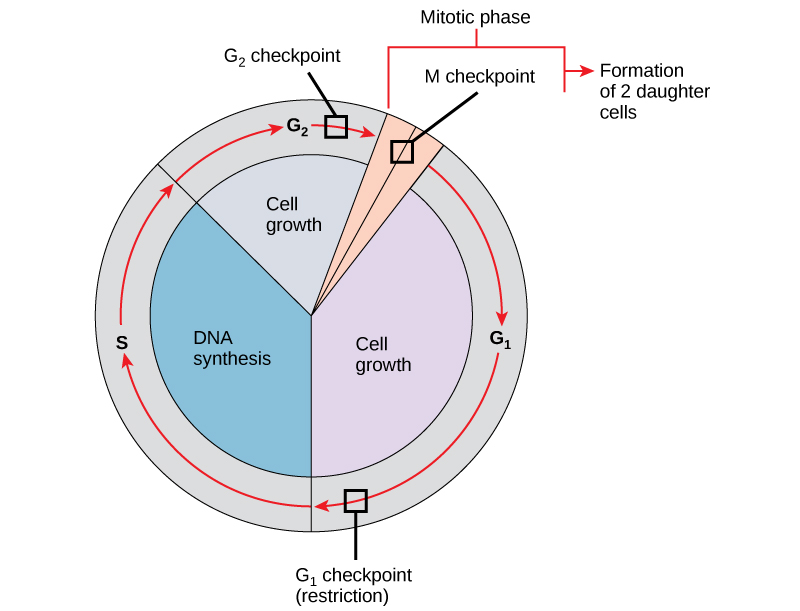

Figure 10.11図 10.11
The cell cycle is controlled at three checkpoints. The integrity of the DNA is assessed at the G1 checkpoint. Proper chromosome duplication is assessed at the G2 checkpoint. Attachment of each kinetochore to a spindle fiber is assessed at the M checkpoint.
細胞周期は三つのチェックポイントで制御される。G1チェックポイントではDNAの完全性を、G2チェックポイントでは染色体が適切に複製されたかを調べる。Mチェックポイントでは各動原体に紡錘糸が付着しているかを調べる。
The G1 CheckpointG1チェックポイント
The G1 checkpoint determines whether all conditions are favorable for cell division to proceed. The G1 checkpoint, also called the restriction point (in yeast), is a point at which the cell irreversibly commits to the cell division process. External influences, such as growth factors, play a large role in carrying the cell past the G1 checkpoint. In addition to adequate reserves and cell size, there is a check for genomic DNA damage at the G1 checkpoint. A cell that does not meet all the requirements will not be allowed to progress into the S phase. The cell can halt the cycle and attempt to remedy the problematic condition, or the cell can advance into G0 and await further signals when conditions improve.
英語のヒント
G1チェックポイントは、細胞分裂を進めるための条件がすべて整ったかを判断する。G1チェックポイントは、酵母では制限点とも呼ばれ、細胞が不可逆的に分裂過程へ進むことを決める地点である。成長因子などの外部の影響は、細胞がG1チェックポイントを越えるうえで大きな役割を果たす。G1チェックポイントでは、十分な備蓄と細胞サイズに加え、ゲノムDNAの損傷も調べる。すべての条件を満たさない細胞はS期に進めない。周期を止めて問題のある状態の修復を試みることも、G0期に入って、条件が改善した際の追加のシグナルを待つこともできる。