第10章細胞の増殖
10.4 Cancer and the Cell Cycle10.4 がんと細胞周期
Learning Objectives学習目標
By the end of this section, you will be able to do the following:
この節を学び終えると、次のことができるようになる。
- Describe how cancer is caused by uncontrolled cell growth制御されない細胞増殖によってがんが起こるしくみを説明する。
- Understand how proto-oncogenes are normal cell genes that, when mutated, become oncogenesがん原遺伝子は正常な細胞の遺伝子で、変異するとがん遺伝子になることを理解する。
- Describe how tumor suppressors functionがん抑制因子の働きを説明する。
- Explain how mutant tumor suppressors cause cancer変異したがん抑制因子ががんを起こすしくみを説明する。
Cancer comprises many different diseases caused by a common mechanism: uncontrolled cell growth. Despite the redundancy and overlapping levels of cell-cycle control, errors do occur. One of the critical processes monitored by the cell-cycle checkpoint surveillance mechanism is the proper replication of DNA during the S phase. Even when all of the cell-cycle controls are fully functional, a small percentage of replication errors (mutations) will be passed on to the daughter cells. If changes to the DNA nucleotide sequence occur within a coding portion of a gene and are not corrected, a gene mutation results. All cancers start when a gene mutation gives rise to a faulty protein that plays a key role in cell reproduction.
英語のヒント
がんは、制御されない細胞増殖という共通のしくみによって起こる多くの異なる病気を含む。細胞周期の制御は重複し、多層になっているが、それでも誤りは起こる。チェックポイントの監視機構が確認する重要な過程の一つは、S期の正確なDNA複製である。すべての制御が完全に働いていても、わずかな割合の複製誤り、すなわち変異は娘細胞へ伝わる。遺伝子のコード領域でDNAのヌクレオチド配列が変わり、訂正されなければ遺伝子変異となる。すべてのがんは、遺伝子変異によって、細胞増殖で重要な役割を持つタンパク質に欠陥が生じることから始まる。
The change in the cell that results from the malformed protein may be minor: perhaps a slight delay in the binding of Cdk to cyclin or an Rb protein that detaches from its target DNA while still phosphorylated. Even minor mistakes, however, may allow subsequent mistakes to occur more readily. Over and over, small uncorrected errors are passed from the parent cell to the daughter cells and amplified as each generation produces more non-functional proteins from uncorrected DNA damage. Eventually, the pace of the cell cycle speeds up as the effectiveness of the control and repair mechanisms decreases. Uncontrolled growth of the mutated cells outpaces the growth of normal cells in the area, and a tumor (“-oma”) can result.
英語のヒント
異常な形のタンパク質が細胞に起こす変化は小さいかもしれない。例えばCdkのサイクリンへの結合が少し遅れたり、Rbがリン酸化されたまま標的DNAから離れたりする程度である。しかし小さな誤りであっても、その後の誤りを起こりやすくする。訂正されない小さな誤りは親細胞から娘細胞へ繰り返し伝わり、世代を重ねるごとに、未修復のDNA損傷から機能しないタンパク質が増えて増幅される。やがて制御と修復のしくみの効き目が弱まるにつれ、細胞周期の進行が速くなる。変異した細胞の無制御な増殖が周囲の正常細胞の増殖を上回ると、腫瘍(語尾「-oma」)ができることがある。
OpenStax, Rice University; Biology 2e. Credit: Rao, A. and Ryan, K. Department of Biology, Texas A&M University. · CC BY 4.0 · Source出典

Figure 10.15図 10.15
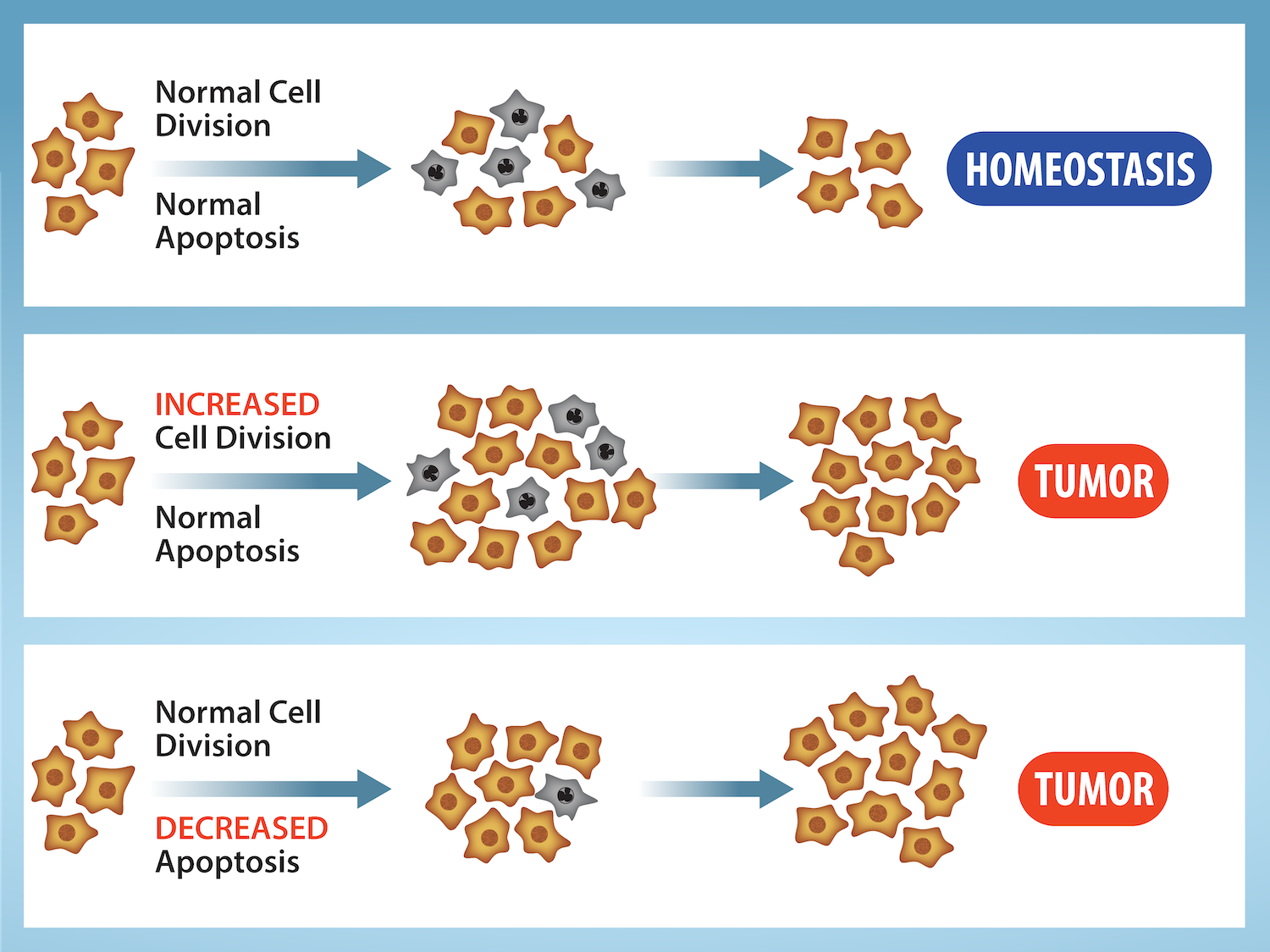
Cell Division and Apoptosis. In an adult organism, normal cell division is balanced by apoptosis (programmed cell death) to maintain a constant cell number in homeostasis. Either an increase in cell division or a decrease in apoptosis leads an increase in the number of cells and tumor formation. Credit: Rao, A. and Ryan, K. Department of Biology, Texas A&M University.
細胞分裂とアポトーシス。成体では、正常な細胞分裂とプログラムされた細胞死であるアポトーシスが釣り合い、恒常性によって細胞数を一定に保つ。細胞分裂の増加またはアポトーシスの減少は、細胞数の増加と腫瘍形成につながる。出典:Rao, A.、Ryan, K.、テキサスA&M大学生物学科。
Proto-oncogenesがん原遺伝子
The genes that code for the positive cell-cycle regulators are called proto-oncogenes. Proto-oncogenes are normal genes that, when mutated in certain ways, become oncogenes—genes that cause a cell to become cancerous. Consider what might happen to the cell cycle in a cell with a recently acquired oncogene. In most instances, the alteration of the DNA sequence will result in a less functional (or non-functional) protein. The result is detrimental to the cell and will likely prevent the cell from completing the cell cycle; however, the organism is not harmed because the mutation will not be carried forward. If a cell cannot reproduce, the mutation is not propagated and the damage is minimal. Occasionally, however, a gene mutation causes a change that increases the activity of a positive regulator. For example, a mutation that allows Cdk to be activated without being partnered with cyclin could push the cell cycle past a checkpoint before all of the required conditions are met. If the resulting daughter cells are too damaged to undergo further cell divisions, the mutation would not be propagated and no harm would come to the organism. However, if the atypical daughter cells are able to undergo further cell divisions, subsequent generations of cells may accumulate even more mutations, some possibly in additional genes that regulate the cell cycle.
英語のヒント
細胞周期の正の調節因子をコードする遺伝子を、がん原遺伝子という。通常は正常な遺伝子だが、特定の変異が起こると、細胞をがん化させるがん遺伝子になる。新たにがん遺伝子を獲得した細胞の周期に何が起こるか、考えてみよう。大部分の場合、DNA配列の変化は、機能が低下した、または機能しないタンパク質を生じる。その結果は細胞に有害で、細胞周期を完了できなくなる可能性が高い。しかし、変異が先へ伝わらないため、生物体は害を受けない。細胞が増殖できなければ変異は広がらず、損害は最小限になる。しかし時には、変異が正の調節因子の活性を高める。例えば、サイクリンと結合しなくてもCdkが活性化する変異は、必要条件がすべて満たされる前に、細胞周期をチェックポイントの先へ押し進めうる。生じた娘細胞の損傷が大きすぎて再び分裂できなければ、変異は伝わらず、生物に害は及ばない。一方、異常な娘細胞がさらに分裂できる場合、後の世代に変異がいっそう蓄積し、細胞周期を調節する他の遺伝子にも変異が起こる可能性がある。
The Cdk gene in the above example is only one of many genes that are considered proto-oncogenes. In addition to the cell-cycle regulatory proteins, any protein that influences the cycle can be altered in such a way as to override cell-cycle checkpoints. An oncogene is any gene that, when altered, leads to an increase in the rate of cell-cycle progression.
英語のヒント
上の例のCdk遺伝子は、多くのがん原遺伝子のうちの一つにすぎない。細胞周期の調節タンパク質に限らず、周期に影響するどのタンパク質も、チェックポイントを無効にするような変化を起こしうる。がん遺伝子は、変化したときに細胞周期の進行速度を上げる遺伝子である。
Tumor Suppressor Genesがん抑制遺伝子
Like proto-oncogenes, many of the negative cell-cycle regulatory proteins were discovered in cells that had become cancerous. Tumor suppressor genes are segments of DNA that code for negative regulator proteins, the type of regulators that, when activated, can prevent the cell from undergoing uncontrolled division. The collective function of the best-understood tumor suppressor gene proteins, Rb, p53, and p21, is to put up a roadblock to cell-cycle progression until certain events are completed. A cell that carries a mutated form of a negative regulator might not be able to halt the cell cycle if there is a problem. Tumor suppressors are similar to brakes in a vehicle: Malfunctioning brakes can contribute to a car crash!
英語のヒント
がん原遺伝子と同じく、細胞周期の負の調節タンパク質の多くは、がん化した細胞で発見された。がん抑制遺伝子は負の調節タンパク質をコードするDNA区間である。この種の調節因子は活性化されると、細胞が無制御に分裂することを防げる。最もよく分かっているRb、p53、p21の総合的な働きは、特定の出来事が完了するまで細胞周期の進行を遮ることである。変異した負の調節因子を持つ細胞は、問題があっても周期を止められないかもしれない。がん抑制因子は車のブレーキに似ている。故障したブレーキは衝突事故の一因になりうる。
Mutated p53 genes have been identified in more than 50 percent of all human tumor cells. This discovery is not surprising in light of the multiple roles that the p53 protein plays at the G1 checkpoint. A cell with a faulty p53 may fail to detect errors present in the genomic DNA (Figure 10.16). Even if a partially functional p53 does identify the mutations, it may no longer be able to signal the necessary DNA repair enzymes. Either way, damaged DNA will remain uncorrected. At this point, a functional p53 will deem the cell unsalvageable and trigger programmed cell death (apoptosis). The damaged version of p53 found in cancer cells, however, cannot trigger apoptosis.
英語のヒント
ヒトの全腫瘍細胞の50%以上で、変異したp53遺伝子が見つかっている。p53がG1チェックポイントで担う多くの役割を考えれば、驚くべき発見ではない。p53に欠陥がある細胞は、ゲノムDNAの誤りを検出できないことがある(図10.16)。部分的に働くp53が変異を検出しても、必要なDNA修復酵素へシグナルを送れなくなっているかもしれない。いずれの場合も損傷DNAは訂正されずに残る。この段階で、機能するp53なら細胞を救済不能と判断し、アポトーシスを引き起こす。しかし、がん細胞に見られる損傷したp53はアポトーシスを起こせない。
The loss of p53 function has other repercussions for the cell cycle. Mutated p53 might lose its ability to trigger p21 production. Without adequate levels of p21, there is no effective block on Cdk activation. Essentially, without a fully functional p53, the G1 checkpoint is severely compromised and the cell proceeds directly from G1 to S regardless of internal and external conditions. At the completion of this shortened cell cycle, two daughter cells are produced that have inherited the mutated p53 gene. Given the non-optimal conditions under which the parent cell reproduced, it is likely that the daughter cells will have acquired other mutations in addition to the faulty tumor-suppressor gene. Cells such as these daughter cells quickly accumulate both oncogenes and non-functional tumor-suppressor genes. Again, the result is tumor growth.
英語のヒント
p53の機能喪失は、細胞周期に他の影響も及ぼす。変異したp53はp21の生産を促す能力を失うことがある。p21が十分になければCdkの活性化を効果的に抑えられない。完全に機能するp53がないと、G1チェックポイントは著しく損なわれ、細胞は内外の条件にかかわらずG1期からS期へ直接進む。短縮された周期を終えると、変異p53遺伝子を受け継いだ2個の娘細胞ができる。親細胞が最適でない条件下で増殖したことを考えると、娘細胞には欠陥のあるがん抑制遺伝子以外にも変異が生じている可能性が高い。こうした細胞には、がん遺伝子と機能しないがん抑制遺伝子がすばやく蓄積する。やはり結果は腫瘍の増殖である。