第10章細胞の増殖
10.5 Prokaryotic Cell Division10.5 原核生物の細胞分裂
Learning Objectives学習目標
By the end of this section, you will be able to do the following:
この節を学び終えると、次のことができるようになる。
- Describe the process of binary fission in prokaryotes原核生物の二分裂の過程を説明する。
- Explain how FtsZ and tubulin proteins are examples of homologyFtsZとチューブリンが相同性の例となる理由を説明する。
Prokaryotes, such as bacteria, produce daughter cells by binary fission. For unicellular organisms, cell division is the only method to produce new individuals. In both prokaryotic and eukaryotic cells, the outcome of cell reproduction is a pair of daughter cells that are genetically identical to the parent cell. In unicellular organisms, daughter cells are individuals.
英語のヒント
細菌などの原核生物は、二分裂によって娘細胞を作る。単細胞生物では、細胞分裂が新たな個体を作る唯一の方法である。原核細胞でも真核細胞でも、増殖の結果は、親細胞と遺伝的に同じ2個の娘細胞になる。単細胞生物の娘細胞はそれぞれが個体である。
To achieve the outcome of cloned offspring, certain steps are essential. The genomic DNA must be replicated and then allocated into the daughter cells; the cytoplasmic contents must also be divided to give both new cells the cellular machinery to sustain life. As we’ve seen with bacterial cells, the genome consists of a single, circular DNA chromosome; therefore, the process of cell division is simplified. Karyokinesis is unnecessary because there is no true nucleus and thus no need to direct one copy of the multiple chromosomes into each daughter cell. This type of cell division is called binary (prokaryotic) fission.
英語のヒント
クローンの子孫を作るには、いくつかの不可欠な段階がある。ゲノムDNAを複製して娘細胞へ配分し、両方の新しい細胞に生命維持の装置を与えるため、細胞質の内容物も分けなければならない。細菌で見たように、ゲノムは1本の環状DNA染色体からなるため、分裂過程は単純になる。真の核がないので核分裂は不要であり、複数の染色体を1コピーずつ各娘細胞へ振り分ける必要もない。この細胞分裂を、原核生物の二分裂という。
Binary Fission二分裂
Due to the relative simplicity of the prokaryotes, the cell division process is a less complicated and much more rapid process than cell division in eukaryotes. As a review of the general information on cell division we discussed at the beginning of this chapter, recall that the single, circular DNA chromosome of bacteria occupies a specific location, the nucleoid region, within the cell (Figure 10.2). Although the DNA of the nucleoid is associated with proteins that aid in packaging the molecule into a compact size, there are no histone proteins and thus no nucleosomes in prokaryotes. The packing proteins of bacteria are, however, related to the cohesin and condensin proteins involved in the chromosome compaction of eukaryotes.
英語のヒント
原核生物は比較的単純なので、細胞分裂も真核生物より複雑さが少なく、ずっと速い。章の冒頭で述べた分裂の一般事項を振り返ると、細菌の1本の環状DNA染色体は細胞内の核様体領域という特定の場所にある(図10.2)。核様体のDNAには分子を小さくまとめるタンパク質が結び付いているが、原核生物にはヒストンがないためヌクレオソームもない。ただし、細菌の凝縮タンパク質は、真核生物の染色体凝縮にかかわるコヒーシンやコンデンシンと関係がある。
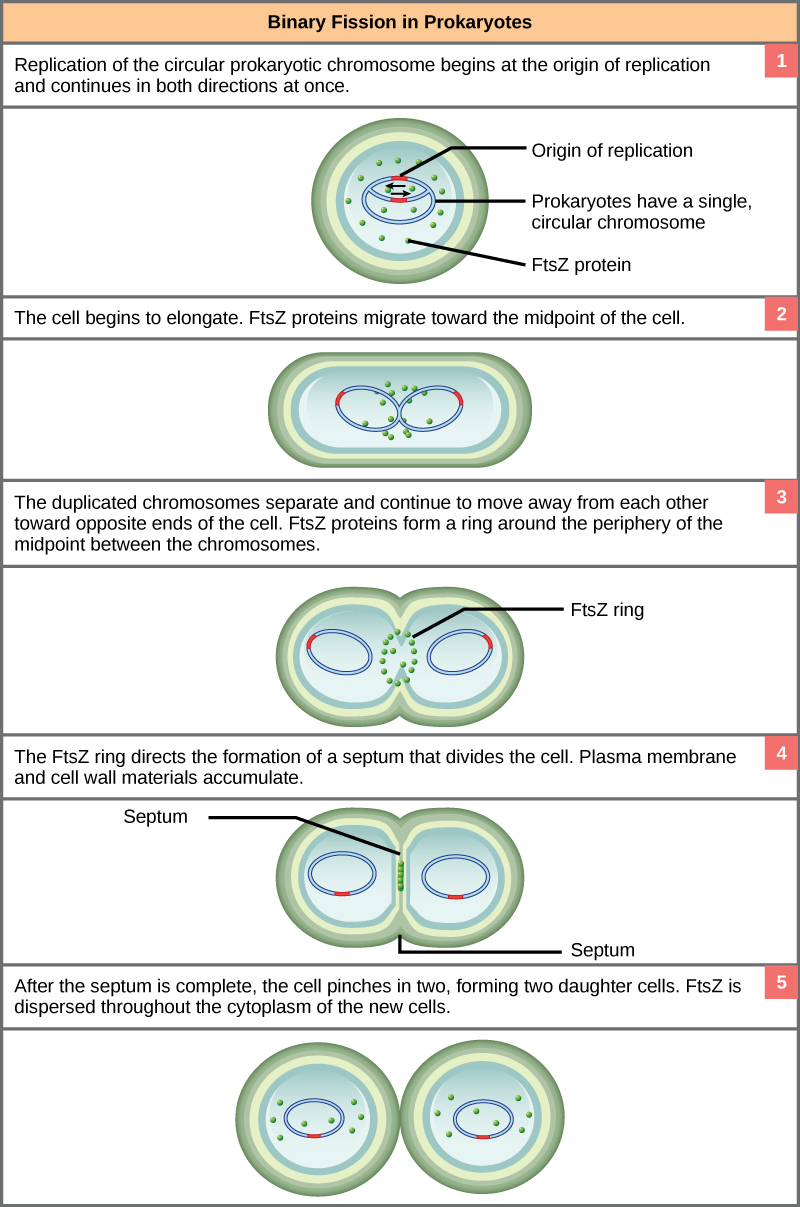
The bacterial chromosome is attached to the plasma membrane at about the midpoint of the cell. The starting point of replication, the origin, is close to the binding site of the chromosome to the plasma membrane (Figure 10.17). Replication of the DNA is bidirectional, moving away from the origin on both strands of the loop simultaneously. As the new double strands are formed, each origin point moves away from the cell wall attachment toward the opposite ends of the cell. As the cell elongates, the growing membrane aids in the transport of the chromosomes. After the chromosomes have cleared the midpoint of the elongated cell, cytoplasmic separation begins. The formation of a ring composed of repeating units of a protein called FtsZ (short for “filamenting temperature-sensitive mutant Z”) directs the partition between the nucleoids. Formation of the FtsZ ring triggers the accumulation of other proteins that work together to recruit new membrane and cell wall materials to the site. A septum is formed between the daughter nucleoids, extending gradually from the periphery toward the center of the cell. When the new cell walls are in place, the daughter cells separate.
英語のヒント
細菌の染色体は細胞のほぼ中央で細胞膜に付着している。複製の始点である複製起点は、この膜への結合部位の近くにある(図10.17)。DNA複製は双方向に進み、環の両側の鎖で起点から同時に離れていく。新しい二本鎖ができるにつれ、それぞれの起点は細胞壁への付着部位から離れ、細胞の反対側の端へ向かう。細胞が伸びると、成長する膜が染色体の移動を助ける。染色体が伸びた細胞の中央部を離れると、細胞質の分離が始まる。FtsZ(「フィラメント化する温度感受性変異体Z」の略)というタンパク質の反復単位からなる環ができ、核様体間の仕切りを導く。この環は、協同して新しい膜や細胞壁の材料をその場所へ集める他のタンパク質の蓄積を促す。娘核様体の間に隔壁ができ、周辺から細胞中央へ徐々に伸びる。新しい細胞壁が整うと、娘細胞が分離する。
OpenStax, Rice University; Biology 2e. (credit: modification of work by “Mcstrother”/Wikimedia Commons) · CC BY 4.0 · Source出典

Figure 10.17図 10.17
These images show the steps of binary fission in prokaryotes. (credit: modification of work by “Mcstrother”/Wikimedia Commons)
原核生物の二分裂の各段階。(出典:“Mcstrother”/Wikimedia Commonsの作品を改変)