第10章細胞の増殖
Eukaryotic Chromosomal Structure and Compaction真核生物の染色体の構造と凝縮
If the DNA from all 46 chromosomes in a human cell nucleus were laid out end-to-end, it would measure approximately two meters; however, its diameter would be only 2 nm! Considering that the size of a typical human cell is about 10 µm (100,000 cells lined up to equal one meter), DNA must be tightly packaged to fit in the cell’s nucleus. At the same time, it must also be readily accessible for the genes to be expressed. For this reason, the long strands of DNA are condensed into compact chromosomes during certain stages of the cell cycle. There are a number of ways that chromosomes are compacted.
英語のヒント
ヒトの細胞核の46本すべての染色体からDNAを取り出し、端と端をつないで伸ばすと、長さは約2メートルになる。しかし直径はわずか2ナノメートルである。典型的なヒトの細胞は約10マイクロメートルで、10万個を並べてやっと1メートルになる。この大きさを考えると、DNAは核内に収まるように密にまとめなければならない。同時に、遺伝子を発現できるように、すぐに利用できる状態でもなければならない。このため、長いDNAの鎖は細胞周期の特定の段階で、コンパクトな染色体へ凝縮する。染色体を小さくまとめる方法はいくつもある。
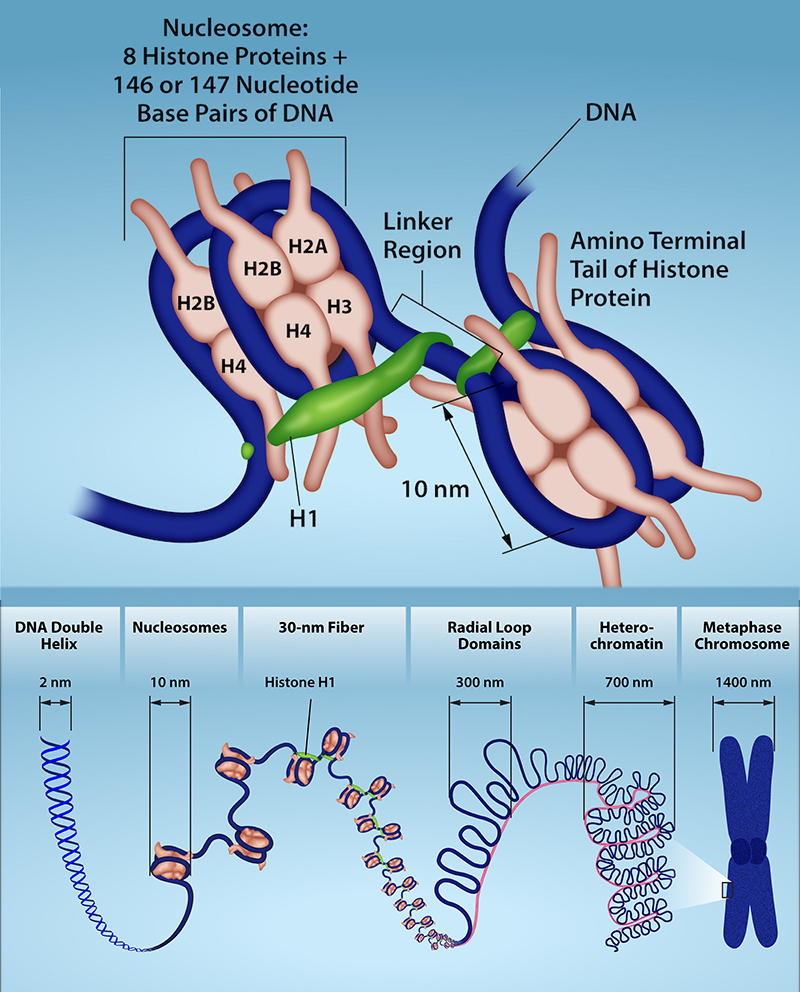
In the first level of compaction, short stretches of the DNA double helix wrap around a core of eight histone proteins at regular intervals along the entire length of the chromosome (Figure 10.4). The DNA-histone complex is called chromatin. The beadlike, histone DNA complex is called a nucleosome, and DNA connecting the nucleosomes is called linker DNA. A DNA molecule in this form is about seven times shorter than the double helix without the histones, and the beads are about 10 nm in diameter, in contrast with the 2-nm diameter of a DNA double helix.
英語のヒント
凝縮の第1段階では、染色体の全長に沿って一定の間隔で、DNA二重らせんの短い部分が8個のヒストンタンパク質からなる核に巻き付く(図10.4)。DNAとヒストンの複合体をクロマチンという。ビーズ状のヒストンとDNAの複合体はヌクレオソーム、ヌクレオソームどうしをつなぐDNAはリンカーDNAと呼ばれる。この形のDNA分子はヒストンのない二重らせんの約7分の1の長さになり、ビーズの直径は約10ナノメートルとなる。これはDNA二重らせんの直径2ナノメートルより大きい。
The second level of compaction occurs as the nucleosomes and the linker DNA between them coil into a 30-nm chromatin fiber. This coiling further condenses the chromosome so that it is now about 50 times shorter than the extended form.
英語のヒント
凝縮の第2段階では、ヌクレオソームとその間のリンカーDNAが巻き込み、直径30ナノメートルのクロマチン繊維になる。この巻き込みで染色体はさらに凝縮し、伸ばした形の約50分の1の長さになる。
In the third level of compaction, a variety of fibrous proteins is used to “pack the chromatin.” These fibrous proteins also ensure that each chromosome in a non-dividing cell occupies a particular area of the nucleus that does not overlap with that of any other chromosome (see the top image in Figure 10.3).
英語のヒント
凝縮の第3段階では、さまざまな繊維状タンパク質を使ってクロマチンを「詰め込む」。これらのタンパク質は、分裂していない細胞内でも、各染色体が核内の特定の領域を占め、他の染色体の領域と重ならないようにする(図10.3の上の画像を参照)。
OpenStax, Rice University; Biology 2e. Credit: Rao, A., Ryan, K. Fletcher, S. Hawkins, A. and Tag, A. Department of Biology, Texas A&M University. · CC BY 4.0 · Source出典

Figure 10.4図 10.4
Each linear chromosome in a eukaryotic cell is packaged into chromatin, a combination of DNA and proteins. The double-stranded DNA helix associates with the core histones to form nucleosomes. These nucleosomes are further organized into a 30 nm fiber by the linker histone, H1. The fiber then associates with additional proteins to form loops and higher-order heterochromatin packing. DNA packing reaches its most condensed state during metaphase in mitosis in preparation for chromosome separation. Chromatin packing is dynamic and undergoes reversible changes in response to changes in gene expression and the cell cycle. Credit: Rao, A., Ryan, K. Fletcher, S. Hawkins, A. and Tag, A. Department of Biology, Texas A&M University.
真核細胞の各線状染色体は、DNAとタンパク質の組み合わせであるクロマチンにまとめられる。二本鎖DNAらせんはコアヒストンと結び付き、ヌクレオソームを作る。これらはリンカーヒストンH1によって、さらに30ナノメートル繊維へ組織化される。繊維は別のタンパク質と結び付き、ループと、さらに高次に詰め込まれたヘテロクロマチンを作る。DNAは有糸分裂の中期に、染色体の分離に備えて最も凝縮した状態になる。クロマチンの凝縮は動的で、遺伝子発現や細胞周期の変化に応じて可逆的に変わる。出典:Rao, A.、Ryan, K.、Fletcher, S.、Hawkins, A.、Tag, A.、テキサスA&M大学生物学科。
DNA replicates in the S phase of interphase, which technically is not a part of mitosis, but must always precede it. After replication, the chromosomes are composed of two linked sister chromatids. When fully compact, the pairs of identically packed chromosomes are bound to each other by cohesin proteins. The connection between the sister chromatids is closest in a region called the centromere. The conjoined sister chromatids, with a diameter of about 1 µm, are visible under a light microscope. The centromeric region is highly condensed and thus will appear as a constricted area.
英語のヒント
DNAは間期のS期に複製される。厳密には間期は有糸分裂の一部ではないが、必ずその前に起こらなければならない。複製後、染色体はつながった2本の姉妹染色分体からなる。完全に凝縮すると、同じようにまとめられた染色体の対は、コヒーシンタンパク質によって互いに結ばれる。姉妹染色分体はセントロメアという領域で最も密につながる。結合した姉妹染色分体の直径は約1マイクロメートルで、光学顕微鏡で見える。セントロメア領域は高度に凝縮しているため、くびれた領域として見える。
Section Summaryこの節のまとめ
Prokaryotes have a single circular chromosome composed of double-stranded DNA, whereas eukaryotes have multiple, linear chromosomes composed of chromatin wrapped around histones, all of which are surrounded by a nuclear membrane. The 46 chromosomes of human somatic cells are composed of 22 pairs of autosomes (matched pairs) and a pair of sex chromosomes, which may or may not be matched. This is the 2n or diploid state. Human gametes have 23 chromosomes, or one complete set of chromosomes; a set of chromosomes is complete with either one of the sex chromosomes, X or Y. This is the n or haploid state. Genes are segments of DNA that code for a specific functional molecule (a protein or RNA). An organism’s traits are determined by the genes inherited from each parent. Duplicated chromosomes are composed of two sister chromatids. Chromosomes are compacted using a variety of mechanisms during certain stages of the cell cycle. Several classes of protein are involved in the organization and packing of the chromosomal DNA into a highly condensed structure. The condensing complex compacts chromosomes, and the resulting condensed structure is necessary for chromosomal segregation during mitosis.
原核生物は二本鎖DNAからなる1本の環状染色体を持つ。一方、真核生物はヒストンに巻き付いたクロマチンからなる複数の線状染色体を持ち、そのすべてが核膜で囲まれる。ヒトの体細胞の46本の染色体は、対応する22対の常染色体と、対応する場合もしない場合もある1対の性染色体からなる。これは2n、すなわち二倍体の状態である。ヒトの配偶子は23本、すなわち完全な1組の染色体を持つ。XまたはYのどちらか一方の性染色体があれば、1組が完成する。これがn、すなわち半数体の状態である。遺伝子は、タンパク質またはRNAという特定の機能分子をコードするDNAの区間である。生物の形質はそれぞれの親から受け継ぐ遺伝子で決まる。複製された染色体は2本の姉妹染色分体からなる。染色体は細胞周期の特定の段階で、さまざまなしくみによって凝縮する。染色体DNAを高度に凝縮した構造へまとめることには、複数の種類のタンパク質がかかわる。凝縮複合体は染色体を密にまとめ、その凝縮構造は有糸分裂での染色体の分配に必要である。