第10章細胞の増殖
10.1 Cell Division10.1 細胞分裂
Learning Objectives学習目標
By the end of this section, you will be able to do the following:
この節を学び終えると、次のことができるようになる。
- Describe the structure of prokaryotic and eukaryotic genomes原核生物と真核生物のゲノムの構造を説明する。
- Distinguish between chromosomes, genes, and traits染色体、遺伝子、形質を区別する。
- Describe the mechanisms of chromosome compaction染色体が凝縮するしくみを説明する。
The continuity of life from one cell to another has its foundation in the reproduction of cells by way of the cell cycle. The cell cycle is an orderly sequence of events that describes the stages of a cell’s life from the division of a single parent cell to the production of two new genetically identical daughter cells.
英語のヒント
一つの細胞から次の細胞へ生命が連続する基盤は、細胞周期による細胞の増殖にある。細胞周期は、1個の親細胞の分裂から、遺伝的に同一な新しい2個の娘細胞の形成に至るまで、細胞の一生の各段階を表す、秩序立った一連の出来事である。
Genomic DNAゲノムDNA
Before discussing the steps a cell must undertake to replicate and divide its DNA, a deeper understanding of the structure and function of a cell’s genetic information is necessary. A cell’s DNA, packaged as a double-stranded DNA molecule, is called its genome. In prokaryotes, the genome is composed of a single, double-stranded DNA molecule in the form of a loop or circle (Figure 10.2). The region in the cell containing this genetic material is called a nucleoid. Some prokaryotes also have smaller loops of DNA called plasmids that are not essential for normal growth. Bacteria can exchange these plasmids with other bacteria, sometimes receiving beneficial new genes that the recipient can add to their chromosomal DNA. Antibiotic resistance is one trait that often spreads through a bacterial colony through plasmid exchange from resistant donors to recipient cells.
英語のヒント
DNAを複製して分配するために細胞がたどる段階を論じる前に、細胞の遺伝情報の構造と機能をより深く理解する必要がある。二本鎖DNA分子としてまとめられた細胞のDNAを、ゲノムという。原核生物のゲノムは、輪や環の形をした1本の二本鎖DNA分子からなる(図10.2)。この遺伝物質を含む細胞内の領域を核様体という。原核生物の中には、正常な増殖には不可欠でない、プラスミドという小さな環状DNAも持つものがある。細菌は他の細菌とプラスミドを交換でき、ときには受け手が自分の染色体DNAに加えられる有益な新しい遺伝子を受け取る。抗生物質耐性は、耐性のある供与細胞から受容細胞へのプラスミド交換によって細菌の集団に広がることの多い形質の一つである。
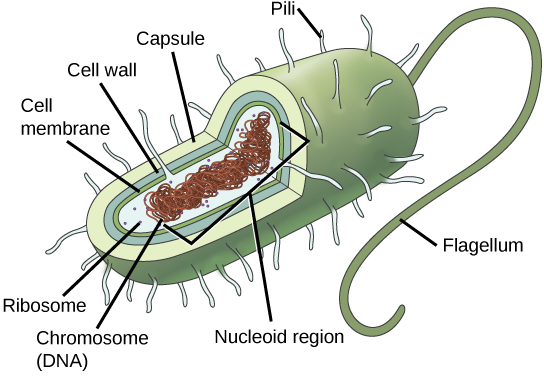

Figure 10.2図 10.2
Prokaryotes, including both Bacteria and Archaea, have a single, circular chromosome located in a central region called the nucleoid.
細菌と古細菌を含む原核生物は、核様体という中央の領域に、1本の環状染色体を持つ。
In eukaryotes, the genome consists of several double-stranded linear DNA molecules (Figure 10.3). Each species of eukaryotes has a characteristic number of chromosomes in the nuclei of its cells. Human body (somatic) cells have 46 chromosomes, while human gametes (sperm or eggs) have 23 chromosomes each. A typical body cell contains two matched or homologous sets of chromosomes (one set from each biological parent)—a configuration known as diploid. (Note: The letter n is used to represent a single set of chromosomes; therefore, a diploid organism is designated 2n.) Human cells that contain one set of chromosomes are called gametes, or sex cells; these are eggs and sperm, and are designated 1n, or haploid.
英語のヒント
真核生物のゲノムは、複数の線状の二本鎖DNA分子からなる(図10.3)。真核生物の各種は、細胞核にその種固有の本数の染色体を持つ。ヒトの体細胞には46本、配偶子である精子や卵にはそれぞれ23本の染色体がある。典型的な体細胞は、互いに対応する相同な染色体を2組持つ。各組は生物学的な両親のそれぞれから受け継ぐ。この状態を二倍体という。(注:染色体1組をnで表すため、二倍体の生物は2nと表す。)染色体を1組持つヒトの細胞は配偶子、または生殖細胞と呼ばれる。卵と精子がこれに当たり、1n、すなわち半数体と表す。
Upon fertilization, each gamete contributes one set of chromosomes, creating a diploid cell containing matched pairs of chromosomes called homologous (“same knowledge”) chromosomes. Homologous chromosomes are the same length and have specific nucleotide segments called genes in exactly the same location, or locus. Genes, the functional units of chromosomes, determine specific characteristics by coding for specific proteins. Traits are the variations of those characteristics. For example, hair color is a characteristic with traits that are blonde, brown, or black, and many colors in between.
英語のヒント
受精の際、各配偶子が染色体1組ずつを提供し、相同(「同じ知識」の意)の染色体と呼ばれる、対応した対を持つ二倍体細胞ができる。相同染色体は同じ長さで、遺伝子という特定のヌクレオチドの区間を、まったく同じ位置、すなわち遺伝子座に持つ。染色体の機能単位である遺伝子は、特定のタンパク質をコードすることで特定の特徴を決める。形質は、その特徴の現れ方の違いである。例えば毛の色という特徴には、金色、茶色、黒色、そしてその中間の多くの色という形質がある。
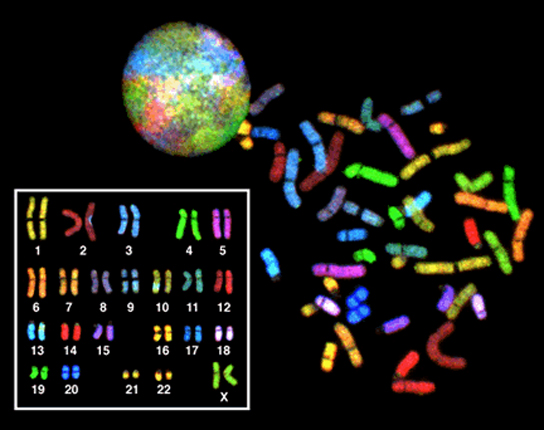
OpenStax, Rice University; Biology 2e. (credit: National Human Genome Project/NIH) · CC BY 4.0 · Source出典

Figure 10.3図 10.3
There are 23 pairs of homologous chromosomes in a female human somatic cell. The condensed chromosomes are viewed within the nucleus (top), removed from a cell during mitosis (also called karyokinesis or nuclear division) and spread out on a slide (right), and artificially arranged according to length (left); an arrangement like this is called a karyotype. In this image, the chromosomes were exposed to fluorescent stains for differentiation of the different chromosomes. A method of staining called “chromosome painting” employs fluorescent dyes that highlight chromosomes in different colors. (credit: National Human Genome Project/NIH)
ヒト女性の体細胞には相同染色体が23対ある。凝縮した染色体を、核内で見た像(上)、有糸分裂(核分裂ともいう)の途中で細胞から取り出してスライド上に広げた像(右)、長さに従って人為的に並べた像(左)を示す。このような配列を核型という。この画像では、異なる染色体を区別するために蛍光染色を行った。「染色体ペインティング」という方法では、蛍光色素によって染色体を異なる色で目立たせる。(出典:米国ヒトゲノムプロジェクト/NIH)
Each copy of a homologous pair of chromosomes originates from a different parent; therefore, the different genes (alleles) themselves are not identical, although they code for the same traits such as “hair color.” The variation of individuals within a species is due to the specific combination of the genes inherited from both parents. Even a slightly altered sequence of nucleotides within a gene can result in an alternative trait. For example, there are three possible gene sequences on the human chromosome that code for blood type: sequence A, sequence B, and sequence O. Because all diploid human cells have two copies of the chromosome that determines blood type, the blood type (the trait) is determined by the two alleles of the marker gene that are inherited. It is possible to have two copies of the same gene sequence on both homologous chromosomes, with one on each (for example, AA, BB, or OO), or two different sequences, such as AB, AO, or BO.
英語のヒント
一対の相同染色体の各1本は異なる親に由来する。そのため「毛の色」のように同じ形質をコードしていても、遺伝子の型(対立遺伝子)そのものは同一ではない。種内の個体差は、両親から受け継いだ遺伝子の特定の組み合わせによる。遺伝子内のヌクレオチド配列がわずかに変わるだけでも、別の形質が現れることがある。例えばヒトの染色体には、血液型をコードする遺伝子配列としてA、B、Oの3種類がある。ヒトの二倍体細胞はすべて、血液型を決める染色体を2本持つため、血液型という形質は、受け継いだマーカー遺伝子の二つの対立遺伝子で決まる。相同染色体のそれぞれに同じ配列を1コピーずつ持つ場合(AA、BB、OOなど)も、AB、AO、BOのように異なる配列を持つ場合もある。
Apparently minor variations of traits, such as blood type, eye color, and handedness, contribute to the natural variation found within a species, but even though they seem minor, these traits may be connected with the expression of other traits as of yet unknown. However, if the entire DNA sequence from any pair of human homologous chromosomes is compared, the difference is much less than one percent. The sex chromosomes, X and Y, are the single exception to the rule of homologous chromosome uniformity: Other than a small amount of homology that is necessary to accurately produce gametes, the genes found on the X and Y chromosomes are different.
英語のヒント
血液型、目の色、利き手など、一見小さな形質の違いが、種の内部で見られる自然な変異を生む。小さく見えても、こうした形質は、まだ分かっていない他の形質の発現と結び付いているかもしれない。しかし、ヒトのどの一対の相同染色体についてもDNA配列全体を比較すれば、違いは1%をはるかに下回る。性染色体XとYは、相同染色体の均一性という規則の唯一の例外である。配偶子を正確に作るために必要なわずかな相同性を除くと、X染色体とY染色体にある遺伝子は異なる。