第42章免疫系
Helper T LymphocytesヘルパーTリンパ球
The TH lymphocytes function indirectly to identify potential pathogens for other cells of the immune system. These cells are important for extracellular infections, such as those caused by certain bacteria, helminths, and protozoa. TH lymphocytes recognize specific antigens displayed in the MHC II complexes of APCs. There are two major populations of TH cells: TH1 and TH2. TH1 cells secrete cytokines to enhance the activities of macrophages and other T cells. TH1 cells activate the action of cytotoxic T cells, as well as macrophages. TH2 cells stimulate naïve B cells to destroy foreign invaders via antibody secretion. Whether a TH1 or a TH2 immune response develops depends on the specific types of cytokines secreted by cells of the innate immune system, which in turn depends on the nature of the invading pathogen.
英語のヒント
THリンパ球は、免疫系の他の細胞のために病原体となり得るものを識別し、間接的に働く。特定の細菌、蠕虫、原生動物によるものなど、細胞外感染で重要な細胞である。TH リンパ球は、APCのMHC II複合体に提示された特定の抗原を認識する。TH細胞には、TH1とTH2という2つの主要な集団がある。TH1細胞はサイトカインを分泌し、マクロファージや他のT細胞の活動を強める。TH1細胞は、マクロファージとともに、細胞傷害性T細胞の働きを活性化する。TH2細胞はナイーブB細胞を刺激し、抗体の分泌によって外来の侵入者を破壊させる。TH1とTH2のどちらの免疫応答が生じるかは、自然免疫系の細胞が分泌するサイトカインの種類によって決まる。そしてその種類は、侵入病原体の性質によって決まる。
The TH1-mediated response involves macrophages and is associated with inflammation. Recall the frontline defenses of macrophages involved in the innate immune response. Some intracellular bacteria, such as Mycobacterium tuberculosis, have evolved to multiply in macrophages after they have been engulfed. These pathogens evade attempts by macrophages to destroy and digest the pathogen. When M. tuberculosis infection occurs, macrophages can stimulate naïve T cells to become TH1 cells. These stimulated T cells secrete specific cytokines that send feedback to the macrophage to stimulate its digestive capabilities and allow it to destroy the colonizing M. tuberculosis. In the same manner, TH1-activated macrophages also become better suited to ingest and kill tumor cells. In summary; TH1 responses are directed toward intracellular invaders while TH2 responses are aimed at those that are extracellular.
英語のヒント
TH1を介した応答にはマクロファージが関わり、炎症と結び付いている。自然免疫応答における、マクロファージの最前線の防御を思い出そう。結核菌(Mycobacterium tuberculosis)など一部の細胞内細菌は、取り込まれた後にマクロファージ内で増殖するよう進化した。マクロファージが病原体を破壊・消化しようとしても、これらの病原体はそれを逃れる。M. tuberculosisによる感染が起こると、マクロファージはナイーブT細胞を刺激し、TH1細胞にすることができる。刺激されたT細胞は特定のサイトカインを分泌し、マクロファージへフィードバックを送る。それによって消化能力が高まり、定着しているM. tuberculosisを破壊できるようになる。同様に、TH1によって活性化されたマクロファージは、腫瘍細胞を取り込んで殺すことにも適した状態になる。まとめると、TH1応答は細胞内の侵入者に向けられ、TH2応答は細胞外の侵入者に向けられる。
B LymphocytesBリンパ球
When stimulated by the TH2 pathway, naïve B cells differentiate into antibody-secreting plasma cells. A plasma cell is an immune cell that secrets antibodies; these cells arise from B cells that were stimulated by antigens. Similar to T cells, naïve B cells initially are coated in thousands of B cell receptors (BCRs), which are membrane-bound forms of Ig (immunoglobulin, or an antibody). The B cell receptor has two heavy chains and two light chains connected by disulfide linkages. Each chain has a constant and a variable region; the latter is involved in antigen binding. Two other membrane proteins, Ig alpha and Ig beta, are involved in signaling. The receptors of any particular B cell, as shown in Figure 42.13 are all the same, but the hundreds of millions of different B cells in an individual have distinct recognition domains that contribute to extensive diversity in the types of molecular structures to which they can bind. In this state, B cells function as APCs. They bind and engulf foreign antigens via their BCRs and then display processed antigens in the context of MHC II molecules to TH2 cells. When a TH2 cell detects that a B cell is bound to a relevant antigen, it secretes specific cytokines that induce the B cell to proliferate rapidly, which makes thousands of identical (clonal) copies of it, and then it synthesizes and secretes antibodies with the same antigen recognition pattern as the BCRs. The activation of B cells corresponding to one specific BCR variant and the dramatic proliferation of that variant is known as clonal selection. This phenomenon drastically, but briefly, changes the proportions of BCR variants expressed by the immune system, and shifts the balance toward BCRs specific to the infecting pathogen.
英語のヒント
TH2経路で刺激されると、ナイーブB細胞は抗体を分泌する形質細胞へ分化する。形質細胞は抗体を分泌する免疫細胞で、抗原に刺激されたB細胞から生じる。T細胞と同様、ナイーブB細胞は当初、数千個のB細胞受容体(BCR)で覆われている。BCRは、Ig(免疫グロブリン、すなわち抗体)が膜に結合した形である。B細胞受容体は、ジスルフィド結合でつながる2本の重鎖と2本の軽鎖をもつ。各鎖には定常領域と可変領域があり、後者が抗原への結合に関わる。別の2つの膜タンパク質、IgαとIgβはシグナル伝達に関わる。図42.13に示すように、ある1個のB細胞がもつ受容体はすべて同じである。しかし、1個体の数億個の異なるB細胞は、それぞれ異なる認識ドメインをもち、結合できる分子構造の種類に大きな多様性をもたらす。この状態で、B細胞はAPCとして働く。BCRを介して外来抗原に結合して取り込み、処理した抗原をMHC II分子とともにTH2細胞に提示する。TH2細胞は、B細胞が対応する抗原に結合していると検出すると、特定のサイトカインを分泌し、B細胞を急速に増殖させる。こうして数千個の同一のコピー(クローン)が作られ、続いてBCRと同じ抗原認識パターンをもつ抗体が合成・分泌される。1つの特定のBCR型に対応するB細胞の活性化と、その型の劇的な増殖を、クローン選択という。この現象は、短期間ながら免疫系が発現するBCRの型の割合を大きく変え、感染した病原体に特異的なBCRが優勢になるよう、つり合いを移す。
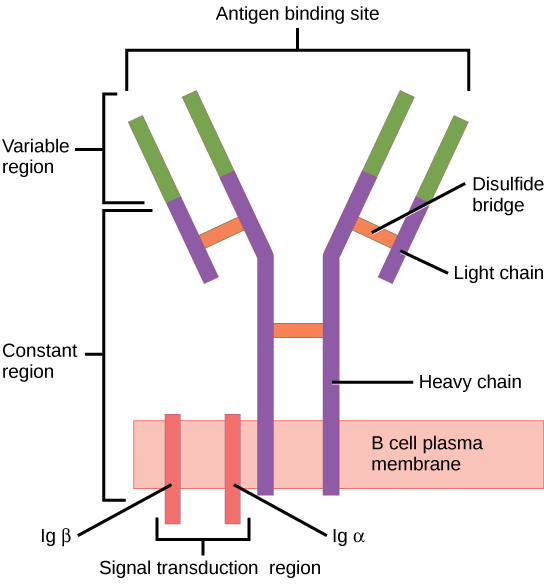

Figure 42.13図 42.13
B cell receptors are embedded in the membranes of B cells and bind a variety of antigens through their variable regions. The signal transduction region transfers the signal into the cell.
B細胞受容体はB細胞の膜に埋め込まれ、可変領域を介してさまざまな抗原に結合する。シグナル伝達領域が、信号を細胞内へ伝える。
T and B cells differ in one fundamental way: whereas T cells bind antigens that have been digested and embedded in MHC molecules by APCs, B cells function as APCs that bind intact antigens that have not been processed. Although T and B cells both react with molecules that are termed “antigens,” these lymphocytes actually respond to very different types of molecules. B cells must be able to bind intact antigens because they secrete antibodies that must recognize the pathogen directly, rather than digested remnants of the pathogen. Bacterial carbohydrate and lipid molecules can activate B cells independently from the T cells.
英語のヒント
T細胞とB細胞は、1つの基本的な点で異なる。T細胞が結合するのは、APCによって消化されMHC分子に組み込まれた抗原である。一方、B細胞はAPCとして働き、処理されていない、そのままの抗原に結合する。T細胞もB細胞も「抗原」と呼ばれる分子と反応するが、実際に応答する分子の種類は大きく異なる。B細胞は、病原体の消化された残りではなく、病原体そのものを直接認識する必要のある抗体を分泌する。このため、そのままの抗原に結合できなければならない。細菌の炭水化物や脂質の分子は、T細胞とは独立にB細胞を活性化できる。