第42章免疫系
Cytokine Release Effectサイトカイン放出の効果
The binding of PRRs with PAMPs triggers the release of cytokines, which signal that a pathogen is present and needs to be destroyed along with any infected cells. A cytokine is a chemical messenger that regulates cell differentiation (form and function), proliferation (production), and gene expression to affect immune responses. At least 40 types of cytokines exist in humans that differ in terms of the cell type that produces them, the cell type that responds to them, and the changes they produce. One type of cytokine, interferon, is illustrated in Figure 42.4.
英語のヒント
PRRとPAMPの結合はサイトカインの放出を引き起こす。サイトカインは、病原体が存在し、感染した細胞とともに破壊する必要があることを伝える。サイトカインは化学的な伝達物質で、細胞の分化(形態と機能)、増殖(産生)、遺伝子発現を調節し、免疫応答に影響する。ヒトには少なくとも40種類のサイトカインがある。それぞれ、作る細胞の種類、応答する細胞の種類、生じる変化が異なる。サイトカインの一種であるインターフェロンを、図42.4に示す。
One subclass of cytokines is the interleukin (IL), so named because they mediate interactions between leukocytes (white blood cells). Interleukins are involved in bridging the innate and adaptive immune responses. In addition to being released from cells after PAMP recognition, cytokines are released by the infected cells which bind to nearby uninfected cells and induce those cells to release cytokines, which results in a cytokine burst.
英語のヒント
サイトカインの一群に、インターロイキン(IL)がある。白血球の間の相互作用を仲介することから、その名が付いている。インターロイキンは、自然免疫応答と獲得免疫応答をつなぐ働きに関わる。サイトカインはPAMPの認識後に細胞から放出されるほか、感染した細胞からも放出される。感染した細胞は近くの未感染細胞に結合し、そこからサイトカインを放出させるため、サイトカインが一気に増える。
A second class of early-acting cytokines is interferons, which are released by infected cells as a warning to nearby uninfected cells. One of the functions of an interferon is to inhibit viral replication. They also have other important functions, such as tumor surveillance. Interferons work by signaling neighboring uninfected cells to destroy RNA and reduce protein synthesis, signaling neighboring infected cells to undergo apoptosis (programmed cell death), and activating immune cells.
英語のヒント
早期に働くサイトカインの第2の群はインターフェロンである。感染した細胞から放出され、近くの未感染細胞に警告を発する。インターフェロンの機能の1つは、ウイルスの複製を阻害することである。腫瘍の監視など、ほかにも重要な機能をもつ。インターフェロンは、近隣の未感染細胞にRNAを分解してタンパク質合成を減らすよう伝え、近隣の感染細胞にアポトーシス(プログラムされた細胞死)を起こすよう伝え、さらに免疫細胞を活性化することで働く。
In response to interferons, uninfected cells alter their gene expression, which increases the cells’ resistance to infection. One effect of interferon-induced gene expression is a sharply reduced cellular protein synthesis. Virally infected cells produce more viruses by synthesizing large quantities of viral proteins. Thus, by reducing protein synthesis, a cell becomes resistant to viral infection.
英語のヒント
インターフェロンに応答して、未感染細胞は遺伝子発現を変え、感染への抵抗性を高める。インターフェロンによって誘導された遺伝子発現の効果の1つは、細胞のタンパク質合成が大幅に減ることである。ウイルスに感染した細胞は、大量のウイルスタンパク質を合成して、さらに多くのウイルスを作る。そのため、タンパク質合成を減らすことで、細胞はウイルス感染に抵抗性をもつようになる。
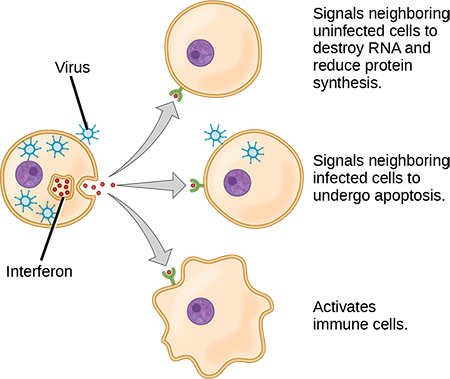
Figure 42.4図 42.4
Interferons are cytokines that are released by a cell infected with a virus. Response of neighboring cells to interferon helps stem the infection.
インターフェロンは、ウイルスに感染した細胞が放出するサイトカインである。近隣の細胞がインターフェロンに応答することで、感染の拡大を食い止める。
Phagocytosis and Inflammation食作用と炎症
The first cytokines to be produced are pro-inflammatory; that is, they encourage inflammation, the localized redness, swelling, heat, and pain that result from the movement of leukocytes and fluid through increasingly permeable capillaries to a site of infection. The population of leukocytes that arrives at an infection site depends on the nature of the infecting pathogen. Both macrophages and dendritic cells engulf pathogens and cellular debris through phagocytosis. A neutrophil is also a phagocytic leukocyte that engulfs and digests pathogens. Neutrophils, shown in Figure 42.3, are the most abundant leukocytes of the immune system. Neutrophils have a nucleus with two to five lobes, and they contain organelles, called lysosomes, that digest engulfed pathogens. An eosinophil is a leukocyte that works with other eosinophils to surround a parasite; it is involved in the allergic response and in protection against helminthes (parasitic worms).
英語のヒント
最初に作られるサイトカインは炎症促進性である。つまり、炎症を促す。炎症とは、透過性が増した毛細血管を通って白血球と液体が感染部位へ移動することで生じる、局所の発赤、腫脹、熱感、痛みである。感染部位に到着する白血球の構成は、感染している病原体の性質によって異なる。マクロファージと樹状細胞は、どちらも食作用によって病原体や細胞の残骸を取り込む。好中球も、病原体を取り込んで消化する食作用をもつ白血球である。図42.3に示す好中球は、免疫系で最も数の多い白血球である。2〜5つに分葉した核をもち、取り込んだ病原体を消化するリソソームという細胞小器官を含む。好酸球は、他の好酸球と協力して寄生生物を取り囲む白血球である。アレルギー応答と、蠕虫(寄生性の虫)に対する防御に関わる。
Neutrophils and eosinophils are particularly important leukocytes that engulf large pathogens, such as bacteria and fungi. A mast cell is a leukocyte that produces inflammatory molecules, such as histamine, in response to large pathogens. A basophil is a leukocyte that, like a neutrophil, releases chemicals to stimulate the inflammatory response as illustrated in Figure 42.5. Basophils are also involved in allergy and hypersensitivity responses and induce specific types of inflammatory responses. Eosinophils and basophils produce additional inflammatory mediators to recruit more leukocytes. A hypersensitive immune response to harmless antigens, such as in pollen, often involves the release of histamine by basophils and mast cells.
英語のヒント
好中球と好酸球は、細菌や菌類などの大きな病原体を取り込む、特に重要な白血球である。肥満細胞は、大きな病原体に応答してヒスタミンなどの炎症性分子を作る白血球である。好塩基球は、図42.5のように、好中球と同様、炎症応答を促す化学物質を放出する白血球である。好塩基球はアレルギーや過敏反応にも関わり、特定の種類の炎症応答を誘導する。好酸球と好塩基球は、さらに多くの白血球を呼び寄せるため、追加の炎症メディエーターを作る。花粉中の抗原など、無害な抗原に対する過敏な免疫応答には、しばしば好塩基球や肥満細胞によるヒスタミンの放出が関わる。
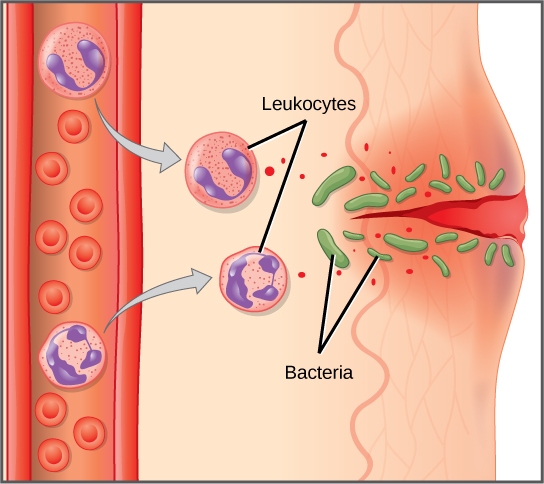


Figure 42.5図 42.5
In response to a cut, mast cells secrete histamines that cause nearby capillaries to dilate. Neutrophils and monocytes leave the capillaries. Monocytes mature into macrophages. Neutrophils, dendritic cells, and macrophages release chemicals to stimulate the inflammatory response. Neutrophils and macrophages also consume invading bacteria by phagocytosis.
切り傷に応答して、肥満細胞は近くの毛細血管を拡張させるヒスタミンを分泌する。好中球と単球が毛細血管を出る。単球はマクロファージへ成熟する。好中球、樹状細胞、マクロファージは、炎症応答を促す化学物質を放出する。また、好中球とマクロファージは、侵入した細菌を食作用で取り込む。
Cytokines also send feedback to cells of the nervous system to bring about the overall symptoms of feeling sick, which include lethargy, muscle pain, and nausea. These effects may have evolved because the symptoms encourage the individual to rest and prevent the spreading of the infection to others. Cytokines also increase the core body temperature, causing a fever, which causes the liver to withhold iron from the blood. Without iron, certain pathogens, such as some bacteria, are unable to replicate; this is called nutritional immunity.
英語のヒント
サイトカインは神経系の細胞にもフィードバックを送り、倦怠感、筋肉痛、吐き気など、体調不良を感じる全身症状を引き起こす。これらの症状は個体に休息を促し、他者への感染拡大を防ぐため、そのような効果が進化したのかもしれない。サイトカインは深部体温も上げ、発熱を起こす。発熱により、肝臓は血液への鉄の供給を抑える。鉄がないと、一部の細菌などの病原体は増殖できない。これを栄養免疫という。