第42章免疫系
Antibody Functions抗体の機能
Differentiated plasma cells are crucial players in the humoral response, and the antibodies they secrete are particularly significant against extracellular pathogens and toxins. Antibodies circulate freely and act independently of plasma cells. Antibodies can be transferred from one individual to another to temporarily protect against infectious disease. For instance, a person who has recently produced a successful immune response against a particular disease agent can donate blood to a nonimmune recipient and confer temporary immunity through antibodies in the donor’s blood serum. This phenomenon is called passive immunity; it also occurs naturally during breastfeeding, which makes breastfed infants highly resistant to infections during the first few months of life.
英語のヒント
分化した形質細胞は、液性免疫応答の重要な担い手である。その分泌する抗体は、細胞外の病原体や毒素への対抗に特に重要である。抗体は自由に循環し、形質細胞から独立して働く。抗体をある個体から別の個体へ移すことで、一時的に感染症から保護できる。例えば、特定の病原体に対して最近有効な免疫応答を生じた人が、免疫のない受容者に献血すれば、提供者の血清中の抗体を通して一時的な免疫を与えられる。この現象を受動免疫という。受動免疫は母乳育児でも自然に起こる。そのため、母乳で育つ乳児は生後数か月間、感染に対して高い抵抗性をもつ。
Antibodies coat extracellular pathogens and neutralize them, as illustrated in Figure 42.24, by blocking key sites on the pathogen that enhance their infectivity (such as receptors that “dock” pathogens on host cells). Antibody neutralization can prevent pathogens from entering and infecting host cells, as opposed to the CTL-mediated approach of killing cells that are already infected to prevent progression of an established infection. The neutralized antibody-coated pathogens can then be filtered by the spleen and eliminated in urine or feces.
英語のヒント
抗体は細胞外の病原体を覆い、図42.24のように、その感染力を高める重要な部位をふさいで中和する。例えば、病原体を宿主細胞に「接合」させる受容体などをふさぐ。抗体による中和は、病原体が宿主細胞へ侵入・感染することを防げる。これは、すでに成立した感染の進行を止めるために、感染済みの細胞を殺すCTLの方法とは異なる。中和され抗体で覆われた病原体は、その後脾臓で濾し取られ、尿や便に排出される。
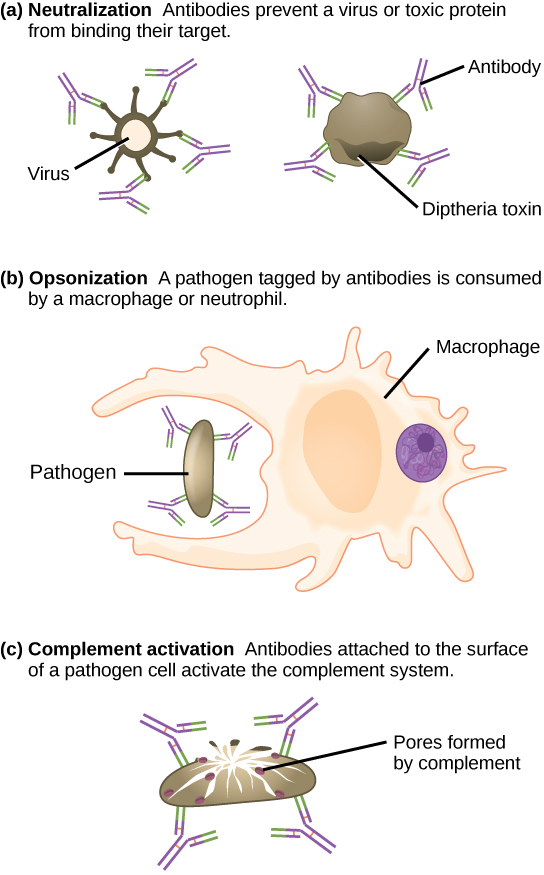
Figure 42.24図 42.24
Antibodies may inhibit infection by (a) preventing the antigen from binding its target, (b) tagging a pathogen for destruction by macrophages or neutrophils, or (c) activating the complement cascade.
抗体は、(a)抗原の標的への結合を防ぐ、(b)マクロファージや好中球が破壊できるよう病原体に目印を付ける、(c)補体カスケードを活性化する、という方法で感染を抑えることがある。
Antibodies also mark pathogens for destruction by phagocytic cells, such as macrophages or neutrophils, because phagocytic cells are highly attracted to macromolecules complexed with antibodies. Phagocytic enhancement by antibodies is called opsonization. In a process called complement fixation, IgM and IgG in serum bind to antigens and provide docking sites onto which sequential complement proteins can bind. The combination of antibodies and complement enhances opsonization even further and promotes rapid clearing of pathogens.
英語のヒント
抗体は、マクロファージや好中球などの食細胞が病原体を破壊できるよう、目印も付ける。食細胞は抗体と複合体を作った高分子に強く引き寄せられるためである。抗体による食作用の促進を、オプソニン化という。補体結合と呼ばれる過程では、血清中のIgMとIgGが抗原に結合し、補体タンパク質が順に結合できる足場を提供する。抗体と補体が組み合わさると、オプソニン化がさらに強まり、病原体の速やかな除去が促される。
Affinity, Avidity, and Cross Reactivity親和性、結合活性、交差反応性
Not all antibodies bind with the same strength, specificity, and stability. In fact, antibodies exhibit different affinities (attraction) depending on the molecular complementarity between antigen and antibody molecules, as illustrated in Figure 42.25. An antibody with a higher affinity for a particular antigen would bind more strongly and stably, and thus would be expected to present a more challenging defense against the pathogen corresponding to the specific antigen.
英語のヒント
すべての抗体が同じ強さ、特異性、安定性で結合するわけではない。実際、図42.25のように、抗原分子と抗体分子の相補性によって、抗体の親和性(引き合う強さ)は異なる。特定の抗原への親和性が高い抗体は、より強く安定して結合する。そのため、その抗原に対応する病原体にとって、より突破しにくい防御となることが期待される。
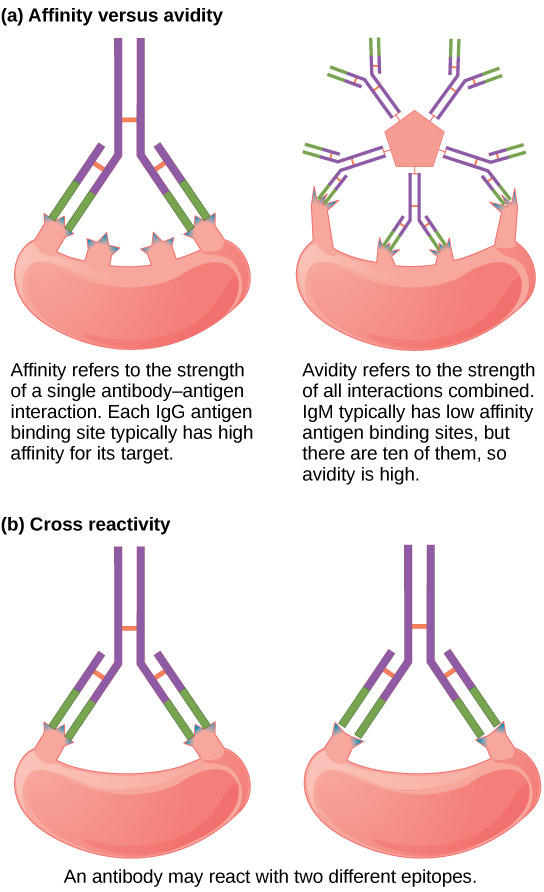


Figure 42.25図 42.25
(a) Affinity refers to the strength of single interaction between antigen and antibody, while avidity refers to the strength of all interactions combined. (b) An antibody may cross react with different epitopes.
(a)親和性は、抗原と抗体の1つの相互作用の強さを表し、結合活性はすべての相互作用を合わせた強さを表す。(b)抗体は、異なるエピトープに交差反応することがある。
The term avidity describes binding by antibody classes that are secreted as joined, multivalent structures (such as IgM and IgA). Although avidity measures the strength of binding, just as affinity does, the avidity is not simply the sum of the affinities of the antibodies in a multimeric structure. The avidity depends on the number of identical binding sites on the antigen being detected, as well as other physical and chemical factors. Typically, multimeric antibodies, such as pentameric IgM, are classified as having lower affinity than monomeric antibodies, but high avidity. Essentially, the fact that multimeric antibodies can bind many antigens simultaneously balances their slightly lower binding strength for each antibody/antigen interaction.
英語のヒント
結合活性(アビディティ)という用語は、つながった多価の構造として分泌される抗体クラス(IgMやIgAなど)の結合を表す。親和性と同じく結合の強さを測るものだが、多量体構造内の抗体の親和性を単純に足し合わせた値ではない。結合活性は、検出される抗原上の同一の結合部位の数や、その他の物理的・化学的要因によって決まる。一般に、五量体のIgMなどの多量体抗体は、単量体抗体より親和性が低いが、結合活性は高いものに分類される。つまり、多量体抗体は多くの抗原に同時に結合できることによって、1つ1つの抗体・抗原相互作用の結合力がやや低いことを補っている。
Antibodies secreted after binding to one epitope on an antigen may exhibit cross reactivity for the same or similar epitopes on different antigens. Because an epitope corresponds to such a small region (the surface area of about four to six amino acids), it is possible for different macromolecules to exhibit the same molecular identities and orientations over short regions. Cross reactivity describes when an antibody binds not to the antigen that elicited its synthesis and secretion, but to a different antigen.
英語のヒント
ある抗原の1つのエピトープへの結合を経て分泌された抗体は、異なる抗原上にある同じ、または似たエピトープに交差反応することがある。エピトープは非常に小さな領域(およそ4〜6個のアミノ酸の表面積)に相当するため、異なる高分子でも、短い領域に限れば同じ分子的性質や配置を示すことがある。交差反応性とは、抗体が、その合成と分泌を誘導した抗原ではなく、別の抗原に結合することをいう。
Cross reactivity can be beneficial if an individual develops immunity to several related pathogens despite having only been exposed to or vaccinated against one of them. For instance, antibody cross reactivity may occur against the similar surface structures of various Gram-negative bacteria. Conversely, antibodies raised against pathogenic molecular components that resemble self molecules may incorrectly mark host cells for destruction and cause autoimmune damage. Patients who develop systemic lupus erythematosus (SLE) commonly exhibit antibodies that react with their own DNA. These antibodies may have been initially raised against the nucleic acid of microorganisms but later cross-reacted with self-antigens. This phenomenon is also called molecular mimicry.
英語のヒント
交差反応性は、関連する病原体の1つにしかさらされていない、またはその1つへのワクチンしか接種していないのに、複数の病原体への免疫が生じる場合には有益である。例えば、さまざまなグラム陰性細菌の似た表面構造に対して、抗体が交差反応することがある。逆に、自己の分子に似た病原体の分子成分に対して作られた抗体は、宿主細胞に誤って破壊対象の目印を付け、自己免疫による損傷を起こすことがある。全身性エリテマトーデス(SLE)を発症した患者には、自分自身のDNAと反応する抗体がよく見られる。これらの抗体は、最初は微生物の核酸に対して作られ、その後、自己抗原に交差反応したのかもしれない。この現象は分子擬態とも呼ばれる。