第42章免疫系
Autoimmunity自己免疫
Autoimmunity is a type of hypersensitivity to self antigens that affects approximately five percent of the population. Most types of autoimmunity involve the humoral immune response. Antibodies that inappropriately mark self components as foreign are termed autoantibodies. In patients with the autoimmune disease myasthenia gravis, muscle cell receptors that induce contraction in response to acetylcholine are targeted by antibodies. The result is muscle weakness that may include marked difficulty with fine and/or gross motor functions. In systemic lupus erythematosus, a diffuse autoantibody response to the individual’s own DNA and proteins results in various systemic diseases. As illustrated in Figure 42.27, systemic lupus erythematosus may affect the heart, joints, lungs, skin, kidneys, central nervous system, or other tissues, causing tissue damage via antibody binding, complement recruitment, lysis, and inflammation.
英語のヒント
自己免疫は、自己抗原に対する過敏反応の一種で、人口の約5%に影響する。大部分の種類には液性免疫応答が関わる。自己の構成要素に、誤って異物としての目印を付ける抗体を、自己抗体という。自己免疫疾患である重症筋無力症では、アセチルコリンに応答して収縮を誘導する筋細胞の受容体が、抗体の標的になる。その結果、筋力が低下し、細かな運動や大きな動作が著しく困難になることがある。全身性エリテマトーデスでは、自分自身のDNAやタンパク質に対する広範な自己抗体応答が、さまざまな全身性疾患をもたらす。図42.27のように、心臓、関節、肺、皮膚、腎臓、中枢神経系などの組織に影響し、抗体の結合、補体の動員、溶解、炎症を通じて組織を損傷することがある。
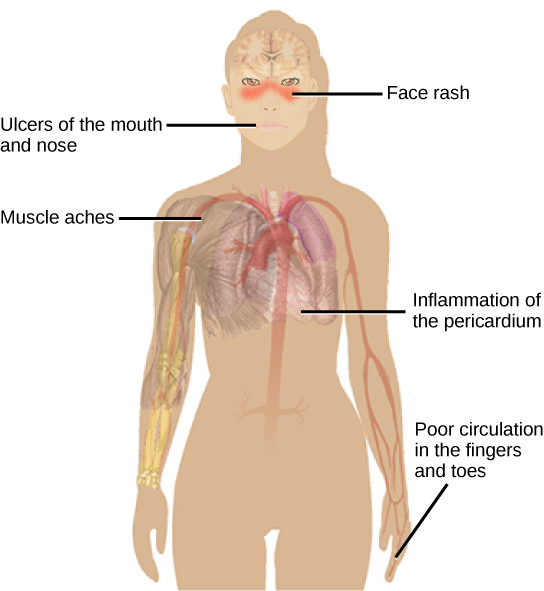
OpenStax, Rice University; Biology 2e. (credit: modification of work by Mikael Häggström) · CC BY 4.0 · Source出典

Figure 42.27図 42.27
Systemic lupus erythematosus is characterized by autoimmunity to the individual’s own DNA and/or proteins, which leads to varied dysfunction of the organs. (credit: modification of work by Mikael Häggström)
全身性エリテマトーデスは、自分自身のDNAやタンパク質に対する自己免疫を特徴とし、さまざまな器官の機能障害を引き起こす。(出典:Mikael Häggströmの作品を改変)
Autoimmunity can develop with time, and its causes may be rooted in molecular mimicry. Antibodies and TCRs may bind self antigens that are structurally similar to pathogen antigens, which the immune receptors first raised. As an example, infection with Streptococcus pyogenes (bacterium that causes strep throat) may generate antibodies or T cells that react with heart muscle, which has a similar structure to the surface of S. pyogenes. These antibodies can damage heart muscle with autoimmune attacks, leading to rheumatic fever. Insulin-dependent (Type 1) diabetes mellitus arises from a destructive inflammatory TH1 response against insulin-producing cells of the pancreas. Patients with this autoimmunity must be injected with insulin that originates from other sources.
英語のヒント
自己免疫は時間とともに生じることがあり、その原因は分子擬態にあるかもしれない。抗体やTCRは、最初にそれらの免疫受容体を生じさせた病原体抗原に、構造が似ている自己抗原と結合することがある。例えば、連鎖球菌性咽頭炎を起こす化膿レンサ球菌(Streptococcus pyogenes)への感染は、心筋と反応する抗体やT細胞を生じさせることがある。心筋が、S. pyogenesの表面に似た構造をもつためである。これらの抗体は自己免疫攻撃によって心筋を損傷し、リウマチ熱をもたらすことがある。インスリン依存性(1型)糖尿病は、膵臓のインスリン産生細胞に対する、破壊的な炎症性のTH1応答から生じる。この自己免疫をもつ患者は、外部の供給源に由来するインスリンを注射されなければならない。
Section Summary節のまとめ
Immune disruptions may involve insufficient immune responses or inappropriate immune targets. Immunodeficiency increases an individual's susceptibility to infections and cancers. Hypersensitivities are misdirected responses either to harmless foreign particles, as in the case of allergies, or to host factors, as in the case of autoimmunity. Reactions to self components may be the result of molecular mimicry.
免疫の障害には、免疫応答が不十分な場合と、免疫の標的が不適切な場合がある。免疫不全は、感染やがんへのかかりやすさを高める。過敏反応は、アレルギーのように無害な外来粒子に向けられる、または自己免疫のように宿主の成分に向けられる、誤った方向の応答である。自己の構成要素への反応は、分子擬態の結果である可能性がある。
Review Questions確認問題
Exercises 27–30練習問題 27–30
Exercise 27問題 27
Allergy to pollen is classified as:
花粉へのアレルギーは、どれに分類されるか。
- an autoimmune reaction自己免疫反応
- immunodeficiency免疫不全
- delayed hypersensitivity遅延型過敏反応
- immediate hypersensitivity即時型過敏反応
Solution解き方
D
D
Exercise 28問題 28
A potential cause of acquired autoimmunity is ________.
後天的な自己免疫の原因となり得るものは、________である。
- tissue hypersensitivity組織の過敏反応
- molecular mimicry分子擬態
- histamine releaseヒスタミンの放出
- radiation exposure放射線への曝露
Solution解き方
B
B
Exercise 29問題 29
Autoantibodies are probably involved in:
自己抗体が関わると考えられるものはどれか。
- reactions to poison ivyポイズンアイビーへの反応
- pollen allergies花粉アレルギー
- systemic lupus erythematosus全身性エリテマトーデス
- HIV/AIDSHIV/AIDS
Solution解き方
C
C
Exercise 30問題 30
Which of the following diseases is not due to autoimmunity?
次の疾患のうち、自己免疫によるものではないのはどれか。
- rheumatic feverリウマチ熱
- systemic lupus erythematosus全身性エリテマトーデス
- diabetes mellitus糖尿病
- HIV/AIDSHIV/AIDS
Solution解き方
D
D
allergy
アレルギー
immune reaction that results from immediate hypersensitivities in which an antibody-mediated immune response occurs within minutes of exposure to a harmless antigen
無害な抗原にさらされてから数分以内に、抗体を介した免疫応答が起こる即時型過敏反応による免疫反応。
autoantibody
自己抗体
antibody that incorrectly marks “self” components as foreign and stimulates the immune response
「自己」の構成要素に誤って異物としての目印を付け、免疫応答を刺激する抗体。
autoimmunity
自己免疫
type of hypersensitivity to self antigens
自己抗原に対する過敏反応の一種。
hypersensitivities
過敏反応
spectrum of maladaptive immune responses toward harmless foreign particles or self antigens; occurs after tissue sensitization and includes immediate-type (allergy), delayed-type, and autoimmunity
無害な外来粒子や自己抗原に向けられる、一連の不適切な免疫応答。組織の感作後に生じ、即時型(アレルギー)、遅延型、自己免疫を含む。
immunodeficiency
免疫不全
failure, insufficiency, or delay at any level of the immune system, which may be acquired or inherited
免疫系のいずれかの段階における機能不全、不足、遅れ。後天性または遺伝性の場合がある。