第42章免疫系
42.2 Adaptive Immune Response42.2 獲得免疫応答
Learning Objectives学習目標
By the end of this section, you will be able to do the following:
この節を学ぶと、次のことができるようになる。
- Explain adaptive immunity獲得免疫を説明する。
- Compare and contrast adaptive and innate immunity獲得免疫と自然免疫の共通点と相違点を述べる。
- Describe cell-mediated immune response and humoral immune response細胞性免疫応答と液性免疫応答を説明する。
- Describe immune tolerance免疫寛容を説明する。
The adaptive, or acquired, immune response takes days or even weeks to become established—much longer than the innate response; however, adaptive immunity is more specific to pathogens and has memory. Adaptive immunity is an immunity that occurs after exposure to an antigen either from a pathogen or a vaccination. This part of the immune system is activated when the innate immune response is insufficient to control an infection. In fact, without information from the innate immune system, the adaptive response could not be mobilized. There are two types of adaptive responses: the cell-mediated immune response, which is carried out by T cells, and the humoral immune response, which is controlled by activated B cells and antibodies. Activated T cells and B cells that are specific to molecular structures on the pathogen proliferate and attack the invading pathogen. Their attack can kill pathogens directly or secrete antibodies that enhance the phagocytosis of pathogens and disrupt the infection. Adaptive immunity also involves a memory to provide the host with long-term protection from reinfection with the same type of pathogen; on reexposure, this memory will facilitate an efficient and quick response.
英語のヒント
獲得免疫応答(適応免疫応答)が成立するには、数日、ときには数週間かかり、自然免疫応答よりはるかに遅い。しかし、獲得免疫は病原体に対する特異性が高く、記憶をもつ。病原体やワクチンに由来する抗原にさらされた後に生じる免疫である。自然免疫応答だけでは感染を抑えきれないときに活性化される。実際、自然免疫系からの情報がなければ、獲得免疫応答を動員することはできない。獲得免疫応答には2種類ある。T細胞によって行われる細胞性免疫応答と、活性化B細胞および抗体によって制御される液性免疫応答である。病原体の分子構造に特異的な、活性化したT細胞とB細胞が増殖し、侵入病原体を攻撃する。病原体を直接殺したり、病原体の食作用を促して感染を阻止する抗体を分泌したりする。獲得免疫には記憶もあり、同じ種類の病原体による再感染から宿主を長期にわたって守る。再びさらされたとき、この記憶によって効率的で迅速な応答が可能になる。
Antigen-presenting Cells抗原提示細胞
Unlike NK cells of the innate immune system, B cells (B lymphocytes) are a type of white blood cell that gives rise to antibodies, whereas T cells (T lymphocytes) are a type of white blood cell that plays an important role in the immune response. T cells are a key component in the cell-mediated response—the specific immune response that utilizes T cells to neutralize cells that have been infected with viruses and certain bacteria. There are three types of T cells: cytotoxic, helper, and suppressor T cells. Cytotoxic T cells destroy virus-infected cells in the cell-mediated immune response, and helper T cells play a part in activating both the antibody and the cell-mediated immune responses. Suppressor T cells deactivate T cells and B cells when needed, and thus prevent the immune response from becoming too intense.
英語のヒント
自然免疫系のNK細胞とは異なり、B細胞(Bリンパ球)は抗体を生み出す種類の白血球である。一方、T細胞(Tリンパ球)は免疫応答で重要な役割を果たす白血球である。T細胞は細胞性免疫応答の主要な構成要素である。細胞性免疫応答は、T細胞を使い、ウイルスや特定の細菌に感染した細胞を無力化する特異的な免疫応答である。T細胞には、細胞傷害性T細胞、ヘルパーT細胞、サプレッサーT細胞の3種類がある。細胞傷害性T細胞は、細胞性免疫応答でウイルス感染細胞を破壊する。ヘルパーT細胞は、抗体応答と細胞性免疫応答の両方の活性化に関わる。サプレッサーT細胞は必要に応じてT細胞とB細胞の働きを止め、免疫応答が強くなりすぎるのを防ぐ。
An antigen is a foreign or “non-self” macromolecule that reacts with cells of the immune system. Not all antigens will provoke a response. For instance, individuals produce innumerable “self” antigens and are constantly exposed to harmless foreign antigens, such as food proteins, pollen, or dust components. The suppression of immune responses to harmless macromolecules is highly regulated and typically prevents processes that could be damaging to the host, known as tolerance.
英語のヒント
抗原とは、免疫系の細胞と反応する、外来または「非自己」の高分子である。すべての抗原が応答を引き起こすわけではない。例えば、個体は無数の「自己」抗原を作っており、食物のタンパク質、花粉、ほこりの成分など、無害な外来抗原にも絶えずさらされている。無害な高分子に対する免疫応答の抑制は厳密に調節され、通常は宿主を傷つけかねない過程を防いでいる。これを免疫寛容という。
The innate immune system contains cells that detect potentially harmful antigens, and then inform the adaptive immune response about the presence of these antigens. An antigen-presenting cell (APC) is an immune cell that detects, engulfs, and informs the adaptive immune response about an infection. When a pathogen is detected, these APCs will phagocytose the pathogen and digest it to form many different fragments of the antigen. Antigen fragments will then be transported to the surface of the APC, where they will serve as an indicator to other immune cells. Dendritic cells are immune cells that process antigen material; they are present in the skin (Langerhans cells) and the lining of the nose, lungs, stomach, and intestines. Sometimes a dendritic cell presents on the surface of other cells to induce an immune response, thus functioning as an antigen-presenting cell. Macrophages also function as APCs. Before activation and differentiation, B cells can also function as APCs.
英語のヒント
自然免疫系には、害を及ぼす可能性のある抗原を検出し、その存在を獲得免疫応答に知らせる細胞がある。抗原提示細胞(APC)は、感染を検出し、病原体を取り込み、その情報を獲得免疫応答に伝える免疫細胞である。病原体を検出すると、APCは食作用で取り込み、消化して、多くの異なる抗原断片を作る。抗原断片は次にAPCの表面へ運ばれ、他の免疫細胞への目印となる。樹状細胞は抗原物質を処理する免疫細胞で、皮膚(ランゲルハンス細胞)や、鼻、肺、胃、腸の内面に存在する。樹状細胞は、ときに他の細胞の表面で提示を行って免疫応答を誘導し、抗原提示細胞として働く。マクロファージもAPCとして機能する。活性化・分化前のB細胞も、APCとして機能できる。
After phagocytosis by APCs, the phagocytic vesicle fuses with an intracellular lysosome forming phagolysosome. Within the phagolysosome, the components are broken down into fragments; the fragments are then loaded onto MHC class I or MHC class II molecules and are transported to the cell surface for antigen presentation, as illustrated in Figure 42.8. Note that T lymphocytes cannot properly respond to the antigen unless it is processed and embedded in an MHC II molecule. APCs express MHC on their surfaces, and when combined with a foreign antigen, these complexes signal a “non-self” invader. Once the fragment of antigen is embedded in the MHC II molecule, the immune cell can respond. Helper T cells are one of the main lymphocytes that respond to antigen-presenting cells. Recall that all other nucleated cells of the body expressed MHC I molecules, which signal “healthy” or “normal.”
英語のヒント
APCによる食作用の後、食作用でできた小胞は細胞内のリソソームと融合し、ファゴリソソームを形成する。その内部で構成成分が断片へ分解される。断片はMHCクラスIまたはMHCクラスII分子に載せられ、図42.8のように細胞表面へ運ばれて抗原提示される。Tリンパ球は、抗原が処理されMHC II分子に組み込まれなければ、適切に応答できない点に注意しよう。APCは表面にMHCを発現し、外来抗原と組み合わされた複合体が「非自己」の侵入者の存在を示す。抗原断片がMHC II分子に組み込まれると、免疫細胞が応答できるようになる。ヘルパーT細胞は、抗原提示細胞に応答する主要なリンパ球の1つである。体の他のすべての有核細胞も、MHC I分子を発現して「健康」または「正常」であることを示す、ということを思い出そう。
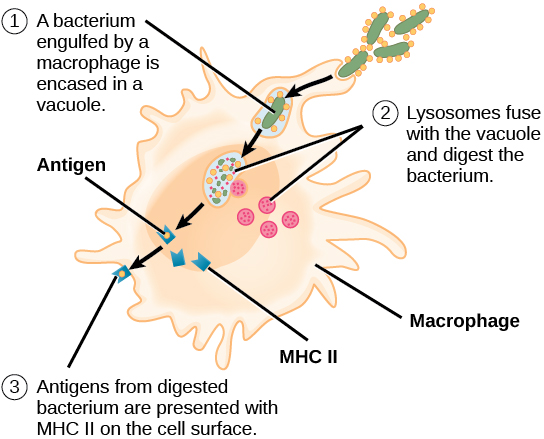

Figure 42.8図 42.8
An APC, such as a macrophage, engulfs and digests a foreign bacterium. An antigen from the bacterium is presented on the cell surface in conjunction with an MHC II molecule. Lymphocytes of the adaptive immune response interact with antigen-embedded MHC II molecules to mature into functional immune cells.
マクロファージなどのAPCが、外来の細菌を取り込んで消化する。細菌由来の抗原がMHC II分子とともに細胞表面へ提示される。獲得免疫応答のリンパ球は、抗原を組み込んだMHC II分子と相互作用し、機能する免疫細胞へ成熟する。