第42章免疫系
42.1 Innate Immune Response42.1 自然免疫応答
Learning Objectives学習目標
By the end of this section, you will be able to do the following:
この節を学ぶと、次のことができるようになる。
- Describe physical and chemical immune barriers免疫における物理的・化学的な障壁を説明する。
- Explain immediate and induced innate immune responses即時の自然免疫応答と、誘導される自然免疫応答を説明する。
- Discuss natural killer cellsナチュラルキラー細胞について論じる。
- Describe major histocompatibility complex I molecules主要組織適合遺伝子複合体I分子を説明する。
- Summarize how the proteins in a complement system function to destroy extracellular pathogens補体系のタンパク質が細胞外の病原体を破壊する仕組みをまとめる。
The immune system comprises both innate and adaptive immune responses. Innate immunity occurs naturally because of genetic factors or physiology; it is not induced by infection or vaccination but works to reduce the workload for the adaptive immune response. Both the innate and adaptive levels of the immune response involve secreted proteins, receptor-mediated signaling, and intricate cell-to-cell communication. The innate immune system developed early in animal evolution, roughly a billion years ago, as an essential response to infection. Innate immunity has a limited number of specific targets: any pathogenic threat triggers a consistent sequence of events that can identify the type of pathogen and either clear the infection independently or mobilize a highly specialized adaptive immune response. For example, tears and mucus secretions contain microbicidal factors.
英語のヒント
免疫系は自然免疫応答と獲得免疫応答の両方からなる。自然免疫は遺伝的要因や生理機能によって生来備わっており、感染やワクチン接種によって誘導されるものではない。獲得免疫応答の負担を減らす働きをする。どちらの免疫応答にも、分泌タンパク質、受容体を介したシグナル伝達、複雑な細胞間の情報伝達が関わる。自然免疫系は、感染への不可欠な応答として、約10億年前という動物進化の初期に発達した。自然免疫が特異的に認識する標的の種類は限られている。病原性の脅威が生じると、一定の一連の反応が引き起こされる。それによって病原体の種類を識別し、単独で感染を除去するか、高度に特殊化した獲得免疫応答を動員する。例えば、涙や粘液の分泌物には、微生物を殺す因子が含まれる。
Physical and Chemical Barriers物理的・化学的な障壁
Before any immune factors are triggered, the skin functions as a continuous, impassable barrier to potentially infectious pathogens. Pathogens are killed or inactivated on the skin by desiccation (drying out) and by the skin’s acidity. In addition, beneficial microorganisms that coexist on the skin compete with invading pathogens, preventing infection. Regions of the body that are not protected by skin (such as the eyes and mucus membranes) have alternative methods of defense, such as tears and mucus secretions that trap and rinse away pathogens, and cilia in the nasal passages and respiratory tract that push the mucus with the pathogens out of the body. Throughout the body are other defenses, such as the low pH of the stomach (which inhibits the growth of pathogens), blood proteins that bind and disrupt bacterial cell membranes, and the process of urination (which flushes pathogens from the urinary tract).
英語のヒント
免疫因子が作動する前から、皮膚は、感染を起こし得る病原体に対する連続した通過不能の障壁として働く。皮膚上の病原体は、乾燥と皮膚の酸性によって死滅または不活化される。さらに、皮膚に共存する有益な微生物が、侵入してくる病原体と競合して感染を防ぐ。皮膚に保護されていない部分(眼や粘膜など)には、別の防御方法がある。病原体を捕らえて洗い流す涙や粘液の分泌、病原体を含む粘液を体外へ押し出す鼻腔や気道の繊毛などである。体の各所には、ほかにも防御がある。胃の低いpH(病原体の増殖を抑える)、細菌の細胞膜に結合して破壊する血液中のタンパク質、排尿(尿路から病原体を洗い流す)などがその例である。
Despite these barriers, pathogens may enter the body through skin abrasions or punctures, or by collecting on mucosal surfaces in large numbers that overcome the mucus or cilia. Some pathogens have evolved specific mechanisms that allow them to overcome physical and chemical barriers. When pathogens do enter the body, the innate immune system responds with inflammation, pathogen engulfment, and secretion of immune factors and proteins.
英語のヒント
こうした障壁があっても、病原体は皮膚の擦り傷や刺し傷から体内へ入ることがある。また、粘膜の表面に大量に集まり、粘液や繊毛の防御を突破する場合もある。一部の病原体は、物理的・化学的な障壁を突破する特別な仕組みを進化させてきた。病原体が実際に体内へ入ると、自然免疫系は、炎症、病原体の取り込み、免疫因子やタンパク質の分泌によって応答する。
Pathogen Recognition病原体の認識
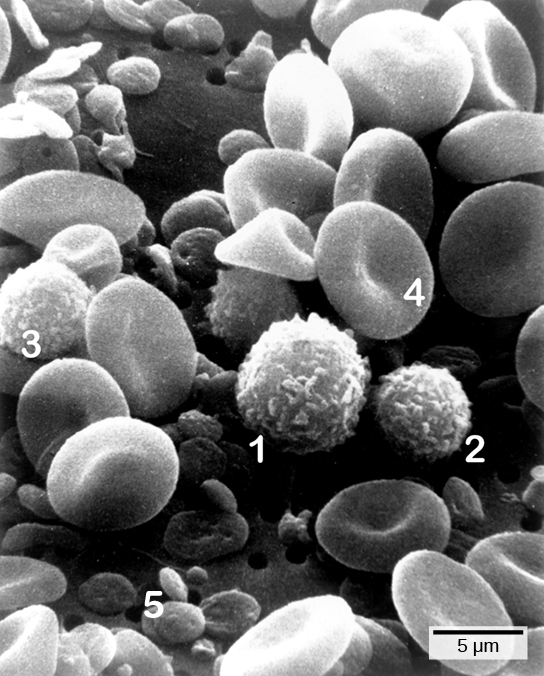
An infection may be intracellular or extracellular, depending on the pathogen. All viruses infect cells and replicate within those cells (intracellularly), whereas bacteria and other parasites may replicate intracellularly or extracellularly, depending on the species. The innate immune system must respond accordingly: by identifying the extracellular pathogen and/or by identifying host cells that have already been infected. When a pathogen enters the body, cells in the blood and lymph detect the specific pathogen-associated molecular patterns (PAMPs) on the pathogen’s surface. PAMPs are carbohydrate, polypeptide, and nucleic acid “signatures” that are expressed by viruses, bacteria, and parasites but which differ from molecules on host cells. The immune system has specific cells, described in Figure 42.2 and shown in Figure 42.3, with receptors that recognize these PAMPs. A macrophage is a large phagocytic cell that engulfs foreign particles and pathogens. Macrophages recognize PAMPs via complementary pattern recognition receptors (PRRs). PRRs are molecules on macrophages and dendritic cells which are in contact with the external environment. A monocyte is a type of white blood cell that circulates in the blood and lymph and differentiates into macrophages after it moves into infected tissue. Dendritic cells bind molecular signatures of pathogens and promote pathogen engulfment and destruction. Toll-like receptors (TLRs) are a type of PRR that recognizes molecules that are shared by pathogens but distinguishable from host molecules. TLRs are present in invertebrates as well as vertebrates, and appear to be one of the most ancient components of the immune system. TLRs have also been identified in the mammalian nervous system.
英語のヒント
感染は、病原体によって細胞内で起こる場合と細胞外で起こる場合がある。すべてのウイルスは細胞に感染し、その細胞の内部で複製する(細胞内)。これに対し、細菌や他の寄生生物は、種に応じて細胞内または細胞外で増殖する。自然免疫系は、それに応じて、細胞外の病原体を識別したり、すでに感染した宿主細胞を識別したりして応答しなければならない。病原体が体内に入ると、血液やリンパ中の細胞が、病原体の表面にある特有の病原体関連分子パターン(PAMP)を検出する。PAMPは、ウイルス、細菌、寄生生物が発現する炭水化物、ポリペプチド、核酸の「目印」であり、宿主細胞の分子とは異なる。免疫系には、これらのPAMPを認識する受容体を備えた特定の細胞がある。その説明を図42.2に、姿を図42.3に示す。マクロファージは、異物の粒子や病原体を取り込む大型の食細胞である。相補的なパターン認識受容体(PRR)を介してPAMPを認識する。PRRは、外部環境と接するマクロファージや樹状細胞上の分子である。単球は、血液やリンパ中を循環する白血球の一種で、感染した組織へ移動した後、マクロファージへ分化する。樹状細胞は病原体の分子的な目印に結合し、病原体の取り込みと破壊を促す。Toll様受容体(TLR)はPRRの一種で、病原体に共通し、宿主の分子とは区別できる分子を認識する。TLRは脊椎動物だけでなく無脊椎動物にも存在し、免疫系の最も古い構成要素の1つと考えられる。哺乳類の神経系でも同定されている。
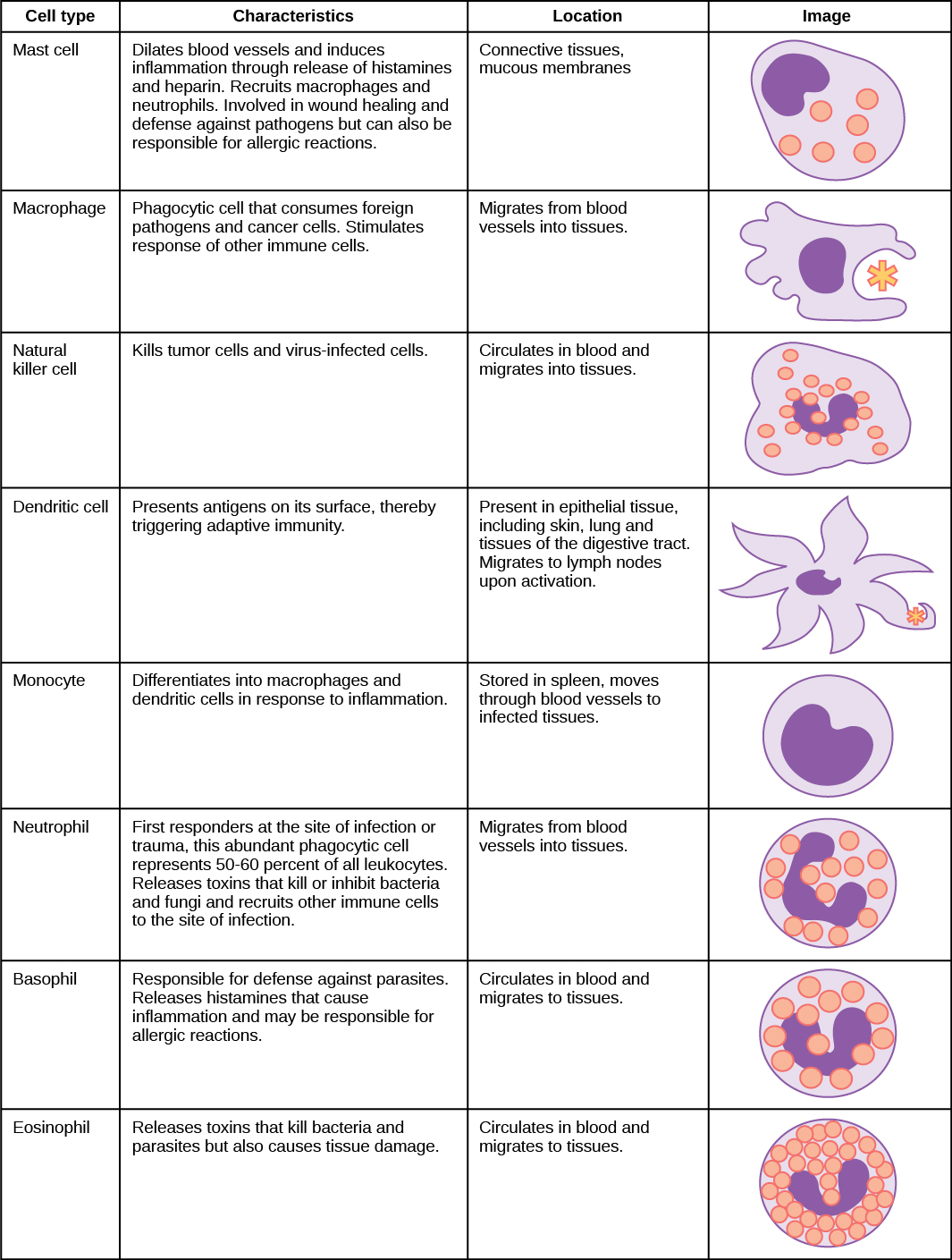

Figure 42.2図 42.2
The characteristics and location of cells involved in the innate immune system are described. (credit: modification of work by NIH)
自然免疫系に関わる細胞の特徴と分布。(出典:NIHの作品を改変)
OpenStax, Rice University; Biology 2e. (credit: modification of work by Bruce Wetzel, Harry Schaefer, NCI; scale-bar data from Matt Russell) · CC BY 4.0 · Source出典

Figure 42.3図 42.3
Cells of the blood include (1) monocytes, (2) lymphocytes, (3) neutrophils, (4) red blood cells, and (5) platelets. Note the very similar morphologies of the leukocytes (1, 2, 3). (credit: modification of work by Bruce Wetzel, Harry Schaefer, NCI; scale-bar data from Matt Russell)
血液の細胞には、(1)単球、(2)リンパ球、(3)好中球、(4)赤血球、(5)血小板がある。白血球(1、2、3)の形態がよく似ていることに注目しよう。(出典:Bruce Wetzel、Harry Schaefer、NCIの作品を改変。スケールバーのデータ:Matt Russell)