第23章原生生物
Rhizariaリザリア
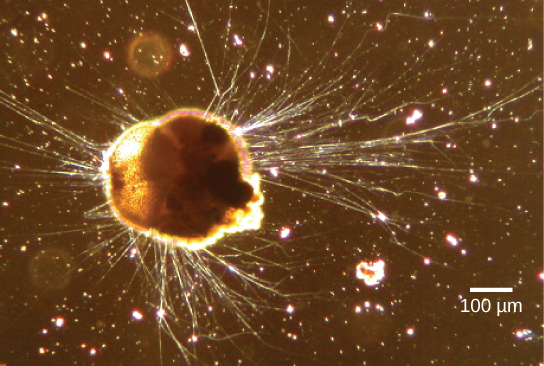
The Rhizaria supergroup includes many of the amoebas with thin threadlike, needle-like or root-like pseudopodia (Figure 23.17), rather than the broader lobed pseudopodia of the Amoebozoa. Many rhizarians make elaborate and beautiful tests—armor-like coverings for the body of the cell—composed of calcium carbonate, silicon, or strontium salts. Rhizarians have important roles in both carbon and nitrogen cycles. When rhizarians die, and their tests sink into deep water, the carbonates are out of reach of most decomposers, locking carbon dioxide away from the atmosphere. In general, this process by which carbon is transported deep into the ocean is described as the biological carbon pump, because carbon is “pumped” to the ocean depths where it is inaccessible to the atmosphere as carbon dioxide. The biological carbon pump is a crucial component of the carbon cycle that maintains lower atmospheric carbon dioxide levels. Foraminiferans are unusual in that they are the only eukaryotes known to participate in the nitrogen cycle by denitrification, an activity usually served only by prokaryotes.
英語のヒント
リザリアには、アメーボゾアの幅広い葉状仮足とは異なり、細い糸状、針状、根状の仮足をもつアメーバの多くが含まれる(図23.17)。多くのリザリアは、炭酸カルシウム、ケイ素、ストロンチウム塩からなる、細胞体をよろいのように覆う精巧で美しい殻を作る。リザリアは、炭素循環と窒素循環の両方で重要な役割を担う。リザリアが死んで殻が深海へ沈むと、炭酸塩は大部分の分解者が届かない場所へ移り、二酸化炭素が大気から隔離される。一般に、このように炭素が深海へ運ばれる過程を、生物学的炭素ポンプという。炭素が海の深部へ「ポンプで送られ」、二酸化炭素として大気へ戻れなくなるためである。生物学的炭素ポンプは、低い大気中二酸化炭素濃度を維持する、炭素循環の重要な構成要素である。有孔虫は、通常は原核生物だけが行う脱窒によって窒素循環に関与することが知られた唯一の真核生物である点で、特殊である。
OpenStax, Rice University; Biology 2e. (credit: modification of work by Scott Fay, UC Berkeley; scale-bar data from Matt Russell) · CC BY 4.0 · Source出典
Figure 23.17図 23.17
Rhizaria. Ammonia tepida, a Rhizaria species viewed here using phase contrast light microscopy, exhibits many threadlike pseudopodia. It also has a chambered calcium carbonate shell or test. (credit: modification of work by Scott Fay, UC Berkeley; scale-bar data from Matt Russell)
リザリア。位相差光学顕微鏡で観察したリザリアの一種Ammonia tepidaは、多くの糸状仮足を示す。内部が小室に分かれた炭酸カルシウムの殻ももつ。(クレジット:UC BerkeleyのScott Fayによる作品を改変。スケールバーのデータ:Matt Russell)
Foraminiferans有孔虫
Foraminiferans, or forams, are unicellular heterotrophic protists, ranging from approximately 20 micrometers to several centimeters in length, and occasionally resembling tiny snails (Figure 23.18). As a group, the forams exhibit porous shells, called tests that are built from various organic materials and typically hardened with calcium carbonate. The tests may house photosynthetic algae, which the forams can harvest for nutrition. Foram pseudopodia extend through the pores and allow the forams to move, feed, and gather additional building materials. Typically, forams are associated with sand or other particles in marine or freshwater habitats. Foraminiferans are also useful as indicators of pollution and changes in global weather patterns.
英語のヒント
有孔虫は、長さ約20マイクロメートルから数センチメートルの単細胞従属栄養性原生生物で、小さなカタツムリに似て見えることもある(図23.18)。有孔虫の群は、多様な有機物から作られ、通常は炭酸カルシウムで硬くなった、多孔性の殻をもつ。殻には光合成藻類がすむことがあり、有孔虫はそれを栄養源として利用できる。有孔虫の仮足は孔を通って伸び、移動、摂食、追加の殻材料の収集を可能にする。通常、有孔虫は海水や淡水の生息環境で、砂や他の粒子に付随している。有孔虫は、汚染や地球規模の気象パターンの変化の指標としても有用である。
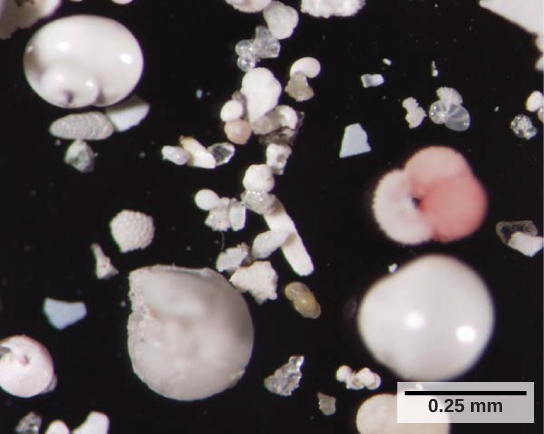


Figure 23.18図 23.18
Foraminiferan Tests. These shells from foraminifera sank to the sea floor. (credit: Deep East 2001, NOAA/OER)
有孔虫の殻。これらの有孔虫の殻は、海底へ沈んだものである。(クレジット:Deep East 2001、NOAA/OER)
Radiolarians放散虫
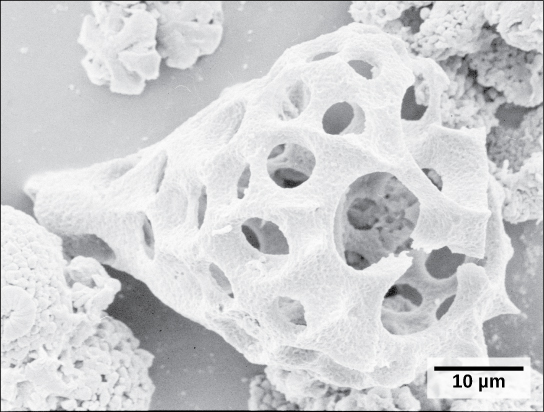
A second subtype of Rhizaria, the radiolarians, exhibit intricate exteriors of glassy silica with radial or bilateral symmetry (Figure 23.19). Needle-like pseudopods supported by microtubules radiate outward from the cell bodies of these protists and function to catch food particles. The shells of dead radiolarians sink to the ocean floor, where they may accumulate in 100 meter-thick depths. Preserved, sedimented radiolarians are very common in the fossil record.
英語のヒント
リザリアの第2の類型である放散虫は、放射相称または左右相称の、ガラス質のシリカからなる精巧な外殻をもつ(図23.19)。微小管に支えられた針状の仮足が、細胞体から放射状に外へ伸び、食物粒子を捕らえる。死んだ放散虫の殻は海底へ沈み、厚さ100メートルに達する堆積物を作ることがある。堆積して保存された放散虫は、化石記録で非常によく見られる。
OpenStax, Rice University; Biology 2e. (credit: modification of work by Hannes Grobe, Alfred Wegener Institute; scale-bar data from Matt Russell) · CC BY 4.0 · Source出典

Figure 23.19図 23.19
Radiolarian shell. This fossilized radiolarian shell was imaged using a scanning electron microscope. (credit: modification of work by Hannes Grobe, Alfred Wegener Institute; scale-bar data from Matt Russell)
放散虫の殻。化石化した放散虫の殻を、走査電子顕微鏡で撮影したもの。(クレジット:Alfred Wegener InstituteのHannes Grobeによる作品を改変。スケールバーのデータ:Matt Russell)
Cercozoaケルコゾア
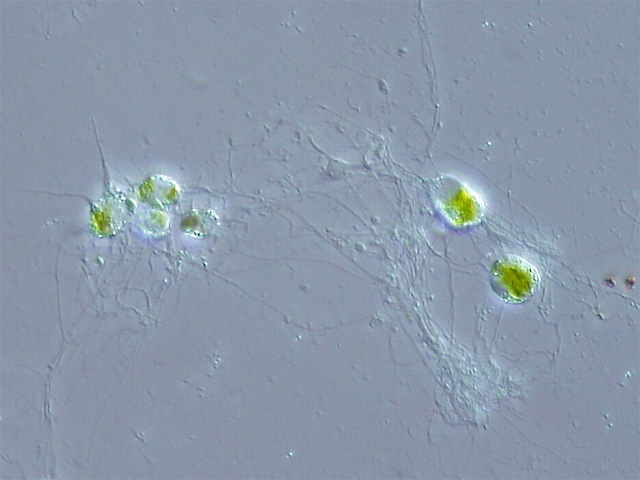
The Cercozoa are both morphologically and metabolically diverse, and include both naked and shelled forms. The Chlorarachniophytes (Figure 23.20) are photosynthetic, having acquired chloroplasts by secondary endosymbiosis. The chloroplast contains a remnant of the chlorophyte endosymbiont nucleus, sandwiched between the two sets of chloroplast membranes. Vampyrellids or "vampire amoebae," as their name suggests, obtain their nutrients by thrusting a pseudopod into the interior of other cells and sucking out their contents.
英語のヒント
ケルコゾアは、形態と代謝の両面で多様であり、裸のものと殻をもつものの両方を含む。クロララクニオン藻(図23.20)は、二次的な細胞内共生で葉緑体を得た光合成生物である。葉緑体には、クロロフィタの細胞内共生体の核の名残が、二組の葉緑体膜の間に挟まれて残っている。バンピレラ類、すなわち「吸血アメーバ」は、その名が示すように、他の細胞の内部へ仮足を突き入れ、内容物を吸い出して栄養を得る。
NEON / NEON_ja; Chlorarachnion reptans. OpenStax, Biology 2e adaptation. · CC BY-SA 2.5 · Source出典

Figure 23.20図 23.20
A Chlorarachniophyte. This rhizarian is mixotrophic, and can obtain nutrients both by photosynthesis and by trapping various microorganisms with its network of pseudopodia. (credit: By ja:User:NEON / commons:User:NEON_ja (Own work) [CC BY-SA 2.5 (http://creativecommons.org/licenses/by-sa/2.5) or CC BY-SA 2.5 (http://creativecommons.org/licenses/by-sa/2.5)], via Wikimedia Commons)
クロララクニオン藻。このリザリアは混合栄養性で、光合成と、仮足の網でさまざまな微生物を捕らえることの両方で栄養を得られる。(クレジット:ja:User:NEON / commons:User:NEON_ja、本人の作品、CC BY-SA 2.5(http://creativecommons.org/licenses/by-sa/2.5)またはCC BY-SA 2.5(http://creativecommons.org/licenses/by-sa/2.5)、Wikimedia Commons経由)
Chromalveolataクロムアルベオラータ
Current evidence suggests that species classified as chromalveolates are derived from a common ancestor that engulfed a photosynthetic red algal cell, which itself had already evolved chloroplasts from an endosymbiotic relationship with a photosynthetic prokaryote. Therefore, the ancestor of chromalveolates is believed to have resulted from a secondary endosymbiotic event. However, some chromalveolates appear to have lost red alga-derived plastid organelles or lack plastid genes altogether. Therefore, this supergroup should be considered a hypothesis-based working group that is subject to change. Chromalveolates include very important photosynthetic organisms, such as diatoms, brown algae, and significant disease agents in animals and plants. The chromalveolates can be subdivided into alveolates and stramenopiles.
英語のヒント
現在の証拠は、クロムアルベオラータに分類される種が、光合成を行う紅藻細胞を取り込んだ共通祖先に由来することを示唆する。その紅藻細胞自体も、光合成原核生物との細胞内共生関係から、すでに葉緑体を進化させていた。したがって、クロムアルベオラータの祖先は、二次的な細胞内共生によって生じたと考えられる。しかし、一部のクロムアルベオラータは、紅藻由来の色素体を失ったように見えたり、色素体遺伝子をまったく欠いたりしている。そのため、このスーパーグループは、変更されうる仮説に基づく暫定的な群として捉えるべきである。クロムアルベオラータには、珪藻や褐藻などの非常に重要な光合成生物と、動植物の重要な病原体が含まれる。この群は、アルベオラータとストラメノパイルに分けられる。