第23章原生生物
Green Algae: Chlorophytes and Charophytes緑藻:クロロフィタとシャジクモ類
The most abundant group of algae is the green algae. The green algae exhibit features similar to those of the land plants, particularly in terms of chloroplast structure. In both green algae and plants, carbohydrates are stored in the plastid. That this group of protists shared a relatively recent common ancestor with land plants is well supported. The green algae are subdivided into the chlorophytes and the charophytes. The charophytes are the closest living relatives to land plants and resemble them in morphology and reproductive strategies. The familiar Spirogyra is a charophyte. Charophytes are common in wet habitats, and their presence often signals a healthy ecosystem.
英語のヒント
藻類の中で最も豊富なのは緑藻である。緑藻は、特に葉緑体の構造の点で、陸上植物に似た特徴を示す。緑藻と植物は、どちらも炭水化物を色素体に貯蔵する。この原生生物群が、陸上植物と比較的最近の共通祖先をもつことは、十分に裏づけられている。緑藻は、クロロフィタとシャジクモ類に分けられる。シャジクモ類は、現生生物の中で陸上植物に最も近縁であり、形態と生殖戦略が似ている。よく知られたアオミドロは、シャジクモ類である。シャジクモ類は湿った生息環境によく見られ、その存在は、健全な生態系のしるしとなることが多い。
The chlorophytes exhibit great diversity of form and function. Chlorophytes primarily inhabit freshwater and damp soil, and are a common component of plankton. Chlamydomonas is a simple, unicellular chlorophyte with a pear-shaped morphology and two opposing, anterior flagella that guide this protist toward light sensed by its eyespot. More complex chlorophyte species exhibit haploid gametes and spores that resemble Chlamydomonas.
英語のヒント
クロロフィタは、形と機能に大きな多様性を示す。主に淡水や湿った土に生息し、プランクトンの一般的な構成要素でもある。クラミドモナスは、洋ナシ形で単細胞の単純なクロロフィタであり、前方に互いに向き合う2本の鞭毛をもつ。この鞭毛は、眼点で感知した光の方向へ個体を導く。より複雑なクロロフィタの種は、クラミドモナスに似た半数体の配偶子と胞子をもつ。
The chlorophyte Volvox is one of only a few examples of a colonial organism, which behaves in some ways like a collection of individual cells, but in other ways like the specialized cells of a multicellular organism (Figure 23.11). Volvox colonies contain 500 to 60,000 cells, each with two flagella, contained within a hollow, spherical matrix composed of a gelatinous glycoprotein secretion. Individual cells in a Volvox colony move in a coordinated fashion and are interconnected by cytoplasmic bridges. Only a few of the cells reproduce to create daughter colonies, an example of basic cell specialization in this organism. Daughter colonies are produced with their flagella on the inside and have to evert as they are released.
英語のヒント
クロロフィタのボルボックスは、群体を作る生物の数少ない例の一つである。ある点では個々の細胞の集まりのように振る舞い、別の点では多細胞生物の特殊化した細胞のように振る舞う(図23.11)。ボルボックスの群体は500〜60,000個の細胞を含み、各細胞は2本の鞭毛をもつ。細胞は、ゼラチン状の糖タンパク質分泌物からなる、中空の球形の基質の中に収まっている。群体内の各細胞は協調して動き、細胞質の橋で互いにつながっている。娘群体を作るために生殖するのは、一部の細胞だけであり、この生物における基本的な細胞の特殊化の例となる。娘群体は鞭毛が内側を向いた状態で作られ、放出される際に裏返らなければならない。
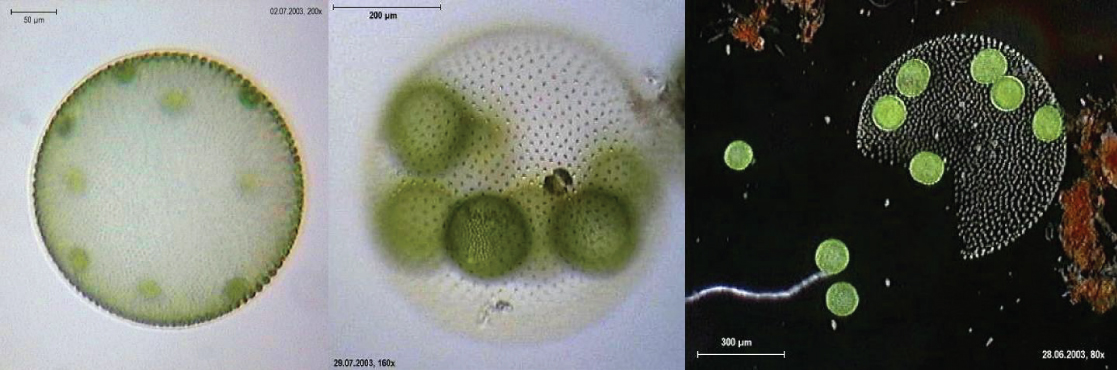
Dr. Ralf Wagner; Volvox aureus. The CC BY option is selected from the original dual license. OpenStax, Biology 2e adaptation. · CC BY 3.0 · Source出典
Figure 23.11図 23.11
Volvox. Volvox aureus is a green alga in the supergroup Archaeplastida. This species exists as a colony, consisting of cells immersed in a gel-like matrix and intertwined with each other via hair-like cytoplasmic extensions. (credit: Dr. Ralf Wagner)
ボルボックス。Volvox aureusは、アーケプラスチダに属する緑藻である。この種は、ゲル状の基質に埋め込まれた細胞が、毛のような細胞質の突起を通じて互いにつながる群体として存在する。(クレジット:Dr. Ralf Wagner)
True multicellular organisms, such as the sea lettuce, Ulva, are also represented among the chlorophytes. In addition, some chlorophytes exist as large, multinucleate, single cells. Species in the genus Caulerpa exhibit flattened fern-like foliage and can reach lengths of 3 meters (Figure 23.12). Caulerpa species undergo nuclear division, but their cells do not complete cytokinesis, remaining instead as massive and elaborate single cells.
英語のヒント
アオサ属Ulvaのような真の多細胞生物も、クロロフィタに含まれる。また、一部のクロロフィタは、巨大な多核の単一細胞として存在する。Caulerpa属の種は、平たいシダ状の葉をもち、長さ3メートルに達することがある(図23.12)。Caulerpa属は核分裂を行うが、細胞質分裂は完了せず、巨大で精巧な単一細胞のままでいる。
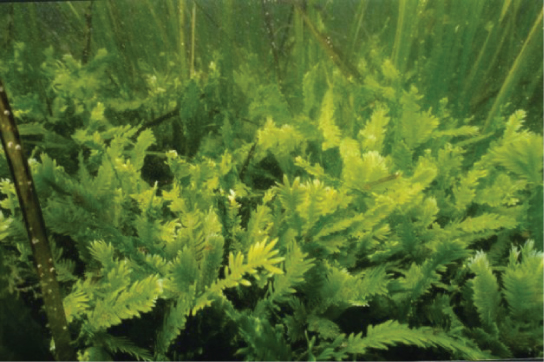
OpenStax, Rice University; Biology 2e. (credit: NOAA). An interesting question is how a single cell can produce such complex shapes. · CC BY 4.0 · Source出典
Figure 23.12図 23.12
A multinucleate alga. Caulerpa taxifolia is a chlorophyte consisting of a single cell containing potentially thousands of nuclei. (credit: NOAA). An interesting question is how a single cell can produce such complex shapes.
多核の藻類。Caulerpa taxifoliaは、数千もの核を含みうる単一細胞からなるクロロフィタである。(クレジット:NOAA)一つの細胞が、どのようにこれほど複雑な形を作れるのかは、興味深い問いである。
Amoebozoaアメーボゾア
Like the Archaeplastida, the Amoebozoa include species with single cells, species with large multinucleated cells, and species that have multicellular phases. Amoebozoan cells characteristically exhibit pseudopodia that extend like tubes or flat lobes. These pseudopods project outward from anywhere on the cell surface and can anchor to a substrate. The protist then transports its cytoplasm into the pseudopod, thereby moving the entire cell. This type of motion is similar to the cytoplasmic streaming used to move organelles in the Archaeplastida, and is also used by other protists as a means of locomotion or as a method to distribute nutrients and oxygen. The Amoebozoa include both free-living and parasitic species.
英語のヒント
アーケプラスチダと同様に、アメーボゾアには、単細胞の種、大きな多核細胞をもつ種、多細胞の段階をもつ種が含まれる。アメーボゾアの細胞は、管状または平たい葉状に伸びる仮足を特徴とする。この仮足は、細胞表面のどこからでも外へ突き出し、基質に固定できる。次に原生生物は、細胞質を仮足へ移し、それによって細胞全体を動かす。この運動は、アーケプラスチダが細胞小器官を動かすために用いる原形質流動に似ており、他の原生生物も、移動手段や、栄養分と酸素を分配する方法として用いる。アメーボゾアには、独立生活する種と寄生する種の両方が含まれる。
Gymnomoebae裸アメーバ類
The Gymnamoeba or lobose amoebae include both naked amoebae like the familiar Amoeba proteus and shelled amoebae, whose bodies protrude like snails from their protective tests. Amoeba proteus is a large amoeba about 500 µm in diameter but is dwarfed by the multinucleate amoebae Pelomyxa, which can be 10 times its size. Although Pelomyxa may have hundreds of nuclei, it has lost its mitochondria, but replaced them with bacterial endosymbionts. The secondary loss or modification of mitochondria is a feature also seen in other protist groups.
英語のヒント
裸アメーバ類、すなわち葉状仮足をもつアメーバ類には、よく知られたAmoeba proteusのような裸のアメーバと、防御用の殻からカタツムリのように体を突き出す有殻アメーバの両方が含まれる。Amoeba proteusは直径約500 µmの大型アメーバだが、最大でその10倍の大きさになる多核アメーバのPelomyxaに比べれば小さい。Pelomyxaは数百個の核をもつことがあるが、ミトコンドリアを失い、その代わりに細胞内共生細菌をもつ。ミトコンドリアの二次的な喪失や変型は、他の原生生物群にも見られる特徴である。
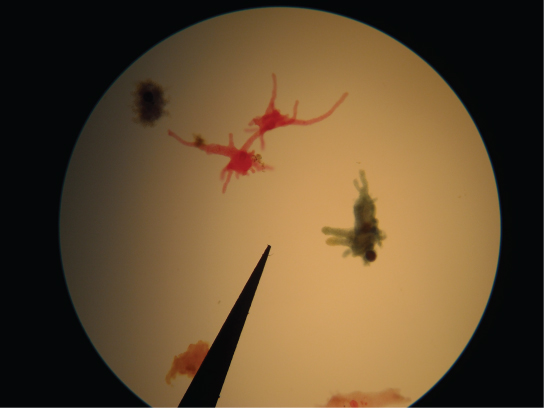


Figure 23.13図 23.13
Amoeba. Amoebae with tubular and lobe-shaped pseudopodia are seen under a microscope. These isolates would be morphologically classified as amoebozoans.
英語のヒント
アメーバ。管状や葉状の仮足をもつアメーバを顕微鏡で観察したもの。これらの分離株は、形態に基づけばアメーボゾアに分類される。