第23章原生生物
Plastids色素体
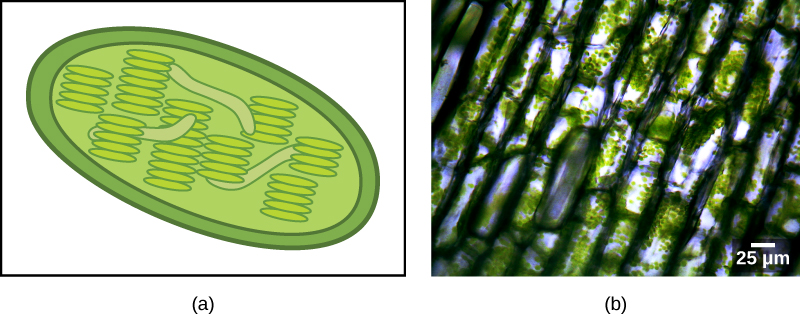
Some groups of eukaryotes are photosynthetic. Their cells contain, in addition to the standard eukaryotic organelles, another kind of organelle called a plastid. When such cells are carrying out photosynthesis, their plastids are rich in the pigment chlorophyll a and a range of other pigments, called accessory pigments, which are involved in harvesting energy from light. Photosynthetic plastids are called chloroplasts (Figure 23.3).
英語のヒント
真核生物の一部の群は光合成を行う。その細胞には、通常の真核細胞の細胞小器官に加え、色素体と呼ばれる別種の細胞小器官がある。こうした細胞が光合成を行うとき、色素体にはクロロフィルaという色素と、補助色素と呼ばれるさまざまな色素が豊富に含まれる。これらは、光からエネルギーを得ることに関わる。光合成を行う色素体は、葉緑体と呼ばれる(図23.3)。
OpenStax, Rice University; Biology 2e. (credit b: modification of work by Brandon Zierer; scale-bar data from Matt Russell) · CC BY 4.0 · Source出典

Figure 23.3図 23.3
Chloroplasts. (a) This chloroplast cross-section illustrates its elaborate inner membrane organization. Stacks of thylakoid membranes compartmentalize photosynthetic enzymes and provide scaffolding for chloroplast DNA. (b) In this micrograph of Elodea sp., the chloroplasts can be seen as small green spheres. (credit b: modification of work by Brandon Zierer; scale-bar data from Matt Russell)
英語のヒント
葉緑体。(a)葉緑体の断面は、精巧な内部膜構造を示す。積み重なったチラコイド膜は、光合成酵素を区画に分け、葉緑体DNAの足場を提供する。(b)Elodea属の顕微鏡写真では、葉緑体が小さな緑色の球として見える。(クレジットb:Brandon Ziererの作品を改変。スケールバーのデータ:Matt Russell)
Like mitochondria, plastids appear to have an endosymbiotic origin. This hypothesis was also proposed and championed with the first direct evidence by Lynn Margulis. We now know that plastids are derived from cyanobacteria that lived inside the cells of an ancestral, aerobic, heterotrophic eukaryote. This is called primary endosymbiosis, and plastids of primary origin are surrounded by two membranes. However, the best evidence is that the acquisition of cyanobacterial endosymbionts has happened twice in the history of eukaryotes. In one case, the common ancestor of the major lineage/supergroup Archaeplastida took on a cyanobacterial endosymbiont; in the other, the ancestor of the small amoeboid rhizarian taxon, Paulinella, took on a different cyanobacterial endosymbiont. Almost all photosynthetic eukaryotes are descended from the first event, and only a couple of species are derived from the other, which in evolutionary terms, appears to be more recent.
英語のヒント
ミトコンドリアと同様、色素体も細胞内共生に由来するようである。この仮説も、リン・マーギュリスが最初の直接証拠とともに提案し、支持した。現在、色素体は、好気性・従属栄養性の祖先的な真核生物の細胞内に住んだ、シアノバクテリアに由来すると分かっている。これは一次細胞内共生と呼ばれ、一次由来の色素体は二つの膜に囲まれる。しかし、最良の証拠によれば、シアノバクテリアの細胞内共生体を獲得した出来事は、真核生物の歴史で二度起こった。一方では、主要系統・スーパーグループであるアーケプラスチダの共通祖先が、シアノバクテリアを取り込んだ。もう一方では、小さなアメーバ状のリザリアの分類群Paulinellaの祖先が、別のシアノバクテリアを取り込んだ。ほぼすべての光合成真核生物は最初の出来事に由来し、もう一方に由来するのは、わずか数種だけである。後者は進化的には、より最近の出来事のようである。
Cyanobacteria are a group of Gram-negative bacteria with all the conventional structures of the group. However, unlike most prokaryotes, they have extensive, internal membrane-bound sacs called thylakoids. Chlorophyll is a component of these membranes, as are many of the proteins of the light reactions of photosynthesis. Cyanobacteria also have the peptidoglycan wall and lipopolysaccharide layer associated with Gram-negative bacteria.
英語のヒント
シアノバクテリアはグラム陰性細菌の群であり、その群の通常の構造をすべてもつ。しかし大半の原核生物と異なり、チラコイドと呼ばれる、膜で囲まれた袋状構造が内部に広く発達している。クロロフィルはこの膜の成分であり、光合成の明反応に関わる多くのタンパク質も同様である。また、グラム陰性細菌に特徴的なペプチドグリカンの細胞壁と、リポ多糖層ももつ。
Chloroplasts of primary endosymbiotic origin have thylakoids, a circular DNA chromosome, and ribosomes similar to those of cyanobacteria. As in mitochondria, each chloroplast is surrounded by two membranes. The outer membrane is thought to be derived from the enclosing vacuole of the host, and the inner membrane is thought to be derived from the plasma membrane of the cyanobacterial endosymbiont. In the group of Archaeplastida called the glaucophytes and in the rhizarian Paulinella, a thin peptidoglycan layer is still present between the outer and inner plastid membranes. All other plastids lack this relict of the cyanobacterial wall.
英語のヒント
一次細胞内共生由来の葉緑体は、チラコイド、環状DNA染色体、シアノバクテリアに似たリボソームをもつ。ミトコンドリアと同様に、それぞれ二つの膜に囲まれる。外膜は、宿主の包み込む液胞に由来し、内膜は、共生したシアノバクテリアの細胞膜に由来すると考えられる。アーケプラスチダの灰色藻という群と、リザリアのPaulinellaでは、色素体の外膜と内膜の間に、薄いペプチドグリカン層が今も存在する。ほかのすべての色素体には、シアノバクテリアの細胞壁のこの名残がない。
There is also, as with the case of mitochondria, strong evidence that many of the genes of the endosymbiont were transferred to the nucleus. Plastids, like mitochondria, cannot live independently outside the host. In addition, like mitochondria, plastids are derived from the division of other plastids and never built from scratch. Researchers have suggested that the endosymbiotic event that led to Archaeplastida occurred 1 to 1.5 billion years ago, at least 5 hundred million years after the fossil record suggests that eukaryotes were present.
ミトコンドリアの場合と同様、共生体の遺伝子の多くが核へ移ったという、強い証拠もある。色素体はミトコンドリアと同じく、宿主の外で独立に生きられない。また、別の色素体の分裂から生じ、ゼロから作られることはない。研究者は、アーケプラスチダにつながる細胞内共生が、10億〜15億年前に起こったと提案している。これは、化石記録が示す真核生物の存在より、少なくとも5億年後である。
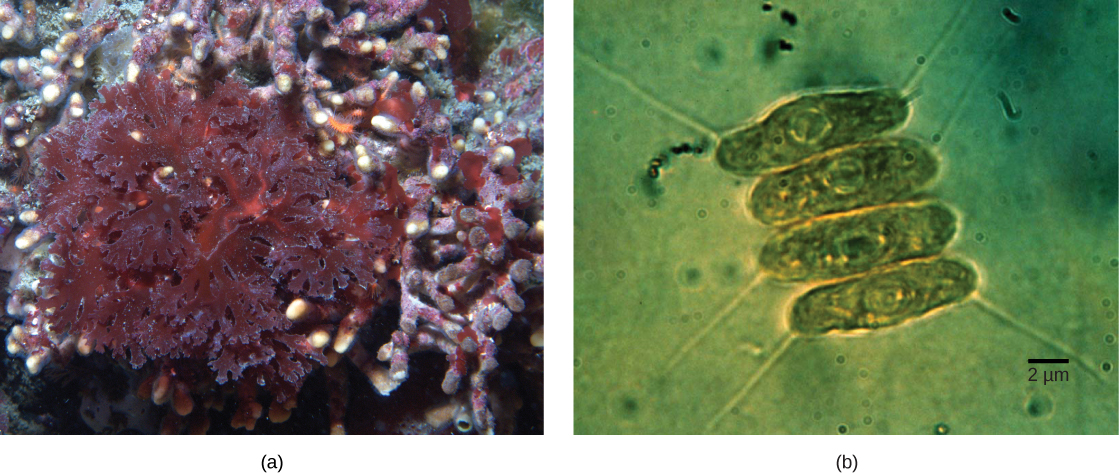
Not all plastids in eukaryotes are derived directly from primary endosymbiosis. Some of the major groups of algae became photosynthetic by secondary endosymbiosis, that is, by taking in either green algae or red algae (both from Archaeplastida) as endosymbionts (Figure 23.4). Numerous microscopic and genetic studies have supported this conclusion. Secondary plastids are surrounded by three or more membranes, and some secondary plastids even have clear remnants of the nucleus (nucleomorphs) of endosymbiotic algae. There are even cases where tertiary or higher-order endosymbiotic events are the best explanations for the features of some eukaryotic plastids.
英語のヒント
真核生物のすべての色素体が、一次細胞内共生から直接生じたわけではない。藻類の主要な群の一部は、二次細胞内共生によって光合成を行うようになった。つまり、どちらもアーケプラスチダに属する緑藻か紅藻を、細胞内共生体として取り込んだのである(図23.4)。多数の顕微鏡研究と遺伝学研究が、この結論を支持している。二次色素体は三つ以上の膜に囲まれ、一部には、共生藻類の核の明瞭な名残、ヌクレオモルフさえある。真核生物の色素体の特徴を最もよく説明するのが、三次、あるいはさらに高次の細胞内共生である場合さえある。
OpenStax, Rice University; Biology 2e. (credit a: modification of work by Ed Bierman; credit b: modification of work by G. Fahnenstiel, NOAA; scale-bar data from Matt Russell) · CC BY 4.0 · Source出典

Figure 23.4図 23.4
Algae. (a) Red algae and (b) green algae (seen here by light microscopy) share similar DNA sequences with photosynthetic cyanobacteria. Scientists speculate that, in a process called endosymbiosis, an ancestral prokaryote engulfed a photosynthetic cyanobacterium that evolved into modern-day chloroplasts. (credit a: modification of work by Ed Bierman; credit b: modification of work by G. Fahnenstiel, NOAA; scale-bar data from Matt Russell)
藻類。(a)紅藻と、光学顕微鏡で示した(b)緑藻は、光合成性シアノバクテリアと似たDNA配列を共有する。科学者は、細胞内共生という過程で、祖先的な原核生物が光合成性シアノバクテリアを取り込み、それが現代の葉緑体へ進化したと推測している。(クレジットa:Ed Biermanの作品を改変。クレジットb:G. Fahnenstiel、NOAAの作品を改変。スケールバーのデータ:Matt Russell)