第23章原生生物
23.2 Characteristics of Protists23.2 原生生物の特徴
Learning Objectives学習目標
By the end of this section, you will be able to do the following:
この節を学ぶと、次のことができるようになる。
- Describe the cell structure characteristics of protists原生生物の細胞構造の特徴を説明する。
- Describe the metabolic diversity of protists原生生物の代謝の多様性を説明する。
- Describe the life cycle diversity of protists原生生物の生活環の多様性を説明する。
There are over 100,000 described living species of protists, and it is unclear how many undescribed species may exist. Since many protists live as commensals or parasites in other organisms and these relationships are often species-specific, there is a huge potential for protist diversity that matches the diversity of their hosts. Because the name "protist" serves as a catchall term for eukaryotic organisms that are not animal, plant, or fungi, it is not surprising that very few characteristics are common to all protists. On the other hand, familiar characteristics of plants and animals are foreshadowed in various protists.
英語のヒント
現生原生生物には、記載済みの種が10万種以上あり、未記載の種がどれほどあるかは不明である。多くの原生生物は他の生物の内部で片利共生者や寄生者として暮らし、こうした関係は種に特異的であることが多い。そのため、宿主の多様性に見合う非常に大きな原生生物の多様性が、潜在的に存在する。「原生生物」という名称は、動物、植物、菌類でない真核生物をまとめて呼ぶ語なので、すべての原生生物に共通する特徴がごく少ないのは、驚くことではない。一方、植物や動物でおなじみの特徴の兆しが、さまざまな原生生物に見られる。
Cell Structure細胞の構造
The cells of protists are among the most elaborate of all cells. Multicellular plants, animals, and fungi are embedded among the protists in eukaryotic phylogeny. In most plants and animals and some fungi, complexity arises out of multicellularity, tissue specialization, and subsequent interaction because of these features. Although a rudimentary form of multicellularity exists among some of the organisms labelled as “protists,” those that have remained unicellular show how complexity can evolve in the absence of true multicellularity, with the differentiation of cellular morphology and function. A few protists live as colonies that behave in some ways as a group of free-living cells and in other ways as a multicellular organism. Some protists are composed of enormous, multinucleate, single cells that look like amorphous blobs of slime, or in other cases, like ferns. In some species of protists, the nuclei are different sizes and have distinct roles in protist cell function.
英語のヒント
原生生物の細胞は、あらゆる細胞の中でも特に精巧である。真核生物の系統において、多細胞の植物、動物、菌類は、原生生物の間に組み込まれている。大部分の植物や動物、一部の菌類では、多細胞性、組織の特殊化、そしてこうした特徴による相互作用から、複雑さが生じる。「原生生物」と呼ばれる生物の一部には、初歩的な多細胞性が存在する。しかし、単細胞のままのものは、真の多細胞性がなくても、細胞の形態と機能が分化することで、複雑さが進化できることを示している。少数の原生生物は群体で暮らし、ある点では独立生活する細胞の集まりのように、別の点では多細胞生物のように振る舞う。一部の原生生物は、巨大な多核の単一細胞からなり、不定形の粘液の塊のように、あるいはシダのように見える。原生生物の中には、核の大きさが異なり、それぞれが細胞機能で別の役割を担う種もある。
Single protist cells range in size from less than a micrometer to three meters in length to hectares! Protist cells may be enveloped by animal-like cell membranes or plant-like cell walls. Others are encased in glassy silica-based shells or wound with pellicles of interlocking protein strips. The pellicle functions like a flexible coat of armor, preventing the protist from being torn or pierced without compromising its range of motion.
英語のヒント
原生生物の単一細胞の大きさは、1マイクロメートル未満から長さ3メートル、さらには面積数ヘクタールにまで及ぶ。原生生物の細胞は、動物のような細胞膜や、植物のような細胞壁に包まれている場合がある。ガラス質のシリカを主成分とする殻に覆われるものや、かみ合ったタンパク質の帯からなるペリクルに包まれるものもある。ペリクルは柔軟なよろいのように働き、運動範囲を損なわずに、原生生物が引き裂かれたり突き刺されたりするのを防ぐ。
Metabolism代謝
Protists exhibit many forms of nutrition and may be aerobic or anaerobic. Those that store energy by photosynthesis belong to a group of photoautotrophs and are characterized by the presence of chloroplasts. Other protists are heterotrophic and consume organic materials (such as other organisms) to obtain nutrition. Amoebas and some other heterotrophic protist species ingest particles by a process called phagocytosis, in which the cell membrane engulfs a food particle and brings it inward, pinching off an intracellular membranous sac, or vesicle, called a food vacuole (Figure 23.7). In some protists, food vacuoles can be formed anywhere on the body surface, whereas in others, they may be restricted to the base of a specialized feeding structure. The vesicle containing the ingested particle, the phagosome, then fuses with a lysosome containing hydrolytic enzymes to produce a phagolysosome, and the food particle is broken down into small molecules that can diffuse into the cytoplasm and be used in cellular metabolism. Undigested remains ultimately are expelled from the cell via exocytosis.
英語のヒント
原生生物はさまざまな栄養様式を示し、好気性の場合も嫌気性の場合もある。光合成でエネルギーを蓄えるものは光独立栄養生物の群に属し、葉緑体をもつことが特徴である。別の原生生物は従属栄養性で、他の生物などの有機物を摂取して栄養を得る。アメーバや一部の従属栄養性原生生物は、食作用という過程で粒子を取り込む。この過程では、細胞膜が食物粒子を包んで内側へ運び、食胞と呼ばれる膜性の袋、すなわち小胞を細胞内へくびり切る(図23.7)。食胞を体表のどこにでも形成できる原生生物もいれば、特殊化した摂食構造の基部だけに形成するものもいる。取り込んだ粒子を含む小胞であるファゴソームは、次に加水分解酵素を含むリソソームと融合し、ファゴリソソームを作る。食物粒子は小さな分子に分解され、それらは細胞質へ拡散して細胞代謝に利用される。未消化の残りは、最終的にエキソサイトーシスで細胞外へ排出される。
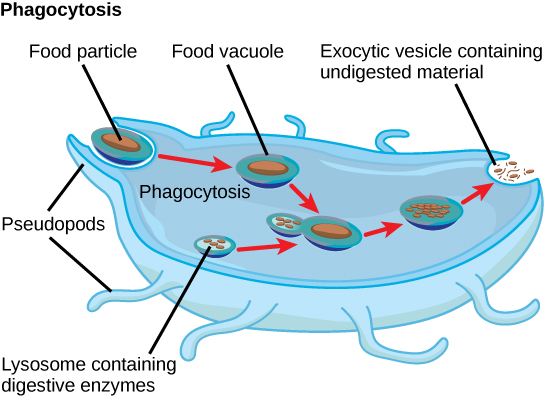
Figure 23.7図 23.7
Phagocytosis. The stages of phagocytosis include the engulfment of a food particle, the digestion of the particle using hydrolytic enzymes contained within a lysosome, and the expulsion of undigested materials from the cell.
食作用。食作用の段階には、食物粒子の取り込み、リソソーム内の加水分解酵素による粒子の消化、未消化物の細胞外への排出がある。
Subtypes of heterotrophs, called saprobes, absorb nutrients from dead organisms or their organic wastes. Some protists can function as mixotrophs, obtaining nutrition by photoautotrophic or heterotrophic routes, depending on whether sunlight or organic nutrients are available.
英語のヒント
従属栄養生物の一類型である腐生生物は、死んだ生物やその有機性の排出物から栄養分を吸収する。一部の原生生物は混合栄養生物として働くことができ、日光や有機栄養物が利用できるかどうかに応じて、光独立栄養または従属栄養によって栄養を得る。
Motility運動性
The majority of protists are motile, but different types of protists have evolved varied modes of movement (Figure 23.8). Some protists have one or more flagella, which they rotate or whip. Others are covered in rows or tufts of tiny cilia that they beat in a coordinated manner to swim. Still others form cytoplasmic extensions called pseudopodia anywhere on the cell, anchor the pseudopodia to a substrate, and pull themselves forward. Some protists can move toward or away from a stimulus, a movement referred to as taxis. For example, movement toward light, termed phototaxis, is accomplished by coupling their locomotion strategy with a light-sensing organ.
英語のヒント
大部分の原生生物は運動性をもつが、その種類に応じて多様な移動様式を進化させてきた(図23.8)。1本以上の鞭毛を回転させたり、むちのように動かしたりする原生生物もいる。別のものは、小さな繊毛の列や束に覆われ、それらを協調させて打ち動かして泳ぐ。さらに別のものは、細胞のどこにでも仮足と呼ばれる細胞質の突起を作り、仮足を基質に固定して、体を前へ引っ張る。一部の原生生物は、刺激へ近づいたり遠ざかったりでき、この運動を走性という。たとえば、光へ近づく運動である走光性は、移動の仕組みと光を感じる器官を結びつけることで実現する。
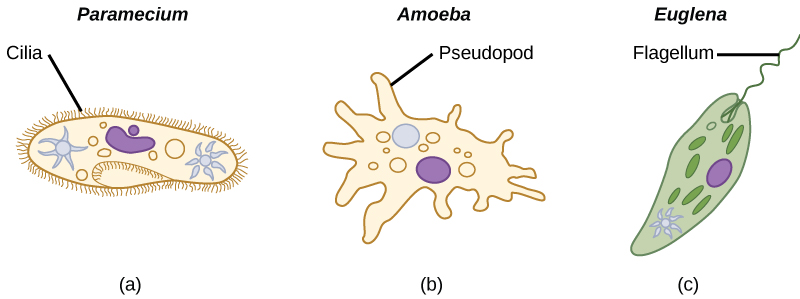


Figure 23.8図 23.8
Locomotor organelles in protists. Protists use various methods for transportation. (a) Paramecium waves hair-like appendages called cilia to propel itself. (b) Amoeba uses lobe-like pseudopodia to anchor itself to a solid surface and pull itself forward. (c) Euglena uses a whip-like tail called a flagellum to propel itself.
英語のヒント
原生生物の運動小器官。原生生物は、さまざまな方法で移動する。(a)ゾウリムシは、繊毛と呼ばれる毛状の付属物を波打たせて進む。(b)アメーバは、葉状の仮足を使って固体表面に固定し、体を前へ引っ張る。(c)ミドリムシは、鞭毛と呼ばれるむち状の尾を使って進む。