第39章呼吸器系
Transport of Carbon Dioxide in the Blood血液中での二酸化炭素の運搬
Carbon dioxide molecules are transported in the blood from body tissues to the lungs by one of three methods: dissolution directly into the blood, binding to hemoglobin, or carried as a bicarbonate ion. Several properties of carbon dioxide in the blood affect its transport. First, carbon dioxide is more soluble in blood than oxygen. About 5 to 7 percent of all carbon dioxide is dissolved in the plasma. Second, carbon dioxide can bind to plasma proteins or can enter red blood cells and bind to hemoglobin. This form transports about 10 percent of the carbon dioxide. When carbon dioxide binds to hemoglobin, a molecule called carbaminohemoglobin is formed. Binding of carbon dioxide to hemoglobin is reversible. Therefore, when it reaches the lungs, the carbon dioxide can freely dissociate from the hemoglobin and be expelled from the body.
英語のヒント
二酸化炭素分子は、血液に直接溶ける、ヘモグロビンに結合する、炭酸水素イオンとして運ばれる、という3つの方法のいずれかで、体の組織から肺へ運ばれる。血中の二酸化炭素のいくつかの性質が、その運搬に関わる。第1に、二酸化炭素は酸素より血液に溶けやすい。全二酸化炭素の約5〜7%は血漿に溶けている。第2に、二酸化炭素は血漿タンパク質に結合するか、赤血球へ入ってヘモグロビンに結合できる。この形で約10%が運ばれる。二酸化炭素がヘモグロビンに結合すると、カルバミノヘモグロビンという分子ができる。この結合は可逆的である。そのため肺へ達すると、二酸化炭素はヘモグロビンから容易に解離し、体外へ排出される。
Third, the majority of carbon dioxide molecules (85 percent) are carried as part of the bicarbonate buffer system. In this system, carbon dioxide diffuses into the red blood cells. Carbonic anhydrase (CA) within the red blood cells quickly converts the carbon dioxide into carbonic acid (H2CO3). Carbonic acid is an unstable intermediate molecule that immediately dissociates into bicarbonate ions and hydrogen (H+) ions. Since carbon dioxide is quickly converted into bicarbonate ions, this reaction allows for the continued uptake of carbon dioxide into the blood down its concentration gradient. It also results in the production of H+ ions. If too much H+ is produced, it can alter blood pH. However, hemoglobin binds to the free H+ ions and thus limits shifts in pH. The newly synthesized bicarbonate ion is transported out of the red blood cell into the liquid component of the blood in exchange for a chloride ion (Cl-); this is called the chloride shift. When the blood reaches the lungs, the bicarbonate ion is transported back into the red blood cell in exchange for the chloride ion. The H+ ion dissociates from the hemoglobin and binds to the bicarbonate ion. This produces the carbonic acid intermediate, which is converted back into carbon dioxide through the enzymatic action of CA. The carbon dioxide produced is expelled through the lungs during exhalation.
英語のヒント
第3に、大部分の二酸化炭素分子(85%)は、炭酸水素緩衝系の一部として運ばれる。この系では、二酸化炭素が赤血球内へ拡散する。赤血球内の炭酸脱水酵素(CA)は、二酸化炭素を速やかに炭酸(H2CO3)へ変換する。炭酸は不安定な中間体であり、直ちに炭酸水素イオンと水素イオン(H+)へ解離する。二酸化炭素は速やかに炭酸水素イオンへ変わるため、濃度勾配に従って血液へ取り込まれ続けることができる。この反応ではH+イオンも生じる。H+が過剰に生じると血液のpHが変わるおそれがあるが、ヘモグロビンが遊離のH+イオンに結合するため、pHの変化が抑えられる。新たに生じた炭酸水素イオンは、塩化物イオン(Cl-)と交換されて赤血球から血液の液体成分へ運び出される。これを塩化物移動という。血液が肺へ達すると、炭酸水素イオンは塩化物イオンとの交換で赤血球へ戻る。H+イオンはヘモグロビンから解離し、炭酸水素イオンと結合する。これによって中間体の炭酸が生じ、CAの酵素作用によって再び二酸化炭素になる。生じた二酸化炭素は、呼気時に肺を通って排出される。
The benefit of the bicarbonate buffer system is that carbon dioxide is “soaked up” into the blood with little change to the pH of the system. This is important because it takes only a small change in the overall pH of the body for severe injury or death to result. The presence of this bicarbonate buffer system also allows for people to travel and live at high altitudes: When the partial pressure of oxygen and carbon dioxide change at high altitudes, the bicarbonate buffer system adjusts to regulate carbon dioxide while maintaining the correct pH in the body.
英語のヒント
炭酸水素緩衝系の利点は、系のpHをほとんど変えずに、二酸化炭素を血液へ「吸収」できることである。体全体のpHは、わずかに変化しただけでも重い障害や死につながりうるため、これは重要である。この緩衝系があることで、人は高地へ移動して生活することもできる。高地で酸素と二酸化炭素の分圧が変わると、炭酸水素緩衝系が調整され、体内の適切なpHを保ちながら二酸化炭素を調節する。
Carbon Monoxide Poisoning一酸化炭素中毒
While carbon dioxide can readily associate and dissociate from hemoglobin, other molecules such as carbon monoxide (CO) cannot. Carbon monoxide has a greater affinity for hemoglobin than oxygen. Therefore, when carbon monoxide is present, it binds to hemoglobin preferentially over oxygen. As a result, oxygen cannot bind to hemoglobin, so very little oxygen is transported through the body (Figure 39.22). Carbon monoxide is a colorless, odorless gas and is therefore difficult to detect. It is produced by gas-powered vehicles and tools. Carbon monoxide can cause headaches, confusion, and nausea; long-term exposure can cause brain damage or death. Administering 100 percent (pure) oxygen is the usual treatment for carbon monoxide poisoning. Administration of pure oxygen speeds up the separation of carbon monoxide from hemoglobin.
英語のヒント
二酸化炭素はヘモグロビンに容易に結合したり解離したりできるが、一酸化炭素(CO)などの分子ではそうはいかない。一酸化炭素は酸素よりヘモグロビンへの親和性が高い。そのため、一酸化炭素があると、酸素より優先してヘモグロビンに結合する。その結果、酸素が結合できず、体内で運ばれる酸素がごくわずかになる(図39.22)。一酸化炭素は無色無臭の気体であり、検出が難しい。ガソリンで動く車両や機器から発生する。一酸化炭素は頭痛、混乱、吐き気を引き起こし、長時間の曝露では脳障害や死につながることがある。一酸化炭素中毒では、通常、100%の純酸素を投与する。純酸素の投与は、一酸化炭素がヘモグロビンから離れるのを速める。
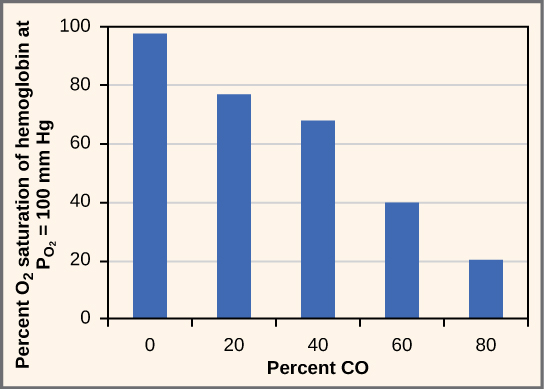

Figure 39.22図 39.22
As percent CO increases, the oxygen saturation of hemoglobin decreases.
COの割合が増えると、ヘモグロビンの酸素飽和度は低下する。
Section Summaryこの節のまとめ
Hemoglobin is a protein found in red blood cells that is comprised of two alpha and two beta subunits that surround an iron-containing heme group. Oxygen readily binds this heme group. The ability of oxygen to bind increases as more oxygen molecules are bound to heme. Disease states and altered conditions in the body can affect the binding ability of oxygen, and increase or decrease its ability to dissociate from hemoglobin.
ヘモグロビンは赤血球内のタンパク質であり、鉄を含むヘム基を取り囲む2つのαサブユニットと2つのβサブユニットからなる。酸素はヘム基に容易に結合する。ヘムに結合する酸素分子が増えるほど、さらに酸素が結合しやすくなる。病態や体内条件の変化は、酸素の結合能力に影響し、ヘモグロビンからの解離のしやすさを高めたり低めたりする。
Carbon dioxide can be transported through the blood via three methods. It is dissolved directly in the blood, bound to plasma proteins or hemoglobin, or converted into bicarbonate. The majority of carbon dioxide is transported as part of the bicarbonate system. Carbon dioxide diffuses into red blood cells. Inside, carbonic anhydrase converts carbon dioxide into carbonic acid (H2CO3), which is subsequently hydrolyzed into bicarbonate and H+. The H+ ion binds to hemoglobin in red blood cells, and bicarbonate is transported out of the red blood cells in exchange for a chloride ion. This is called the chloride shift. Bicarbonate leaves the red blood cells and enters the blood plasma. In the lungs, bicarbonate is transported back into the red blood cells in exchange for chloride. The H+ dissociates from hemoglobin and combines with bicarbonate to form carbonic acid with the help of carbonic anhydrase, which further catalyzes the reaction to convert carbonic acid back into carbon dioxide and water. The carbon dioxide is then expelled from the lungs.
二酸化炭素は、血液に直接溶ける、血漿タンパク質やヘモグロビンに結合する、炭酸水素イオンに変わる、という3つの方法で血液中を運ばれる。大部分は炭酸水素系の一部として運ばれる。二酸化炭素は赤血球へ拡散し、内部の炭酸脱水酵素によって炭酸(H2CO3)になる。炭酸はその後、加水分解されて炭酸水素イオンとH+になる。H+イオンは赤血球内のヘモグロビンに結合し、炭酸水素イオンは塩化物イオンと交換されて赤血球の外へ運び出される。これを塩化物移動という。赤血球を出た炭酸水素イオンは、血漿に入る。肺では、炭酸水素イオンが塩化物イオンとの交換で赤血球内へ戻る。H+がヘモグロビンから解離し、炭酸脱水酵素の助けを受けて炭酸水素イオンと結び付き、炭酸をつくる。この酵素はさらに、炭酸を二酸化炭素と水へ戻す反応を触媒する。二酸化炭素は、その後肺から排出される。