第39章呼吸器系
39.2 Gas Exchange across Respiratory Surfaces39.2 呼吸面を通したガス交換
Learning Objectives学習目標
By the end of this section, you will be able to do the following:
この節を終えると、次のことができるようになる。
- Name and describe lung volumes and capacities肺気量と肺容量の種類を挙げ、それぞれを説明する。
- Understand how gas pressure influences how gases move into and out of the body気体の圧力が、体への気体の出入りにどう影響するかを理解する。
The structure of the lung maximizes its surface area to increase gas diffusion. Because of the enormous number of alveoli (approximately 300 million in each human lung), the surface area of the lung is very large (75 m2). Having such a large surface area increases the amount of gas that can diffuse into and out of the lungs.
英語のヒント
肺は、気体の拡散を増やすために、表面積が最大限に広くなる構造をもつ。肺胞は非常に多数あるため(ヒトでは片肺に約3億個)、肺の表面積は非常に大きい(75m2)。この広い表面積によって、肺へ入ったり肺から出たりする気体の拡散量が増える。
Basic Principles of Gas Exchangeガス交換の基本原理
Gas exchange during respiration occurs primarily through diffusion. Diffusion is a process in which transport is driven by a concentration gradient. Gas molecules move from a region of high concentration to a region of low concentration. Blood that is low in oxygen concentration and high in carbon dioxide concentration undergoes gas exchange with air in the lungs. The air in the lungs has a higher concentration of oxygen than that of oxygen-depleted blood and a lower concentration of carbon dioxide. This concentration gradient allows for gas exchange during respiration.
英語のヒント
呼吸時のガス交換は、主に拡散によって起こる。拡散は、濃度勾配によって物質の輸送が起こる過程である。気体分子は、濃度の高い領域から低い領域へ移動する。酸素濃度が低く、二酸化炭素濃度が高い血液は、肺の中の空気とガス交換を行う。肺内の空気は、酸素の少ない血液よりも酸素濃度が高く、二酸化炭素濃度が低い。この濃度勾配によって、呼吸時のガス交換が可能になる。
Partial pressure is a measure of the concentration of the individual components in a mixture of gases. The total pressure exerted by the mixture is the sum of the partial pressures of the components in the mixture. The rate of diffusion of a gas is proportional to its partial pressure within the total gas mixture. This concept is discussed further in detail below.
英語のヒント
分圧は、混合気体を構成する個々の成分の濃度を表す尺度である。混合気体の及ぼす全圧は、各成分の分圧の和に等しい。ある気体の拡散速度は、混合気体全体の中でのその気体の分圧に比例する。この考え方は、後で詳しく扱う。
Lung Volumes and Capacities肺気量と肺容量
Different animals have different lung capacities based on their activities. Cheetahs have evolved a much higher lung capacity than humans; it helps provide oxygen to all the muscles in the body and allows them to run very fast. Elephants also have a high lung capacity. In this case, it is not because they run fast but because they have a large body and must be able to take up oxygen in accordance with their body size.
英語のヒント
動物の肺容量は、その活動に応じて異なる。チーターはヒトよりもはるかに大きい肺容量を進化させてきた。これによって全身の筋へ酸素を供給し、非常に速く走ることができる。ゾウも大きな肺容量をもつ。この場合は速く走るためではなく、体が大きく、その大きさに見合う酸素を取り込む必要があるためである。
Human lung size is determined by genetics, sex, and height. At maximal capacity, the average adult male's lungs can hold almost six liters of air, but lungs do not usually operate at maximal capacity. Air in the lungs is measured in terms of lung volumes and lung capacities (Figure 39.12 and Table 39.1). Volume measures the amount of air for one function (such as inhalation or exhalation). Capacity is any two or more volumes (for example, how much can be inhaled from the end of a maximal exhalation).
英語のヒント
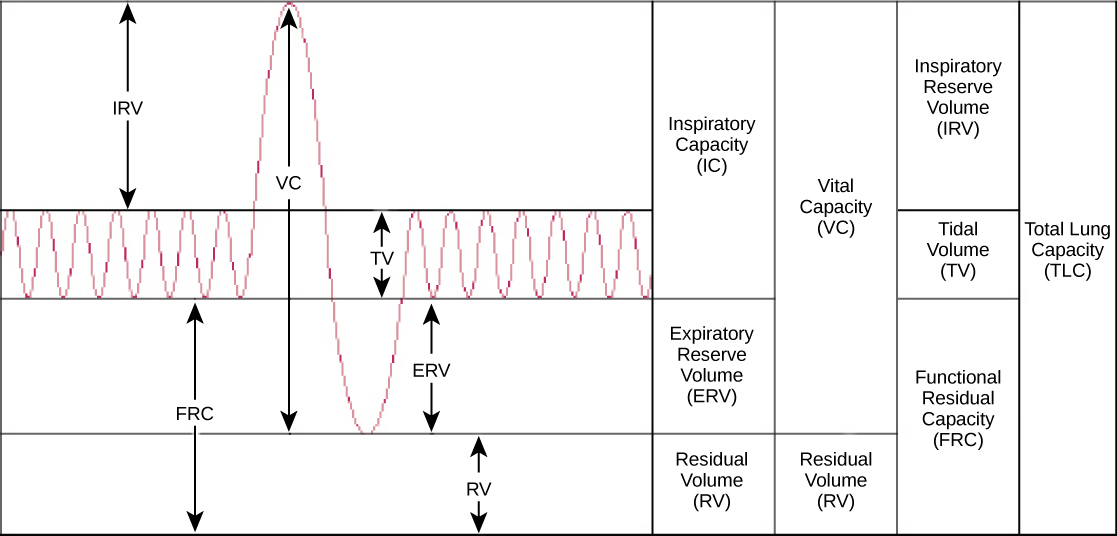

Figure 39.12図 39.12
Human lung volumes and capacities are shown. The total lung capacity of the adult male is six liters. Tidal volume is the volume of air inhaled in a single, normal breath. Inspiratory capacity is the amount of air taken in during a deep breath, and residual volume is the amount of air left in the lungs after forceful respiration.
ヒトの肺気量と肺容量を示す。成人男性の全肺気量は6リットルである。一回換気量は、通常の1回の呼吸で吸い込む空気量をいう。最大吸気量は深く息を吸うときに取り込む空気量、残気量は強制的な呼吸の後にも肺内に残る空気量である。
Lung Volumes and Capacities (Avg Adult Male) 肺気量と肺容量(平均的な成人男性) |
|||
|---|---|---|---|
Volume/Capacity 肺気量/肺容量 |
Definition 定義 |
Volume (liters) 体積(リットル) |
Equations 計算式 |
Tidal volume (TV) 一回換気量(TV) |
Amount of air inhaled during a normal breath 通常の1回の呼吸で吸い込む空気量 |
0.5 |
- |
Expiratory reserve volume (ERV) 予備呼気量(ERV) |
Amount of air that can be exhaled after a normal exhalation 通常の呼気後に、さらに吐き出せる空気量 |
1.2 |
- |
Inspiratory reserve volume (IRV) 予備吸気量(IRV) |
Amount of air that can be further inhaled after a normal inhalation 通常の吸気後に、さらに吸い込める空気量 |
3.1 |
- |
Residual volume (RV) 残気量(RV) |
Air left in the lungs after a forced exhalation 努力呼気後にも肺に残る空気 |
1.2 |
- |
Vital capacity (VC) 肺活量(VC) |
Maximum amount of air that can be moved in or out of the lungs in a single respiratory cycle 1回の呼吸周期で、肺に出し入れできる最大の空気量 |
4.8 |
ERV+TV+IRV ERV+TV+IRV |
Inspiratory capacity (IC) 最大吸気量(IC) |
Volume of air that can be inhaled after a normal exhalation 通常の呼気後に吸い込める空気量 |
3.6 |
TV+IRV TV+IRV |
Functional residual capacity (FRC) 機能的残気量(FRC) |
Volume of air remaining after a normal exhalation 通常の呼気後に残る空気量 |
2.4 |
ERV+RV ERV+RV |
Total lung capacity (TLC) 全肺気量(TLC) |
Total volume of air in the lungs after a maximal inspiration 最大限に吸気した後の肺内の総空気量 |
6.0 |
RV+ERV+TV+IRV RV+ERV+TV+IRV |
Forced expiratory volume (FEV1) 努力呼気量(FEV1) |
How much air can be forced out of the lungs over a specific time period, usually one second 一定時間内、通常は1秒間に肺から強く吐き出せる空気量 |
~4.1 to 5.5 約4.1〜5.5 |
- |
The volume in the lungs can be divided into four units: tidal volume, expiratory reserve volume, inspiratory reserve volume, and residual volume. Tidal volume (TV) measures the amount of air that is inspired and expired during a normal breath. On average, this volume is around one-half liter, which is a little less than the capacity of a 20-ounce drink bottle. The expiratory reserve volume (ERV) is the additional amount of air that can be exhaled after a normal exhalation. It is the reserve amount that can be exhaled beyond what is normal. Conversely, the inspiratory reserve volume (IRV) is the additional amount of air that can be inhaled after a normal inhalation. The residual volume (RV) is the amount of air that is left after expiratory reserve volume is exhaled. The lungs are never completely empty: There is always some air left in the lungs after a maximal exhalation. If this residual volume did not exist and the lungs emptied completely, the lung tissues would stick together and the energy necessary to reinflate the lung could be too great to overcome. Therefore, there is always some air remaining in the lungs. Residual volume is also important for preventing large fluctuations in respiratory gases (O2 and CO2). The residual volume is the only lung volume that cannot be measured directly because it is impossible to completely empty the lungs of air. This volume can only be calculated rather than measured.
英語のヒント
肺内の気量は、一回換気量、予備呼気量、予備吸気量、残気量という4つの区分に分けられる。一回換気量(TV)は、通常の1回の呼吸で吸ったり吐いたりする空気量である。平均では約0.5リットルで、20オンス入りの飲料ボトルの容量を少し下回る。予備呼気量(ERV)は、通常の呼気の後に、さらに吐き出せる空気量である。普段吐き出す量を超えて吐き出せる、予備の量にあたる。反対に、予備吸気量(IRV)は、通常の吸気の後に、さらに吸い込める空気量である。残気量(RV)は、予備呼気量を吐き出した後にも残る空気量をいう。肺が完全に空になることはなく、最大限に息を吐いた後にも必ず空気が残る。もし残気量がなく、肺が完全に空になれば、肺組織どうしが貼り付き、再び肺を膨らませるために必要なエネルギーが大きすぎて、膨らませられなくなるおそれがある。そのため、肺には常に一定の空気が残っている。残気量は、呼吸に関わる気体(O2とCO2)の大幅な変動を防ぐうえでも重要である。肺の空気を完全に出し切ることはできないため、残気量は、肺気量のうち直接測定できない唯一のものである。直接の測定ではなく、計算によって求める必要がある。
Capacities are measurements of two or more volumes. The vital capacity (VC) measures the maximum amount of air that can be inhaled or exhaled during a respiratory cycle. It is the sum of the expiratory reserve volume, tidal volume, and inspiratory reserve volume. The inspiratory capacity (IC) is the amount of air that can be inhaled after the end of a normal expiration. It is, therefore, the sum of the tidal volume and inspiratory reserve volume. The functional residual capacity (FRC) is the volume of air remaining after a normal exhalation (sum of the ERV and RV), which includes the expiratory reserve volume and the residual volume. The FRC measures the amount of additional air that can be exhaled after a normal exhalation. Lastly, the total lung capacity (TLC) is a measurement of the total amount of air that the lungs can hold. It is the sum of the residual volume, expiratory reserve volume, tidal volume, and inspiratory reserve volume.
英語のヒント
肺容量は、2つ以上の肺気量を合わせた測定値である。肺活量(VC)は、1回の呼吸周期で吸い込んだり吐き出したりできる最大の空気量を表す。予備呼気量、一回換気量、予備吸気量の和に等しい。最大吸気量(IC)は、通常の呼気が終わった後に吸い込める空気量であり、一回換気量と予備吸気量の和である。機能的残気量(FRC)は、通常の呼気後に残る空気量(ERVとRVの和)で、予備呼気量と残気量を含む。FRCは、通常の呼気の後にさらに吐き出せる空気量を表す。最後に、全肺気量(TLC)は、肺に収容できる空気の総量を表す。残気量、予備呼気量、一回換気量、予備吸気量の和に等しい。
Lung volumes are measured by a technique called spirometry. An important measurement taken during spirometry is the forced expiratory volume (FEV), which measures how much air can be forced out of the lung over a specific period, usually one second (FEV1). In addition, the forced vital capacity (FVC), which is the total amount of air that can be forcibly exhaled, is measured. The ratio of these values (FEV1/FVC ratio) is used to diagnose lung diseases including asthma, emphysema, and fibrosis. If the FEV1/FVC ratio is high, the lungs are not compliant (meaning they are stiff and unable to bend properly), and the patient most likely has lung fibrosis. Patients exhale most of the lung volume very quickly. Conversely, when the FEV1/FVC ratio is low, there is resistance in the lung that is characteristic of asthma. In this instance, it is hard for the patient to get the air out of their lungs, and it takes a long time to reach the maximal exhalation volume. In either case, breathing is difficult and complications arise.
英語のヒント
肺気量は、スパイロメトリーという方法で測定する。その重要な測定値の1つが努力呼気量(FEV)であり、一定時間内、通常は1秒間に、肺から強く吐き出せる空気量を測る(FEV1、1秒量)。また、強く吐き出せる空気の総量である努力性肺活量(FVC)も測定する。これらの比(FEV1/FVC比)は、喘息、肺気腫、肺線維症などの肺疾患の診断に使われる。FEV1/FVC比が高い場合、肺は伸びにくく、つまり硬くて十分に変形できず、患者は肺線維症である可能性が高い。患者は肺内の空気の大部分を、非常に短時間で吐き出す。反対に、FEV1/FVC比が低い場合には、喘息に特徴的な抵抗が肺に存在する。この場合、患者は肺から空気を出しにくく、最大呼気量に達するまでに時間がかかる。どちらの場合も呼吸は困難となり、合併症が生じる。