第39章呼吸器系
39.1 Systems of Gas Exchange39.1 ガス交換の仕組み
Learning Objectives学習目標
By the end of this section, you will be able to do the following:
この節を終えると、次のことができるようになる。
- Describe the passage of air from the outside environment to the lungs外部環境から肺までの空気の通り道を説明する。
- Explain how the lungs are protected from particulate matter粒子状物質から肺がどのように守られるかを説明する。
The primary function of the respiratory system is to deliver oxygen to the cells of the body’s tissues and remove carbon dioxide, a cell waste product. The main structures of the human respiratory system are the nasal cavity, the trachea, and lungs.
英語のヒント
呼吸器系の主な機能は、体の組織を構成する細胞へ酸素を届け、細胞の老廃物である二酸化炭素を取り除くことである。ヒトの呼吸器系を構成する主な構造は、鼻腔、気管、肺である。
All aerobic organisms require oxygen to carry out their metabolic functions. Along the evolutionary tree, different organisms have devised different means of obtaining oxygen from the surrounding atmosphere. The environment in which the animal lives greatly determines how an animal respires. The complexity of the respiratory system is correlated with the size of the organism. As animal size increases, diffusion distances increase and the ratio of surface area to volume drops. In unicellular organisms, diffusion across the cell membrane is sufficient for supplying oxygen to the cell (Figure 39.2). Diffusion is a slow, passive transport process. In order for diffusion to be a feasible means of providing oxygen to an animal's body, the rate of diffusion across the body surface must match the rate that oxygen is utilized. In other words, if the body were very large or thick, diffusion would not be able to provide oxygen quickly enough to the cells of the body. Therefore, dependence on diffusion as a means of obtaining oxygen and removing carbon dioxide remains feasible only for small organisms or those with highly-flattened bodies, such as many flatworms (Platyhelminthes). Larger organisms had to evolve specialized respiratory tissues, such as gills, lungs, and respiratory passages accompanied by complex circulatory systems, to transport oxygen throughout their entire body.
英語のヒント
好気性の生物はすべて、代謝機能を営むために酸素を必要とする。進化の系統樹をたどると、生物は周囲の大気から酸素を得るために、それぞれ異なる方法を発達させてきた。動物がどのように呼吸するかは、その生息環境に大きく左右される。呼吸器系の複雑さは、生物の大きさと関連している。動物が大きくなると、拡散する距離が長くなり、体積に対する表面積の比が小さくなる。単細胞生物では、細胞膜を通る拡散だけで、細胞に十分な酸素を供給できる(図39.2)。拡散は、ゆっくりとした受動輸送の過程である。拡散によって動物の体へ酸素を供給するには、体表を通る酸素の拡散速度が、酸素を利用する速度に見合っていなければならない。言い換えると、体が非常に大きかったり厚かったりすれば、拡散では体の細胞に十分な速さで酸素を供給できない。したがって、酸素の獲得と二酸化炭素の除去を拡散に頼ることができるのは、小さな生物か、扁形動物の多くのように体が著しく平たい生物に限られる。より大きな生物は、全身へ酸素を運ぶために、えら、肺、呼吸の通り道など、複雑な循環器系を伴う特殊化した呼吸組織を進化させる必要があった。
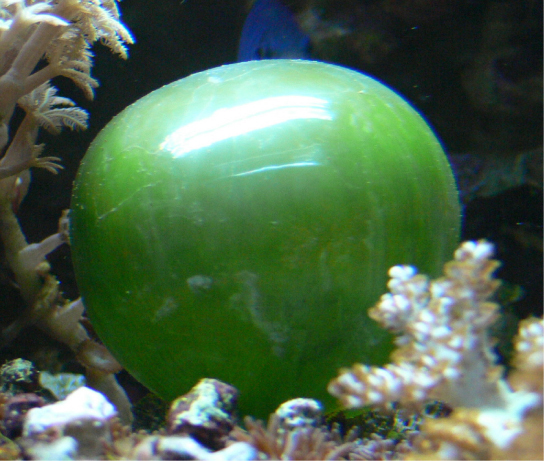
Figure 39.2図 39.2
The cell of the unicellular alga Ventricaria ventricosa is one of the largest known, reaching one to five centimeters in diameter. Like all single-celled organisms, V. ventricosa exchanges gases across the cell membrane.
単細胞藻類Ventricaria ventricosaの細胞は、知られている中でも最大級で、直径は1〜5cmに達する。ほかの単細胞生物と同様に、V. ventricosaは細胞膜を通してガス交換を行う。
Direct Diffusion直接拡散
For small multicellular organisms, diffusion across the outer membrane is sufficient to meet their oxygen needs. Gas exchange by direct diffusion across surface membranes is efficient for organisms less than 1 mm in diameter. In simple organisms, such as cnidarians and flatworms, every cell in the body is close to the external environment. Their cells are kept moist and gases diffuse quickly via direct diffusion. Flatworms are small, literally flat worms, which ‘breathe’ through diffusion across the outer membrane (Figure 39.3). The flat shape of these organisms increases the surface area for diffusion, ensuring that each cell within the body is close to the outer membrane surface and has access to oxygen. If the flatworm had a cylindrical body, then the cells in the center would not be able to get oxygen.
英語のヒント
小さな多細胞生物では、体の外側の膜を通る拡散によって、必要な酸素を十分に得られる。表面の膜を通した直接拡散によるガス交換は、直径1mm未満の生物では効率的である。刺胞動物や扁形動物のような単純な生物では、体内のすべての細胞が外部環境の近くにある。細胞は湿った状態に保たれ、気体は直接拡散によって速やかに移動する。扁形動物は、文字どおり平たい小型の蠕虫で、体の外側の膜を通る拡散によって「呼吸」する(図39.3)。平たい形は拡散のための表面積を大きくし、体内の各細胞が外側の膜の表面に近い位置で酸素を得られるようにする。もし扁形動物の体が円筒形であれば、中心にある細胞は酸素を得られないだろう。
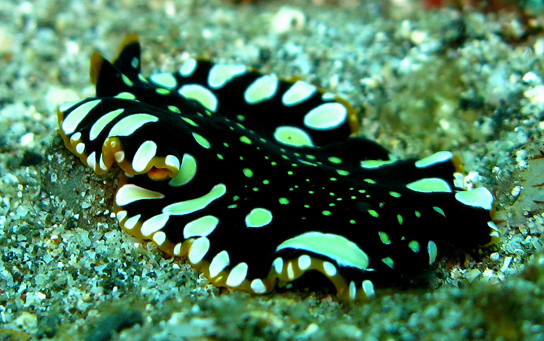


Figure 39.3図 39.3
This flatworm’s process of respiration works by diffusion across the outer membrane. (credit: Stephen Childs)
この扁形動物は、体の外側の膜を通る拡散によって呼吸する。(出典:Stephen Childs)
Skin and Gills皮膚とえら
Earthworms and amphibians use their skin (integument) as a respiratory organ. A dense network of capillaries lies just below the skin and facilitates gas exchange between the external environment and the circulatory system. The respiratory surface must be kept moist in order for the gases to dissolve and diffuse across cell membranes.
英語のヒント
ミミズや両生類は、皮膚(外皮)を呼吸器官として利用する。皮膚のすぐ下には密な毛細血管網があり、外部環境と循環器系の間のガス交換を促進する。気体が溶解して細胞膜を通って拡散できるよう、呼吸面は湿った状態に保たれなければならない。
Organisms that live in water need to obtain oxygen from the water. Oxygen dissolves in water but at a lower concentration than in the atmosphere. The atmosphere has roughly 21 percent oxygen. In water, the oxygen concentration is much lower than that. Fish and many other aquatic organisms have evolved gills to take up the dissolved oxygen from water (Figure 39.4). Gills are thin tissue filaments that are highly branched and folded. When water passes over the gills, the dissolved oxygen in water rapidly diffuses across the gills into the bloodstream. The circulatory system can then carry the oxygenated blood to the other parts of the body. In animals that contain coelomic fluid instead of blood, oxygen diffuses across the gill surfaces into the coelomic fluid. Gills are found in mollusks, annelids, and crustaceans.
英語のヒント
水中にすむ生物は、水から酸素を得る必要がある。酸素は水に溶けるが、その濃度は大気中より低い。大気には約21%の酸素が含まれるが、水中の酸素濃度はそれよりはるかに低い。魚類をはじめ多くの水生生物は、水に溶けた酸素を取り込むためにえらを進化させてきた(図39.4)。えらは、細かく枝分かれし、折り畳まれた薄い糸状の組織である。水がえらの表面を通ると、水中の溶存酸素がえらを通って血流へ速やかに拡散する。その後、循環器系が酸素を多く含む血液を体のほかの部分へ運ぶ。血液の代わりに体腔液をもつ動物では、酸素はえらの表面を通って体腔液へ拡散する。えらは、軟体動物、環形動物、甲殻類に見られる。
OpenStax, Rice University; Biology 2e. (credit: "Guitardude012"/Wikimedia Commons) · CC BY 4.0 · Source出典

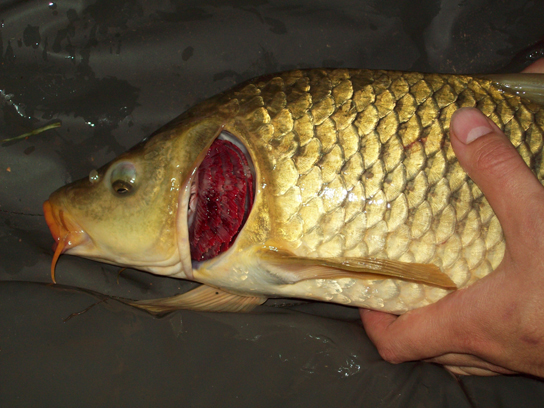
Figure 39.4図 39.4
This common carp, like many other aquatic organisms, has gills that allow it to obtain oxygen from water. (credit: "Guitardude012"/Wikimedia Commons)
このコイは、多くの水生生物と同じく、水から酸素を得るためのえらをもつ。(出典:"Guitardude012"/Wikimedia Commons)
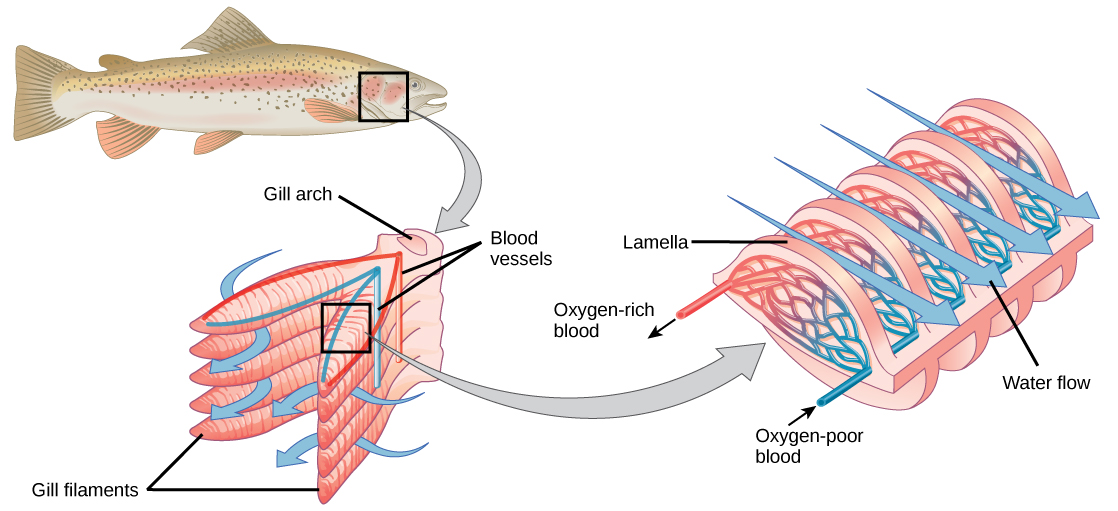
The folded surfaces of the gills provide a large surface area to ensure that the fish gets sufficient oxygen. Diffusion is a process in which material travels from regions of high concentration to low concentration until equilibrium is reached. In this case, blood with a low concentration of oxygen molecules circulates through the gills. The concentration of oxygen molecules in water is higher than the concentration of oxygen molecules in gills. As a result, oxygen molecules diffuse from water (high concentration) to blood (low concentration), as shown in Figure 39.5. Similarly, carbon dioxide molecules in the blood diffuse from the blood (high concentration) to water (low concentration).
英語のヒント
えらの表面にはひだがあり、十分な酸素を得るための大きな表面積が確保されている。拡散とは、平衡に達するまで、物質が濃度の高い領域から低い領域へ移動する過程である。この場合、酸素分子の濃度が低い血液がえらを循環する。水中の酸素分子の濃度は、えらの中の酸素分子の濃度より高い。そのため、図39.5に示すように、酸素分子は濃度の高い水から濃度の低い血液へ拡散する。同様に、血液中の二酸化炭素分子も、濃度の高い血液から濃度の低い水へ拡散する。
OpenStax, Rice University; Biology 2e. (credit "fish": modification of work by Duane Raver, NOAA) · CC BY 4.0 · Source出典

Figure 39.5図 39.5
As water flows over the gills, oxygen is transferred to blood via the capillaries in the lamellae. (credit "fish": modification of work by Duane Raver, NOAA)
水がえらの表面を流れると、薄板内の毛細血管を介して酸素が血液へ移動する。(魚の出典:Duane Raver、NOAAの作品を改変)