第39章呼吸器系
39.4 Transport of Gases in Human Bodily Fluids39.4 ヒトの体液中での気体の運搬
Learning Objectives学習目標
By the end of this section, you will be able to do the following:
この節を終えると、次のことができるようになる。
- Describe how oxygen is bound to hemoglobin and transported to body tissues酸素がヘモグロビンに結合し、体の組織へ運ばれる仕組みを説明する。
- Explain how carbon dioxide is transported from body tissues to the lungs二酸化炭素が体の組織から肺へ運ばれる仕組みを説明する。
Once the oxygen diffuses across the alveoli, it enters the bloodstream and is transported to the tissues where it is unloaded, and carbon dioxide diffuses out of the blood and into the alveoli to be expelled from the body. Although gas exchange is a continuous process, the oxygen and carbon dioxide are transported by different mechanisms.
英語のヒント
酸素は肺胞を通って拡散すると血流に入り、組織へ運ばれ、そこで放出される。一方、二酸化炭素は血液から肺胞へ拡散し、体外へ排出される。ガス交換は連続的に起こるが、酸素と二酸化炭素は異なる仕組みで運搬される。
Transport of Oxygen in the Blood血液中での酸素の運搬
Although oxygen dissolves in blood, only a small amount of oxygen is transported this way. Only 1.5 percent of oxygen in the blood is dissolved directly into the blood itself. Most oxygen—98.5 percent—is bound to a protein called hemoglobin and carried to the tissues.
酸素は血液に溶けるが、この方法で運ばれる量はわずかである。血中の酸素のうち、血液そのものに直接溶けているのは1.5%にすぎない。大部分の98.5%は、ヘモグロビンというタンパク質に結合し、組織へ運ばれる。
Hemoglobinヘモグロビン
Hemoglobin, or Hb, is a protein molecule found in red blood cells (erythrocytes) made of four subunits: two alpha subunits and two beta subunits (Figure 39.19). Each subunit surrounds a central heme group that contains iron and binds one oxygen molecule, allowing each hemoglobin molecule to bind four oxygen molecules. Molecules with more oxygen bound to the heme groups are brighter red. As a result, oxygenated arterial blood where the Hb is carrying four oxygen molecules is bright red, while venous blood that is deoxygenated is darker red.
英語のヒント
ヘモグロビン(Hb)は赤血球に含まれるタンパク質分子で、2つのαサブユニットと2つのβサブユニット、計4つからなる(図39.19)。各サブユニットの中央には、鉄を含むヘム基があり、1分子の酸素を結合する。そのため、ヘモグロビン1分子は4分子の酸素を結合できる。ヘム基に結合している酸素が多い分子ほど、明るい赤色になる。このため、Hbが4分子の酸素を運んでいる、酸素の多い動脈血は鮮やかな赤色を示す。一方、酸素の少ない静脈血は暗い赤色になる。
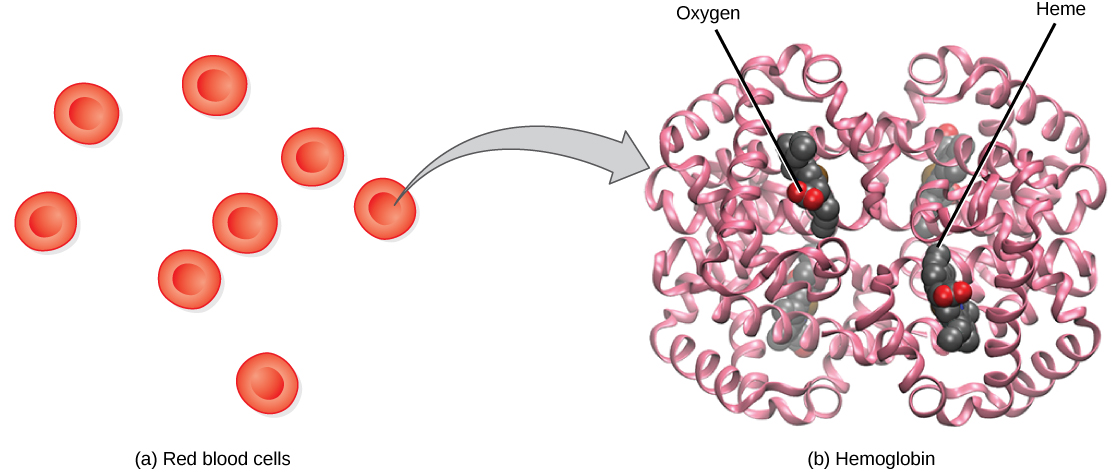

Figure 39.19図 39.19
The protein inside (a) red blood cells that carries oxygen to cells and carbon dioxide to the lungs is (b) hemoglobin. Hemoglobin is made up of four symmetrical subunits and four heme groups. Iron associated with the heme binds oxygen. It is the iron in hemoglobin that gives blood its red color.
英語のヒント
(a)赤血球内で、細胞へ酸素を運び、肺へ二酸化炭素を運ぶタンパク質が、(b)ヘモグロビンである。ヘモグロビンは、対称に配置された4つのサブユニットと4つのヘム基からなる。ヘムに含まれる鉄が酸素を結合する。血液に赤い色を与えるのは、ヘモグロビン中の鉄である。
It is easier to bind a second and third oxygen molecule to Hb than the first molecule. This is because the hemoglobin molecule changes its shape, or conformation, as oxygen binds. The fourth oxygen is then more difficult to bind. The binding of oxygen to hemoglobin can be plotted as a function of the partial pressure of oxygen in the blood (x-axis) versus the relative Hb-oxygen saturation (y-axis). The resulting graph—an oxygen dissociation curve—is sigmoidal, or S-shaped (Figure 39.20). As the partial pressure of oxygen increases, the hemoglobin becomes increasingly saturated with oxygen.
英語のヒント
Hbには、最初の酸素分子よりも、2番目や3番目の酸素分子のほうが結合しやすい。酸素が結合すると、ヘモグロビン分子の形、すなわち立体配座が変わるためである。4番目の酸素は、再び結合しにくくなる。ヘモグロビンへの酸素の結合は、血中の酸素分圧(横軸)に対する、Hbの酸素飽和度(縦軸)の関係として描ける。得られるグラフは酸素解離曲線と呼ばれ、S字型になる(図39.20)。酸素分圧が上昇するほど、ヘモグロビンの酸素飽和度は高くなる。
Factors That Affect Oxygen Binding酸素の結合に影響する要因
The oxygen-carrying capacity of hemoglobin determines how much oxygen is carried in the blood. In addition to , other environmental factors and diseases can affect oxygen carrying capacity and delivery.
ヘモグロビンの酸素運搬能によって、血液中で運ばれる酸素量が決まる。に加えて、ほかの環境要因や疾患も、酸素の運搬能や供給に影響しうる。
Carbon dioxide levels, blood pH, and body temperature affect oxygen-carrying capacity (Figure 39.20). When carbon dioxide is in the blood, it reacts with water to form bicarbonate and hydrogen ions (H+). As the level of carbon dioxide in the blood increases, more H+ is produced and the pH decreases. This increase in carbon dioxide and subsequent decrease in pH reduce the affinity of hemoglobin for oxygen. The oxygen dissociates from the Hb molecule, shifting the oxygen dissociation curve to the right. Therefore, more oxygen is needed to reach the same hemoglobin saturation level as when the pH was higher. A similar shift in the curve also results from an increase in body temperature. Increased temperature, such as from increased activity of skeletal muscle, causes the affinity of hemoglobin for oxygen to be reduced.
英語のヒント
二酸化炭素濃度、血液のpH、体温は、酸素運搬能に影響する(図39.20)。血中の二酸化炭素は水と反応して、炭酸水素イオンと水素イオン(H+)を生じる。血中の二酸化炭素が増えると、H+の産生が増え、pHが下がる。二酸化炭素の増加と、それに続くpHの低下は、ヘモグロビンの酸素への親和性を下げる。酸素がHb分子から解離し、酸素解離曲線は右へ移動する。したがって、pHが高かったときと同じヘモグロビン飽和度に達するには、より多くの酸素が必要となる。体温の上昇も、曲線を同じ方向へ移動させる。たとえば骨格筋の活動増加によって温度が上がると、ヘモグロビンの酸素への親和性は低下する。
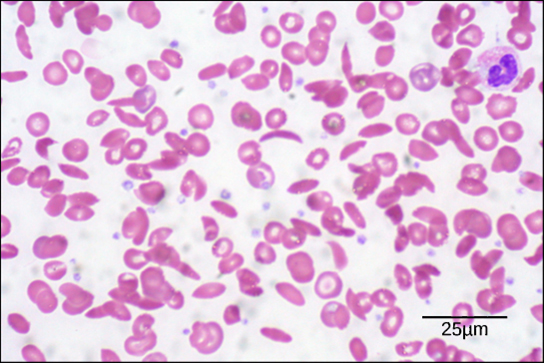
Diseases like sickle cell anemia and thalassemia decrease the blood’s ability to deliver oxygen to tissues and its oxygen-carrying capacity. In sickle cell anemia, the shape of the red blood cell is crescent-shaped, elongated, and stiffened, reducing its ability to deliver oxygen (Figure 39.21). In this form, red blood cells cannot pass through the capillaries. This is painful when it occurs. Thalassemia is a rare genetic disease caused by a defect in either the alpha or the beta subunit of Hb. Patients with thalassemia produce a high number of red blood cells, but these cells have lower-than-normal levels of hemoglobin. Therefore, the oxygen-carrying capacity is diminished.
英語のヒント
鎌状赤血球貧血やサラセミアなどの疾患は、血液が組織へ酸素を届ける能力と、酸素運搬能を低下させる。鎌状赤血球貧血では、赤血球が細長い三日月形になって硬くなり、酸素を届ける能力が低下する(図39.21)。この形の赤血球は毛細血管を通過できず、その際に痛みが生じる。サラセミアは、Hbのαサブユニットまたはβサブユニットの異常による、まれな遺伝性疾患である。患者は多数の赤血球をつくるが、各細胞のヘモグロビン量は正常より少ない。そのため、酸素運搬能が低下する。
OpenStax, Rice University; Biology 2e. (credit: modification of work by Ed Uthman; scale-bar data from Matt Russell) · CC BY 4.0 · Source出典

Figure 39.21図 39.21
Individuals with sickle cell anemia have crescent-shaped red blood cells. (credit: modification of work by Ed Uthman; scale-bar data from Matt Russell)
鎌状赤血球貧血の人は、三日月形の赤血球をもつ。(出典:Ed Uthmanの作品を改変。スケールバーのデータ:Matt Russell)