第39章呼吸器系
The Work of Breathing呼吸の仕事
The number of breaths per minute is the respiratory rate. On average, under non-exertion conditions, the human respiratory rate is 12–15 breaths/minute. The respiratory rate contributes to the alveolar ventilation, or how much air moves into and out of the alveoli. Alveolar ventilation prevents carbon dioxide buildup in the alveoli. There are two ways to keep the alveolar ventilation constant: increase the respiratory rate while decreasing the tidal volume of air per breath (shallow breathing), or decrease the respiratory rate while increasing the tidal volume per breath. In either case, the ventilation remains the same, but the work done and type of work needed are quite different. Both tidal volume and respiratory rate are closely regulated when oxygen demand increases.
英語のヒント
1分間の呼吸の回数を呼吸数という。運動していない状態では、ヒトの呼吸数は平均12〜15回/分である。呼吸数は、肺胞への空気の出入りの量、すなわち肺胞換気量に関わる。肺胞換気は、肺胞内への二酸化炭素の蓄積を防ぐ。肺胞換気を一定に保つには、2つの方法がある。1回あたりの換気量を減らしながら呼吸数を増やす方法(浅い呼吸)と、1回あたりの換気量を増やしながら呼吸数を減らす方法である。どちらも換気量は同じだが、行われる仕事の量や、必要な仕事の種類は大きく異なる。酸素需要が増えると、一回換気量と呼吸数はともに厳密に調節される。
There are two types of work conducted during respiration, flow-resistive and elastic work. Flow-resistive refers to the work of the alveoli and tissues in the lung, whereas elastic work refers to the work of the intercostal muscles, chest wall, and diaphragm. Increasing the respiration rate increases the flow-resistive work of the airways and decreases the elastic work of the muscles. Decreasing the respiratory rate reverses the type of work required.
英語のヒント
呼吸では、流れの抵抗に対する仕事と、弾性に対する仕事の2種類が行われる。前者は肺内の肺胞や組織の仕事を、後者は肋間筋、胸壁、横隔膜の仕事を指す。呼吸数が増えると、気道の流れの抵抗に対する仕事が増し、筋の弾性に対する仕事は減る。呼吸数を減らすと、必要な仕事の種類の関係は逆になる。
Surfactant肺サーファクタント
The air-tissue/water interface of the alveoli has a high surface tension. This surface tension is similar to the surface tension of water at the liquid-air interface of a water droplet that results in the bonding of the water molecules together. Surfactant is a complex mixture of phospholipids and lipoproteins that works to reduce the surface tension that exists between the alveoli tissue and the air found within the alveoli. By lowering the surface tension of the alveolar fluid, it reduces the tendency of alveoli to collapse.
英語のヒント
肺胞の空気と組織・水の境界面には、大きな表面張力がある。これは、水滴の液体と空気の境界面で、水分子どうしが結び付くことによって生じる表面張力に似ている。サーファクタントはリン脂質とリポタンパク質の複雑な混合物で、肺胞組織と肺胞内の空気の間にある表面張力を下げる。肺胞液の表面張力を下げることで、肺胞がつぶれようとする傾向を小さくする。
Surfactant works like a detergent to reduce the surface tension and allows for easier inflation of the airways. When a balloon is first inflated, it takes a large amount of effort to stretch the plastic and start to inflate the balloon. If a little bit of detergent was applied to the interior of the balloon, then the amount of effort or work needed to begin to inflate the balloon would decrease, and it would become much easier to start blowing up the balloon. This same principle applies to the airways. A small amount of surfactant to the airway tissues reduces the effort or work needed to inflate those airways. Babies born prematurely sometimes do not produce enough surfactant. As a result, they suffer from respiratory distress syndrome, because it requires more effort to inflate their lungs. Surfactant is also important for preventing collapse of small alveoli relative to large alveoli.
英語のヒント
サーファクタントは洗剤のように働いて表面張力を下げ、気道を膨らませやすくする。風船を最初に膨らませるときには、素材を引き伸ばし、膨張を始めるために大きな力が必要である。風船の内側に少量の洗剤を塗れば、膨らませ始めるための力や仕事が減り、ずっと容易に膨らませられる。同じ原理が気道にも当てはまる。気道の組織に少量のサーファクタントがあると、気道を膨らませるために必要な力や仕事が減る。早産児では、サーファクタントが十分につくられないことがある。その場合、肺を膨らませるのに多くの力が必要となるため、呼吸窮迫症候群になる。サーファクタントは、大きな肺胞に比べて小さな肺胞がつぶれやすくなるのを防ぐうえでも重要である。
Lung Resistance and Compliance肺の抵抗とコンプライアンス
Pulmonary diseases reduce the rate of gas exchange into and out of the lungs. Two main causes of decreased gas exchange are compliance (how elastic the lung is) and resistance (how much obstruction exists in the airways). A change in either can dramatically alter breathing and the ability to take in oxygen and release carbon dioxide.
英語のヒント
肺疾患は、肺への気体の出入りの速度を低下させる。ガス交換の低下に関わる主な要因は、コンプライアンス(肺がどれだけ弾性的に変形しやすいか)と抵抗(気道にどの程度の妨げがあるか)の2つである。どちらが変わっても、呼吸や、酸素を取り込んで二酸化炭素を放出する能力が大きく変化しうる。
Examples of restrictive diseases are respiratory distress syndrome and pulmonary fibrosis. In both diseases, the airways are less compliant and they are stiff or fibrotic. There is a decrease in compliance because the lung tissue cannot bend and move. In these types of restrictive diseases, the intrapleural pressure is more positive and the airways collapse upon exhalation, which traps air in the lungs. Forced or functional vital capacity (FVC), which is the amount of air that can be forcibly exhaled after taking the deepest breath possible, is much lower than in normal patients, and the time it takes to exhale most of the air is greatly prolonged (Figure 39.18). A patient suffering from these diseases cannot exhale the normal amount of air.
英語のヒント
拘束性疾患には、呼吸窮迫症候群や肺線維症がある。どちらも気道が伸びにくく、硬くなったり線維化したりする。肺組織が変形して動くことができないため、コンプライアンスが低下する。これらの拘束性疾患では、胸膜腔内圧がより正の方向になり、呼気時に気道がつぶれて、空気が肺内に閉じ込められる。最大限に深く息を吸った後に強く吐き出せる空気量である努力性肺活量(FVC。機能的肺活量とも記される)は、正常な人よりはるかに小さく、空気の大部分を吐き出すのに必要な時間が大幅に長くなる(図39.18)。これらの疾患の患者は、正常な量の空気を吐き出せない。
Obstructive diseases and conditions include emphysema, asthma, and pulmonary edema. In emphysema, which mostly arises from smoking tobacco, the walls of the alveoli are destroyed, decreasing the surface area for gas exchange. The overall compliance of the lungs is increased, because as the alveolar walls are damaged, lung elastic recoil decreases due to a loss of elastic fibers, and more air is trapped in the lungs at the end of exhalation. Asthma is a disease in which inflammation is triggered by environmental factors. Inflammation obstructs the airways. The obstruction may be due to edema (fluid accumulation), smooth muscle spasms in the walls of the bronchioles, increased mucus secretion, damage to the epithelia of the airways, or a combination of these events. Those with asthma or edema experience increased occlusion from increased inflammation of the airways. This tends to block the airways, preventing the proper movement of gases (Figure 39.18). Those with obstructive diseases have large volumes of air trapped after exhalation and breathe at a very high lung volume to compensate for the lack of airway recruitment.
英語のヒント
閉塞性の疾患や病態には、肺気腫、喘息、肺水腫がある。肺気腫は主に喫煙によって起こり、肺胞壁が破壊されてガス交換の表面積が減少する。肺胞壁が損傷すると弾性線維が失われ、肺の弾性反跳が弱くなるため、肺全体のコンプライアンスは増加する。また、呼気の終わりに、より多くの空気が肺内に閉じ込められる。喘息は、環境要因によって炎症が引き起こされる疾患である。炎症は気道を閉塞する。閉塞は、浮腫(液体の蓄積)、細気管支壁の平滑筋のけいれん、粘液分泌の増加、気道上皮の損傷、またはこれらの組み合わせによって起こる。喘息や浮腫のある人では、気道の炎症が強まることで閉塞も増す。そのため気道がふさがれ、気体の正常な移動が妨げられる(図39.18)。閉塞性疾患の患者は、呼気後にも大量の空気が肺内に閉じ込められており、気道を十分に開通させられないことを補うため、非常に大きな肺気量で呼吸する。
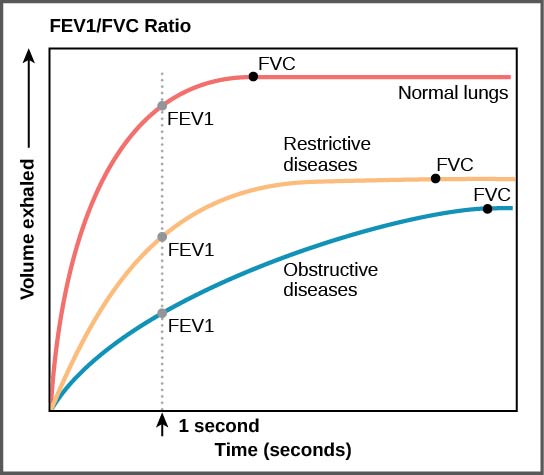

Figure 39.18図 39.18
The ratio of FEV1 (the amount of air that can be forcibly exhaled in one second after taking a deep breath) to FVC (the total amount of air that can be forcibly exhaled) can be used to diagnose whether a person has restrictive or obstructive lung disease. In restrictive lung disease, FVC is reduced but airways are not obstructed, so the person is able to expel air reasonably fast. In obstructive lung disease, airway obstruction results in slow exhalation as well as reduced FVC. Thus, the FEV1/FVC ratio is lower in persons with obstructive lung disease (less than 69 percent) than in persons with restrictive disease (88 to 90 percent).
FVC(強く吐き出せる空気の総量)に対するFEV1(深く吸気した後、1秒間に強く吐き出せる空気量)の比は、拘束性肺疾患か閉塞性肺疾患かを診断するのに使える。拘束性肺疾患ではFVCが低下するが、気道は閉塞していないため、比較的速く空気を排出できる。閉塞性肺疾患では、気道閉塞によって呼気が遅くなり、FVCも低下する。したがって、FEV1/FVC比は、拘束性疾患の人(88〜90%)より、閉塞性肺疾患の人(69%未満)のほうが低い。