第45章個体群と群集の生態学
45.7 Behavioral Biology: Proximate and Ultimate Causes of Behavior45.7 行動生物学:行動の至近要因と究極要因
Learning Objectives学習目標
By the end of this section, you will be able to do the following:
この節を学ぶと、次のことができるようになる。
- Compare innate and learned behavior生得的行動と学習行動を比較する。
- Discuss how movement and migration behaviors are a result of natural selection運動や季節移動の行動が、自然選択の結果として生じることを論じる。
- Discuss the different ways members of a population communicate with each other個体群の成員が意思を伝え合う、さまざまな方法を論じる。
- Give examples of how species use energy for mating displays and other courtship behaviors求愛ディスプレイやほかの求愛行動に、エネルギーを使う例を挙げる。
- Differentiate between various mating systemsさまざまな配偶システムを区別する。
- Describe different ways that species learn生物が学習する異なる方法を説明する。
Behavior is the change in activity of an organism in response to a stimulus. Behavioral biology is the study of the biological and evolutionary bases for such changes. The idea that behaviors evolved as a result of the pressures of natural selection is not new. For decades, several types of scientists have studied animal behavior. Biologists do so in the science of ethology; psychologists in the science of comparative psychology; and other scientists in the science of neurobiology. The first two, ethology and comparative psychology, are the most consequential for the study of behavioral biology.
英語のヒント
行動とは、刺激に応じて生物の活動が変化することである。行動生物学は、その生物学的・進化的基盤を研究する。行動が自然選択の圧力の結果として進化したという考えは、新しいものではない。数十年間、さまざまな分野の科学者が動物行動を研究してきた。生物学者は動物行動学、心理学者は比較心理学、またほかの科学者は神経生物学で研究する。最初の2つ、動物行動学と比較心理学が、行動生物学の研究で特に重要である。
One goal of behavioral biology is to distinguish between the innate behaviors, which have a strong genetic component and are largely independent of environmental influences, from the learned behaviors, which result from environmental conditioning. Innate behavior, or instinct, is important because there is no risk of an incorrect behavior being learned. They are “hard wired” into the system. On the other hand, learned behaviors, although riskier, are flexible, dynamic, and can be altered according to changes in the environment.
英語のヒント
行動生物学の目標の1つは、遺伝的要素が強く、環境の影響からおおむね独立した生得的行動と、環境による条件付けから生じる学習行動を区別することである。生得的行動、すなわち本能は、誤った行動を学ぶ危険がない点で重要である。いわば仕組みに「あらかじめ配線されている」。一方、学習行動は危険もあるが、柔軟で変化しやすく、環境の変化に応じて変えられる。
Innate Behaviors: Movement and Migration生得的行動:運動と移動
Innate or instinctual behaviors rely on response to stimuli. The simplest example of this is a reflex action, an involuntary and rapid response to stimulus. To test the “knee-jerk” reflex, a doctor taps the patellar tendon below the kneecap with a rubber hammer. The stimulation of the nerves leads to the reflex of extending the leg at the knee. This is similar to the reaction of someone who touches a hot stove and instinctually pulls their hand away. Even humans, with our great capacity to learn, still exhibit a variety of innate behaviors.
英語のヒント
生得的、すなわち本能的な行動は、刺激への反応に基づく。最も単純な例は反射で、刺激に対する不随意で素早い反応である。膝蓋腱反射を調べるとき、医師は膝蓋骨の下の腱をゴムのハンマーでたたく。神経の刺激により、膝で脚を伸ばす反射が起こる。熱いストーブに触れ、思わず手を引っ込める反応にも似ている。学習能力に優れる人間にも、さまざまな生得的行動が残っている。
Kinesis and Taxis走動性と走性
Another activity or movement of innate behavior is kinesis, or the undirected movement in response to a stimulus. Orthokinesis is the increased or decreased speed of movement of an organism in response to a stimulus. Woodlice, for example, increase their speed of movement when exposed to high or low temperatures. This movement, although random, increases the probability that the insect spends less time in the unfavorable environment. Another example is klinokinesis, an increase in turning behaviors. It is exhibited by bacteria such as E. coli which, in association with orthokinesis, helps the organisms randomly find a more hospitable environment.
英語のヒント
生得的行動に属する別の運動が、刺激に応じて方向を定めずに動く、走動性(キネシス)である。直進走動性は、刺激に応じて運動速度が増減することをいう。例えばワラジムシは、高温や低温にさらされると速く動く。動きはランダムだが、不適な環境で過ごす時間を短くする可能性が高まる。もう1つは、方向転換が増える屈曲走動性である。大腸菌などが示し、直進走動性とともに、より適した環境を偶然に見つけるのを助ける。
A similar, but more directed version of kinesis is taxis: the directed movement towards or away from a stimulus. This movement can be in response to light (phototaxis), chemical signals (chemotaxis), or gravity (geotaxis) and can be directed toward (positive) or away (negative) from the source of the stimulus. An example of a positive chemotaxis is exhibited by the unicellular protozoan Tetrahymena thermophila. This organism swims using its cilia, at times moving in a straight line, and at other times making turns. The attracting chemotactic agent alters the frequency of turning as the organism moves directly toward the source, following the increasing concentration gradient.
英語のヒント
走動性に似ているが、方向性のあるものが走性(タクシス)で、刺激へ近づく、または遠ざかる運動である。光(走光性)、化学信号(走化性)、重力(走地性)などに反応し、刺激源へ近づく場合を正、遠ざかる場合を負という。正の走化性の例は、単細胞の原生動物Tetrahymena thermophilaに見られる。この生物は繊毛で泳ぎ、直進するときも、方向転換するときもある。誘引する化学物質は方向転換の頻度を変え、生物は濃度が増す勾配に沿って、刺激源へ向かって進む。
Fixed Action Patterns定型的行動パターン
A fixed action pattern is a series of movements elicited by a stimulus such that even when the stimulus is removed, the pattern goes on to completion. An example of such a behavior occurs in the three-spined stickleback, a small freshwater fish (Figure 45.34). Males of this species develop a red belly during breeding season and show instinctual aggressiveness to other males during this time. In laboratory experiments, researchers exposed such fish to objects that in no way resemble a fish in their shape, but which were painted red on their lower halves. The male sticklebacks responded aggressively to the objects just as if they were real male sticklebacks.
英語のヒント
定型的行動パターンは、刺激によって引き起こされる一連の運動で、刺激を取り除いても最後まで続く。小さな淡水魚イトヨに例がある(図45.34)。雄は繁殖期に腹が赤くなり、この時期には他の雄に本能的な攻撃性を示す。実験では、形はまったく魚に似ていないが、下半分を赤く塗った物体を見せた。雄のイトヨは、本物の雄であるかのように、その物体へ攻撃的に反応した。
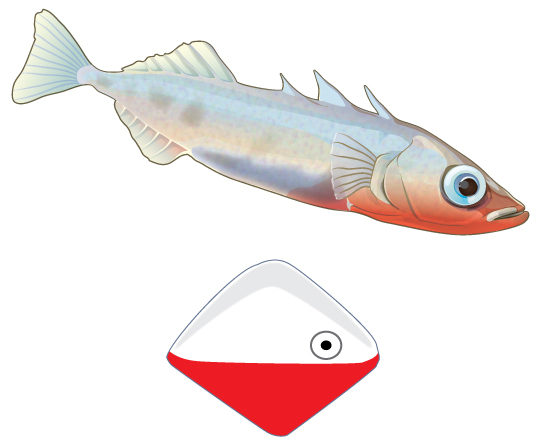

Figure 45.34図 45.34
Male three-spined stickleback fish exhibit a fixed action pattern. During mating season, the males, which develop a bright red belly, react strongly to red-bottomed objects that in no way resemble fish.
雄のイトヨは定型的行動パターンを示す。繁殖期には腹が鮮やかな赤色になり、形が魚にまったく似ていない物体でも、下面が赤ければ強く反応する。