By the end of this section, you will be able to do the following:
この節を学ぶと、次のことができるようになる。
Discuss the predator-prey cycle
捕食者・被食者の周期について論じる。
Give examples of defenses against predation and herbivory
捕食や植食に対する防御の例を挙げる。
Describe the competitive exclusion principle
競争排除則を説明する。
Give examples of symbiotic relationships between species
種間の共生関係の例を挙げる。
Describe community structure and succession
群集の構造と遷移を説明する。
Populations rarely, if ever, live in isolation from populations of other species. In most cases, numerous species share a habitat. The interactions between these populations play a major role in regulating population growth and abundance. All populations occupying the same habitat form a community: populations inhabiting a specific area at the same time. The number of species occupying the same habitat and their relative abundance is known as species diversity. Areas with low diversity, such as the glaciers of Antarctica, still contain a wide variety of living things, whereas the diversity of tropical rainforests is so great that it cannot be counted. Ecology is studied at the community level to understand how species interact with each other and compete for the same resources.
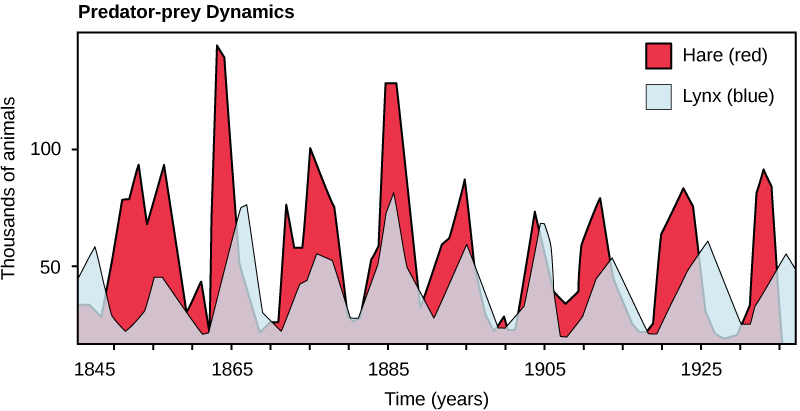
Perhaps the classical example of species interaction is predation: the consumption of prey by its predator. Nature shows on television highlight the drama of one living organism killing another. Populations of predators and prey in a community are not constant over time: in most cases, they vary in cycles that appear to be related. The most often cited example of predator-prey dynamics is seen in the cycling of the lynx (predator) and the snowshoe hare (prey), using nearly 200 year-old trapping data from North American forests (Figure 45.18). This cycle of predator and prey lasts approximately 10 years, with the predator population lagging 1–2 years behind that of the prey population. As the hare numbers increase, there is more food available for the lynx, allowing the lynx population to increase as well. When the lynx population grows to a threshold level, however, they kill so many hares that hare population begins to decline, followed by a decline in the lynx population because of scarcity of food. When the lynx population is low, the hare population size begins to increase due, at least in part, to low predation pressure, starting the cycle anew.
The cycling of lynx and snowshoe hare populations in Northern Ontario is an example of predator-prey dynamics.
オンタリオ州北部のオオヤマネコとカンジキウサギの個体群の周期は、捕食者・被食者動態の一例である。
Some researchers question the idea that predation models entirely control the population cycling of the two species. More recent studies have pointed to undefined density-dependent factors as being important in the cycling, in addition to predation. One possibility is that the cycling is inherent in the hare population due to density-dependent effects such as lower fecundity (maternal stress) caused by crowding when the hare population gets too dense. The hare cycling would then induce the cycling of the lynx because it is the lynxes’ major food source. The more we study communities, the more complexities we find, allowing ecologists to derive more accurate and sophisticated models of population dynamics.
Herbivory describes the consumption of plants by insects and other animals, and it is another interspecific relationship that affects populations. Unlike animals, most plants cannot outrun predators or use mimicry to hide from hungry animals. Some plants have developed mechanisms to defend against herbivory. Other species have developed mutualistic relationships; for example, herbivory provides a mechanism of seed distribution that aids in plant reproduction.
Defense Mechanisms against Predation and Herbivory捕食と植食に対する防御の仕組み
The study of communities must consider evolutionary forces that act on the members of the various populations contained within it. Species are not static, but slowly changing and adapting to their environment by natural selection and other evolutionary forces. Species have evolved numerous mechanisms to escape predation and herbivory. These defenses may be mechanical, chemical, physical, or behavioral.
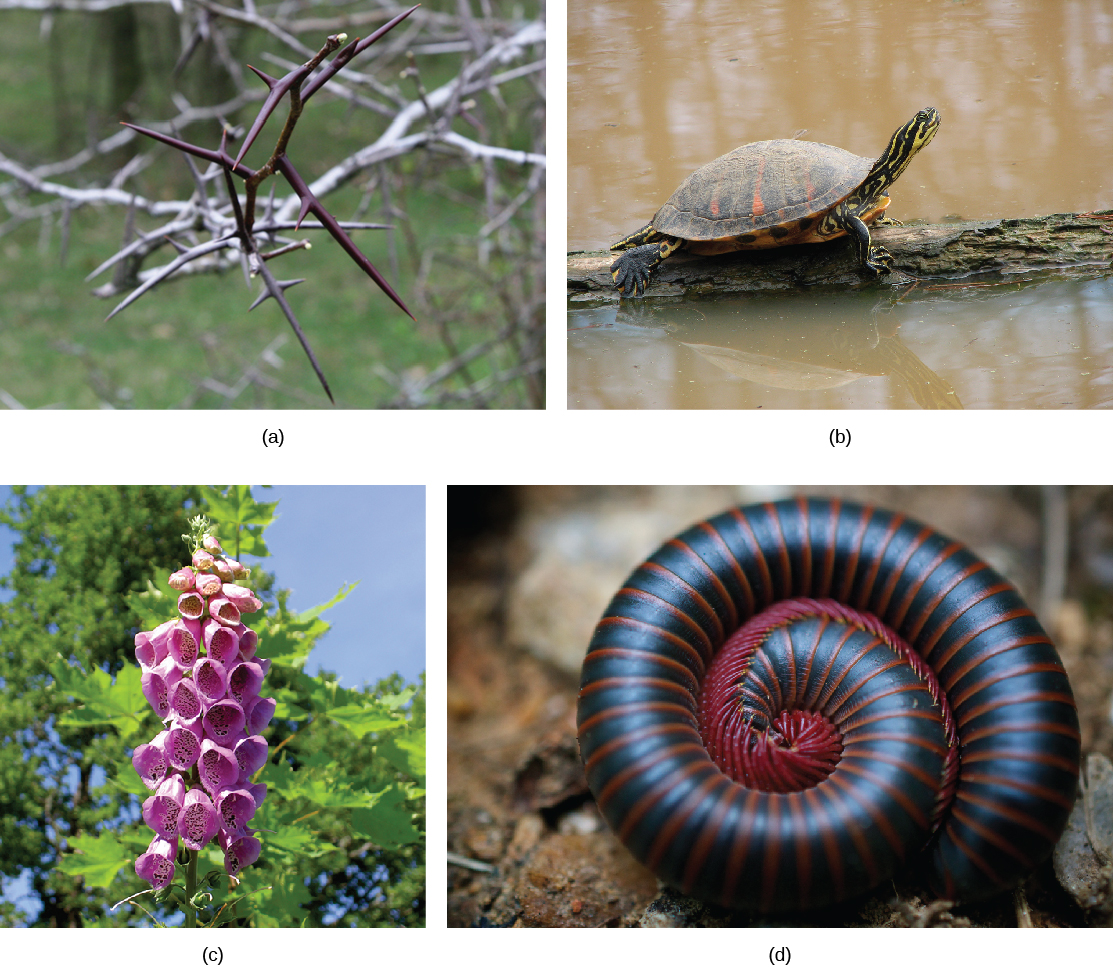
Mechanical defenses, such as the presence of thorns on plants or the hard shell on turtles, discourage animal predation and herbivory by causing physical pain to the predator or by physically preventing the predator from being able to eat the prey. Chemical defenses are produced by many animals as well as plants, such as the foxglove which is extremely toxic when eaten. Figure 45.19 shows some organisms’ defenses against predation and herbivory.
OpenStax, Rice University; Biology 2e. (credit a: modification of work by Huw Williams; credit b: modification of work by “JamieS93”/Flickr; credit c: modification of work by Philip Jägenstedt; credit d: modification of work by Cory Zanker) · CC BY 4.0 · Source出典
Figure 45.19図 45.19
The (a) honey locust tree (Gleditsia triacanthos) uses thorns, a mechanical defense, against herbivores, while the (b) Florida red-bellied turtle (Pseudemys nelsoni) uses its shell as a mechanical defense against predators. (c) Foxglove (Digitalis sp.) uses a chemical defense: toxins produced by the plant can cause nausea, vomiting, hallucinations, convulsions, or death when consumed. (d) The North American millipede (Narceus americanus) uses both mechanical and chemical defenses: when threatened, the millipede curls into a defensive ball and produces a noxious substance that irritates eyes and skin. (credit a: modification of work by Huw Williams; credit b: modification of work by “JamieS93”/Flickr; credit c: modification of work by Philip Jägenstedt; credit d: modification of work by Cory Zanker)
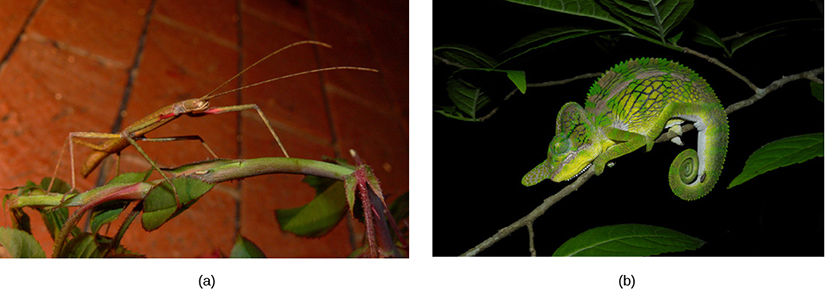
Many species use physical appearance, such as body shape and coloration, to avoid being detected by predators. The tropical walking stick is an insect with the coloration and body shape of a twig which makes it very hard to see when stationary against a background of real twigs (Figure 45.20a). In another example, the chameleon can, within limitations, change its color to match its surroundings (Figure 45.20b). Both of these are examples of camouflage, or avoiding detection by blending in with the background. There are many behavioral adaptations to avoid or confuse predators. Playing dead and traveling in large groups, like schools of fish or flocks of birds, are both behaviors that reduce the risk of being eaten.
OpenStax, Rice University; Biology 2e. (credit a: modification of work by Linda Tanner; credit b: modification of work by Frank Vassen) · CC BY 4.0 · Source出典
Figure 45.20図 45.20
(a) The tropical walking stick and (b) the chameleon use body shape and/or coloration to prevent detection by predators. (credit a: modification of work by Linda Tanner; credit b: modification of work by Frank Vassen)
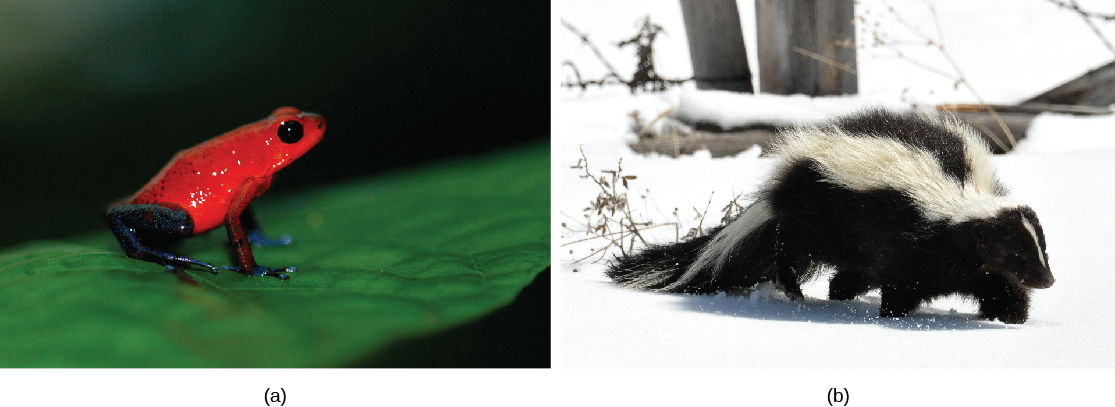
Some species use coloration as a way of warning predators that they are not good to eat. For example, the cinnabar moth caterpillar, the fire-bellied toad, and many species of beetle have bright colors that warn of a foul taste, the presence of toxic chemicals, and/or the ability to sting or bite, respectively. Predators that ignore this coloration and eat the organisms will experience their unpleasant taste or presence of toxic chemicals and learn not to eat them in the future. This type of defensive mechanism is called aposematic coloration, or warning coloration (Figure 45.21).
OpenStax, Rice University; Biology 2e. (credit a: modification of work by Jay Iwasaki; credit b: modification of work by Dan Dzurisin) · CC BY 4.0 · Source出典
Figure 45.21図 45.21
(a) The strawberry poison dart frog (Oophaga pumilio) uses aposematic coloration to warn predators that it is toxic, while the (b) striped skunk (Mephitis mephitis) uses aposematic coloration to warn predators of the unpleasant odor it produces. (credit a: modification of work by Jay Iwasaki; credit b: modification of work by Dan Dzurisin)
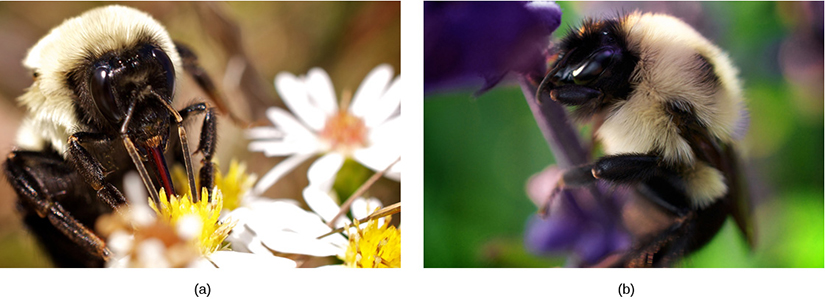
While some predators learn to avoid eating certain potential prey because of their coloration, other species have evolved mechanisms to mimic this coloration to avoid being eaten, even though they themselves may not be unpleasant to eat or contain toxic chemicals. In Batesian mimicry, a harmless species imitates the warning coloration of a harmful one. Assuming they share the same predators, this coloration then protects the harmless ones, even though they do not have the same level of physical or chemical defenses against predation as the organism they mimic. Many insect species mimic the coloration of wasps or bees, which are stinging, venomous insects, thereby discouraging predation (Figure 45.22).
OpenStax, Rice University; Biology 2e. (credit a, b: modification of work by Cory Zanker) · CC BY 4.0 · Source出典
Figure 45.22図 45.22
Batesian mimicry occurs when a harmless species mimics the coloration of a harmful species, as is seen with the (a) bumblebee and (b) bee-like robber fly. (credit a, b: modification of work by Cory Zanker)
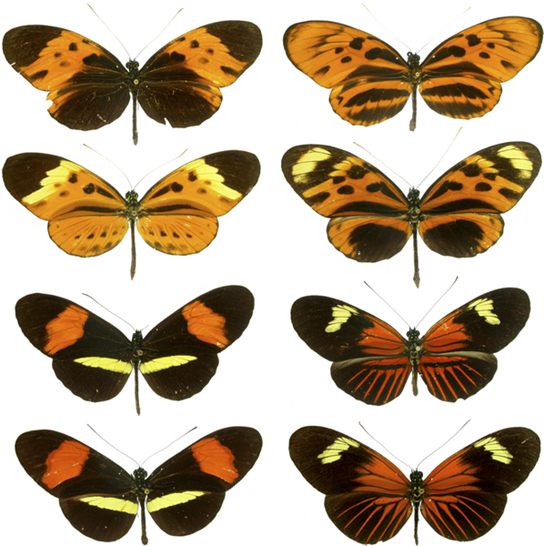
In Müllerian mimicry, multiple species share the same warning coloration, but all of them actually have defenses. Figure 45.23 shows a variety of foul-tasting butterflies with similar coloration. In Emsleyan/Mertensian mimicry, a deadly prey mimics a less dangerous one, such as the venomous coral snake mimicking the nonvenomous milk snake. This type of mimicry is extremely rare and more difficult to understand than the previous two types. For this type of mimicry to work, it is essential that eating the milk snake has unpleasant but not fatal consequences. Then, these predators learn not to eat snakes with this coloration, protecting the coral snake as well. If the snake were fatal to the predator, there would be no opportunity for the predator to learn not to eat it, and the benefit for the less toxic species would disappear.
OpenStax, Rice University; Biology 2e. (credit: Joron M, Papa R, Beltrán M, Chamberlain N, Mavárez J, et al.) · CC BY 4.0 · Source出典
Figure 45.23図 45.23
Several unpleasant-tasting Heliconius butterfly species share a similar color pattern with better-tasting varieties, an example of Müllerian mimicry. (credit: Joron M, Papa R, Beltrán M, Chamberlain N, Mavárez J, et al.)
まずい味のドクチョウ属の数種は、より食べやすい変種と似た色模様を共有する。ミュラー型擬態の一例である。(出典:Joron M, Papa R, Beltrán M, Chamberlain N, Mavárez Jほか)