第45章個体群と群集の生態学
45.4 Population Dynamics and Regulation45.4 個体群の動態と調節
Learning Objectives学習目標
By the end of this section, you will be able to do the following:
この節を学ぶと、次のことができるようになる。
- Give examples of how the carrying capacity of a habitat may change生息地の環境収容力が変わる例を挙げる。
- Compare and contrast density-dependent growth regulation and density-independent growth regulation, giving examples密度依存的な増加調節と密度非依存的な増加調節を、例を挙げて比較する。
- Give examples of exponential and logistic growth in wild animal populations野生動物個体群の指数増加とロジスティック増加の例を挙げる。
- Describe how natural selection and environmental adaptation leads to the evolution of particular life-history patterns自然選択と環境への適応が、特定の生活史パターンの進化につながる仕組みを説明する。
The logistic model of population growth, while valid in many natural populations and a useful model, is a simplification of real-world population dynamics. Implicit in the model is that the carrying capacity of the environment does not change, which is not the case. The carrying capacity varies annually: for example, some summers are hot and dry whereas others are cold and wet. In many areas, the carrying capacity during the winter is much lower than it is during the summer. Also, natural events such as earthquakes, volcanoes, and fires can alter an environment and hence its carrying capacity. Additionally, populations do not usually exist in isolation. They engage in interspecific competition: that is, they share the environment with other species competing for the same resources. These factors are also important to understanding how a specific population will grow.
英語のヒント
ロジスティック増加モデルは、多くの自然個体群に当てはまる有用なモデルだが、現実の個体群動態を単純化している。そこには、環境収容力が変わらないという暗黙の前提があるが、実際は異なる。環境収容力は年ごとに変わる。例えば、暑く乾燥した夏もあれば、寒く湿った夏もある。多くの地域では、冬の環境収容力は夏よりはるかに低い。地震、噴火、火災などの自然現象も、環境とその収容力を変えうる。さらに、個体群は通常、単独では存在しない。同じ資源をめぐって競争するほかの種と環境を共有し、種間競争を行う。これらも、ある個体群がどう増えるかを理解するうえで重要である。
Nature regulates population growth in a variety of ways. These are grouped into density-dependent factors, in which the density of the population at a given time affects growth rate and mortality, and density-independent factors, which influence mortality in a population regardless of population density. Note that in the former, the effect of the factor on the population depends on the density of the population at onset. Conservation biologists want to understand both types because this helps them manage populations and prevent extinction or overpopulation.
英語のヒント
自然はさまざまな方法で個体群の増加を調節する。その要因は、ある時点での密度が増加速度や死亡率に影響する密度依存要因と、密度にかかわらず死亡率に影響する密度非依存要因に分けられる。前者では、個体群への影響が、作用開始時の密度によって変わることに注意しよう。保全生物学者は両方を理解しようとする。個体群を管理し、絶滅や過剰な増加を防ぐのに役立つためである。
Density-Dependent Regulation密度依存的な調節
Most density-dependent factors are biological in nature (biotic), and include predation, inter- and intraspecific competition, accumulation of waste, and diseases such as those caused by parasites. Usually, the denser a population is, the greater its mortality rate. For example, during intra- and interspecific competition, the reproductive rates of the individuals will usually be lower, reducing their population’s rate of growth. In addition, low prey density increases the mortality of its predator because it has more difficulty locating its food source.
英語のヒント
密度依存要因の多くは生物的であり、捕食、種内・種間競争、老廃物の蓄積、寄生生物などによる病気を含む。通常、個体群の密度が高いほど死亡率も高くなる。例えば、種内・種間競争の際には、各個体の繁殖率が通常低くなり、個体群の増加速度が下がる。また、被食者の密度が低いと、捕食者は餌を見つけにくくなるため、死亡率が高くなる。
An example of density-dependent regulation is shown in Figure 45.11 with results from a study focusing on the giant intestinal roundworm (Ascaris lumbricoides), a parasite of humans and other mammals. N.A. Croll et al., “The Population Biology and Control of Ascaris lumbricoides in a Rural Community in Iran.” Transactions of the Royal Society of Tropical Medicine and Hygiene 76, no. 2 (1982): 187-197, doi:10.1016/0035-9203(82)90272-3. Denser populations of the parasite exhibited lower fecundity: they contained fewer eggs. One possible explanation for this is that females would be smaller in more dense populations (due to limited resources) and that smaller females would have fewer eggs. This hypothesis was tested and disproved in a 2009 study which showed that female weight had no influence. Martin Walker et al., “Density-Dependent Effects on the Weight of Female Ascaris lumbricoides Infections of Humans and its Impact on Patterns of Egg Production.” Parasites & Vectors 2, no. 11 (February 2009), doi:10.1186/1756-3305-2-11. The actual cause of the density-dependence of fecundity in this organism is still unclear and awaiting further investigation.
英語のヒント
図45.11は、人間やほかの哺乳類に寄生する回虫(Ascaris lumbricoides)の研究結果で、密度依存的な調節の例を示す。N.A. Croll et al., “The Population Biology and Control of Ascaris lumbricoides in a Rural Community in Iran.” Transactions of the Royal Society of Tropical Medicine and Hygiene 76, no. 2(1982):187–197, doi:10.1016/0035-9203(82)90272-3。密度が高い回虫の個体群ほど、雌の卵数が少なく、産子力が低かった。考えられた説明の1つは、資源制限により高密度では雌が小さくなり、小さい雌ほど卵が少ないというものだった。しかし2009年の研究で検証され、雌の重さに影響がないことが示され、この仮説は否定された。Martin Walker et al., “Density-Dependent Effects on the Weight of Female Ascaris lumbricoides Infections of Humans and its Impact on Patterns of Egg Production.” Parasites & Vectors 2, no. 11(2009年2月), doi:10.1186/1756-3305-2-11。この生物の産子力が密度に依存する本当の原因は、まだ不明であり、さらなる調査が待たれる。
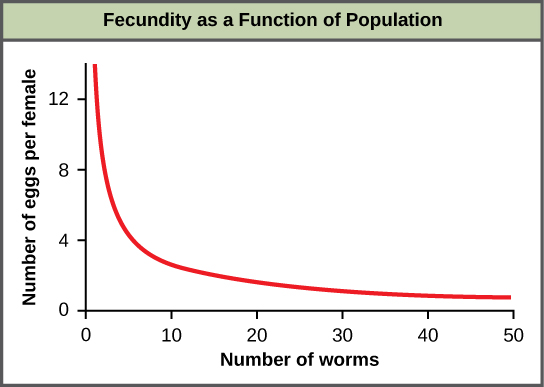

Figure 45.11図 45.11
In this population of roundworms, fecundity (number of eggs) decreases with population density. N.A. Croll et al., “The Population Biology and Control of Ascaris lumbricoides in a Rural Community in Iran.” Transactions of the Royal Society of Tropical Medicine and Hygiene 76, no. 2 (1982): 187-197, doi:10.1016/0035-9203(82)90272-3.
この回虫の個体群では、密度が高いほど産子力(卵数)が低下する。N.A. Croll et al., “The Population Biology and Control of Ascaris lumbricoides in a Rural Community in Iran.” Transactions of the Royal Society of Tropical Medicine and Hygiene 76, no. 2(1982):187–197, doi:10.1016/0035-9203(82)90272-3。
Density-Independent Regulation and Interaction with Density-Dependent Factors密度非依存的な調節と、密度依存要因との相互作用
Many factors, typically physical or chemical in nature (abiotic), influence the mortality of a population regardless of its density, including weather, natural disasters, and pollution. An individual deer may be killed in a forest fire regardless of how many deer happen to be in that area. Its chances of survival are the same whether the population density is high or low. The same holds true for cold winter weather.
英語のヒント
天候、自然災害、汚染など、通常は物理的・化学的、すなわち非生物的な多くの要因が、密度にかかわらず個体群の死亡率に影響する。あるシカは、その地域に何頭のシカがいるかに関係なく、森林火災で死ぬことがある。密度が高くても低くても、その個体の生存の可能性は同じである。冬の寒さにも同じことが当てはまる。
In real-life situations, population regulation is very complicated and density-dependent and independent factors can interact. A dense population that is reduced in a density-independent manner by some environmental factor(s) will be able to recover differently than a sparse population. For example, a population of deer affected by a harsh winter will recover faster if there are more deer remaining to reproduce.
英語のヒント
実際の個体群調節は非常に複雑で、密度依存要因と密度非依存要因は相互に作用しうる。高密度の個体群が、環境要因によって密度と無関係に減った場合、低密度の個体群とは異なる回復をする。例えば厳冬の影響を受けたシカの個体群は、繁殖できるシカが多く残っているほど、速く回復する。