第45章個体群と群集の生態学
Migration季節移動
Migration is the long-range seasonal movement of animals. It is an evolved, adapted response to variation in resource availability, and it is a common phenomenon found in all major groups of animals. Birds fly south for the winter to get to warmer climates with sufficient food, and salmon migrate to their spawning grounds. The popular 2005 documentary March of the Penguins followed the 62-mile migration of emperor penguins through Antarctica to bring food back to their breeding site and to their young. Wildebeests (Figure 45.35) migrate over 1800 miles each year in search of new grasslands.
英語のヒント
季節移動は、動物が季節ごとに長距離を移動することである。資源の利用可能性の変動に対して進化した適応的な反応で、主要な動物群に広く見られる。鳥は冬に南へ飛び、暖かく食料の十分な気候へ移る。サケは産卵場所へ移動する。2005年の人気ドキュメンタリー映画『皇帝ペンギン』は、繁殖地と子に食料を運ぶため、南極を62マイル移動するコウテイペンギンを追った。ヌー(図45.35)は新しい草地を求め、毎年1,800マイル以上移動する。
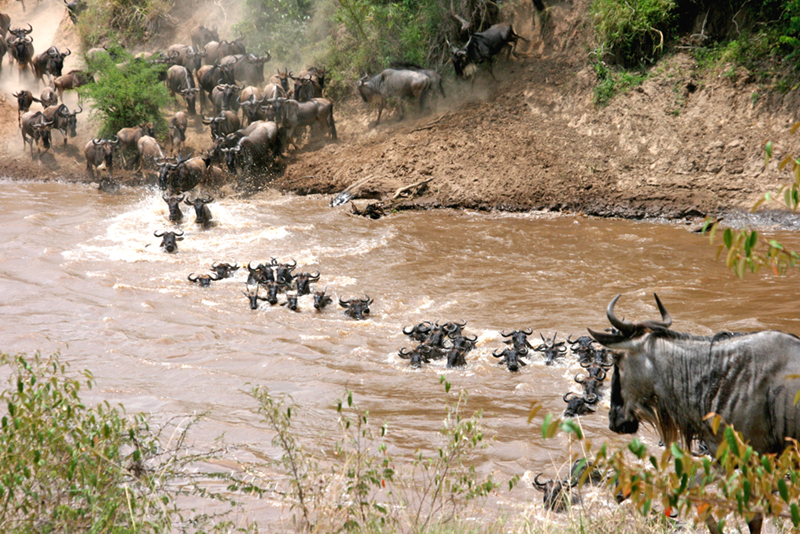
Figure 45.35図 45.35
Wildebeests migrate in a clockwise fashion over 1800 miles each year in search of rain-ripened grass. (credit: Eric Inafuku)
ヌーは、雨で育った草を探し、時計回りの経路で毎年1,800マイル以上移動する。(出典:Eric Inafuku)
Although migration is thought of as innate behavior, only some migrating species always migrate (obligate migration). Animals that exhibit facultative migration can choose to migrate or not. Additionally, in some animals, only a portion of the population migrates, whereas the rest does not migrate (incomplete migration). For example, owls that live in the tundra may migrate in years when their food source, small rodents, is relatively scarce, but not migrate during the years when rodents are plentiful.
英語のヒント
季節移動は生得的行動と考えられるが、必ず移動する種、すなわち義務的移動を行う種は一部だけである。条件的移動を示す動物は、移動するかどうかを選べる。また、個体群の一部だけが移動し、残りはとどまる部分移動を行う動物もいる。例えばツンドラのフクロウは、餌となる小型齧歯類が少ない年には移動し、豊富な年には移動しない場合がある。
Foraging採餌
Foraging is the act of searching for and exploiting food resources. Feeding behaviors that maximize energy gain and minimize energy expenditure are called optimal foraging behaviors, and these are favored by natural selection. The painted stork, for example, uses its long beak to search the bottom of a freshwater marshland for crabs and other food (Figure 45.36).
英語のヒント
採餌とは、食料資源を探し、利用する行為である。得るエネルギーを最大にし、費やすエネルギーを最小にする摂食行動を、最適採餌行動という。これは自然選択によって有利になる。例えばインドトキコウは、長いくちばしを使い、淡水湿地の底からカニなどの餌を探す(図45.36)。
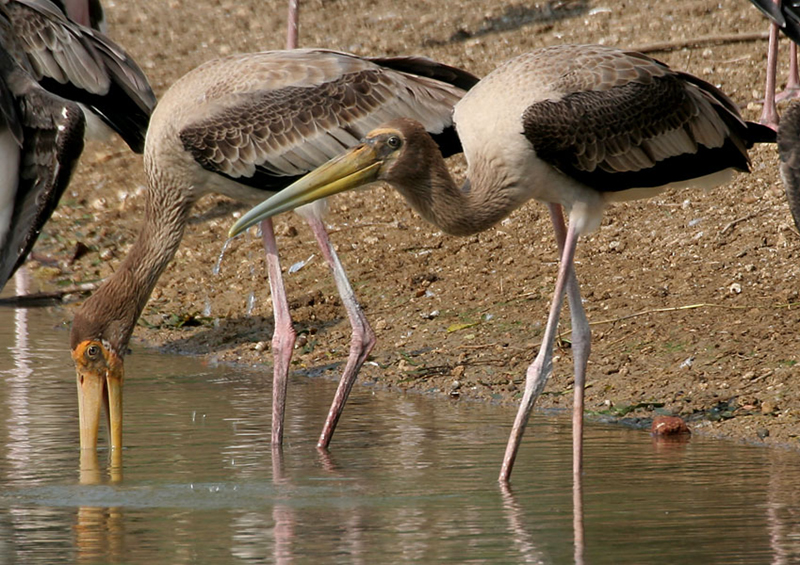
Figure 45.36図 45.36
The painted stork uses its long beak to forage. (credit: J.M. Garg)
インドトキコウは、長いくちばしで採餌する。(出典:J.M. Garg)
Innate Behaviors: Living in Groups生得的行動:集団で暮らす
Not all animals live in groups, but even those that live relatively solitary lives, with the exception of those that can reproduce asexually, must mate. Mating usually involves one animal signaling another so as to communicate the desire to mate. There are several types of energy-intensive behaviors or displays associated with mating, called mating rituals. Other behaviors found in populations that live in groups are described in terms of which animal benefits from the behavior. In selfish behavior, only the animal in question benefits; in altruistic behavior, one animal’s actions benefit another animal; cooperative behavior describes when both animals benefit. All of these behaviors involve some sort of communication between population members.
英語のヒント
すべての動物が集団で暮らすわけではない。それでも、無性生殖できるものを除けば、比較的単独で暮らす動物も交尾しなければならない。交尾では通常、一方が他方へ信号を送り、交尾したいことを伝える。交尾に関わる、エネルギーを多く使う行動やディスプレイにはいくつかの型があり、交尾儀式と呼ばれる。集団生活する個体群のほかの行動は、誰が利益を受けるかによって記述される。利己的行動では行為者だけが利益を受け、利他的行動では一方の行為が別の動物を利する。協力行動は双方が利益を受ける場合を指す。いずれも個体群の成員間で、何らかのコミュニケーションを伴う。
Communication within a Species種内のコミュニケーション
Animals communicate with each other using stimuli known as signals. An example of this is seen in the three-spined stickleback, where the visual signal of a red region in the lower half of a fish signals males to become aggressive and signals females to mate. Other signals are chemical (pheromones), aural (sound), visual (courtship and aggressive displays), or tactile (touch). These types of communication may be instinctual or learned or a combination of both. These are not the same as the communication we associate with language, which has been observed only in humans and perhaps in some species of primates and cetaceans.
英語のヒント
動物は、信号と呼ばれる刺激で意思を伝え合う。イトヨでは、体の下半分の赤い部分という視覚信号が、雄には攻撃性を、雌には交尾を促す。ほかにも、化学的な信号(フェロモン)、聴覚信号(音)、視覚信号(求愛や威嚇のディスプレイ)、触覚信号(接触)がある。これらは本能的な場合、学習される場合、両者の組み合わせの場合がある。人間、そしておそらく一部の霊長類や鯨類でしか観察されていない、言語に関わるコミュニケーションと同じものではない。
A pheromone is a secreted chemical signal used to obtain a response from another individual of the same species. The purpose of pheromones is to elicit a specific behavior from the receiving individual. Pheromones are especially common among social insects, but they are used by many species to attract the opposite sex, to sound alarms, to mark food trails, and to elicit other, more complex behaviors. Even humans are thought to respond to certain pheromones called axillary steroids. These chemicals influence human perception of other people, and in one study were responsible for a group of people synchronizing their menstrual cycles. The role of pheromones in human-to-human communication is not fully understood and continues to be researched.
英語のヒント
フェロモンは、同じ種の別の個体から反応を得るために分泌される化学信号である。受け取った個体に特定の行動を引き起こす。特に社会性昆虫で一般的だが、多くの種が、異性の誘引、警報、餌への道しるべ、さらに複雑な行動の誘発に使う。人間も、腋窩ステロイドと呼ばれる特定のフェロモンに反応すると考えられている。これらは他者の知覚に影響し、ある研究では、集団内で月経周期が同調する原因とされた。人間どうしのコミュニケーションにおける役割は十分理解されておらず、研究が続いている。
Songs are an example of an aural signal, one that needs to be heard by the recipient. Perhaps the best known of these are songs of birds, which identify the species and are used to attract mates. Other well-known songs are those of whales, which are of such low frequency that they can travel long distances underwater. Dolphin species communicate with each other (and occasionally even with other species of dolphins) using a wide variety of vocalizations. Male crickets make chirping sounds using a specialized organ to attract a mate, repel other males, and to announce a successful mating.
英語のヒント
歌は、受信者が聞く必要のある聴覚信号の例である。最もよく知られるのは鳥の歌だろう。種を知らせ、繁殖相手を引き付けるために使われる。クジラの歌も有名で、周波数が非常に低いため水中を遠くまで伝わる。イルカは多様な発声で、同種どうし、ときには別種のイルカともやり取りする。雄のコオロギは特殊な器官で鳴き、相手を引き付け、他の雄を追い払い、交尾の成功を知らせる。
Courtship displays are a series of ritualized visual behaviors (signals) designed to attract and convince a member of the opposite sex to mate. These displays are ubiquitous in the animal kingdom. Often these displays involve a series of steps, including an initial display by one member followed by a response from the other. If at any point, the display is performed incorrectly or a proper response is not given, the mating ritual is abandoned and the mating attempt will be unsuccessful. The mating display of the common stork is shown in Figure 45.37.
英語のヒント
求愛ディスプレイは、異性を引き付け、交尾へ導くための、儀式化された一連の視覚行動、すなわち信号である。動物界に広く見られる。多くの場合、一方の最初のディスプレイに他方が応答するなど、段階を踏む。どこかで動きが正しく行われなかったり、適切な応答がなかったりすると、儀式は中断され、交尾は成功しない。コウノトリの求愛ディスプレイを図45.37に示す。
Aggressive displays are also common in the animal kingdom. For example, a dog bares its teeth when it wants another dog to back down. Presumably, these displays communicate not only the willingness of the animal to fight, but also its fighting ability. Although these displays do signal aggression on the part of the sender, it is thought that these displays are actually a mechanism to reduce the amount of actual fighting that occurs between members of the same species: they allow individuals to assess the fighting ability of their opponent and thus decide whether it is “worth the fight.” The testing of certain hypotheses using game theory has led to the conclusion that some of these displays may overstate an animal’s actual fighting ability and are used to “bluff” the opponent. This type of interaction, even if “dishonest,” would be favored by natural selection if it is successful more times than not.
英語のヒント
威嚇ディスプレイも動物界で一般的である。例えばイヌは、別のイヌを退かせたいとき歯をむく。おそらく、戦う意思だけでなく、戦闘能力も伝えている。送り手の攻撃性を示すものではあるが、実際には、同種間の本当の戦闘を減らす仕組みだと考えられる。相手の戦闘能力を評価し、「戦う価値があるか」を決められるためである。ゲーム理論による仮説の検証から、一部のディスプレイは実際の能力を誇張し、相手を「はったり」で威圧するために使われる、という結論が導かれた。「不正直」なやり取りであっても、失敗するより成功することが多ければ、自然選択で有利になるだろう。
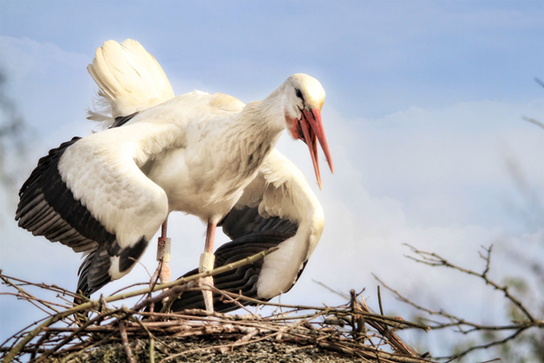


Figure 45.37図 45.37
This stork’s courtship display is designed to attract potential mates. (credit: Linda “jinterwas”/Flickr)
このコウノトリの求愛ディスプレイは、繁殖相手の候補を引き付けるためのものである。(出典:Linda “jinterwas”/Flickr)
Distraction displays are seen in birds and some fish. They are designed to attract a predator away from the nest. This is an example of an altruistic behavior: it benefits the young more than the individual performing the display, which is putting itself at risk by doing so.
英語のヒント
鳥や一部の魚には、注意をそらすディスプレイが見られる。捕食者を巣から引き離すためのものだ。これは利他的行動の例である。行う個体は自分を危険にさらす一方、それ以上の利益を子に与える。
Many animals, especially primates, communicate with other members in the group through touch. Activities such as grooming, touching the shoulder or root of the tail, embracing, lip contact, and greeting ceremonies have all been observed in the Indian langur, an Old World monkey. Similar behaviors are found in other primates, especially in the great apes.
英語のヒント
多くの動物、特に霊長類は、触れることで集団の仲間とやり取りする。旧世界ザルであるインドのラングールでは、毛づくろい、肩や尾の付け根への接触、抱擁、唇の接触、挨拶の儀式などが観察されている。ほかの霊長類、特に大型類人猿にも似た行動がある。