第45章個体群と群集の生態学
45.5 Human Population Growth45.5 人間の人口増加
Learning Objectives学習目標
By the end of this section, you will be able to do the following:
この節を学ぶと、次のことができるようになる。
- Discuss exponential human population growth人間の指数関数的な人口増加について論じる。
- Explain how humans have expanded the carrying capacity of their habitat人間が生息地の環境収容力を拡大してきた方法を説明する。
- Relate population growth and age structure to the level of economic development in different countries各国の人口増加と年齢構成を、経済発展の水準と結び付ける。
- Discuss the long-term implications of unchecked human population growth抑制のない人口増加の長期的な意味を論じる。
Population dynamics can be applied to human population growth. Earth’s human population is growing rapidly, to the extent that some worry about the ability of the earth’s environment to sustain this population. Long-term exponential growth carries the potential risks of famine, disease, and large-scale death.
英語のヒント
個体群動態は、人間の人口増加にも適用できる。地球の人口は急速に増えており、地球環境がそれを支えられるか心配する人もいるほどである。長期にわたる指数増加には、飢饉、病気、大量死の危険が潜む。
Although humans have increased the carrying capacity of their environment, the technologies used to achieve this transformation have caused unprecedented changes to Earth’s environment, altering ecosystems to the point where some may be in danger of collapse. The depletion of the ozone layer, erosion due to acid rain, and damage from global climate change are caused by human activities. The ultimate effect of these changes on our carrying capacity is unknown. As some point out, it is likely that the negative effects of increasing carrying capacity will outweigh the positive ones—the world’s carrying capacity for human beings might actually decrease.
英語のヒント
人間は環境収容力を高めてきたが、そのための技術は地球環境に前例のない変化を起こし、一部の生態系を崩壊の危険にさらすほど変えてきた。オゾン層の減少、酸性雨による侵食、地球規模の気候変動による損害は、人間活動が引き起こしている。これらの変化が人間の環境収容力に最終的にどのような影響を与えるかは不明である。一部の人が指摘するように、収容力を高める悪影響が利益を上回り、世界が人間を支える能力は、実際には低下するかもしれない。
The human population is currently experiencing exponential growth even though human reproduction is far below its biotic potential (Figure 45.14). To reach its biotic potential, all females would have to become pregnant every nine months or so during their reproductive years. Also, resources would have to be such that the environment would support such growth. Neither of these two conditions exists. In spite of this fact, human population is still growing exponentially.
英語のヒント
人間の繁殖は潜在的な最大能力を大きく下回るにもかかわらず、人口は現在、指数増加している(図45.14)。繁殖ポテンシャルに達するには、すべての女性が生殖可能な年齢の間、約9か月ごとに妊娠する必要がある。また、そのような増加を環境が支えられるほど、資源がなければならない。この2条件は、いずれも満たされていない。それでも、人間の人口は指数関数的に増え続けている。
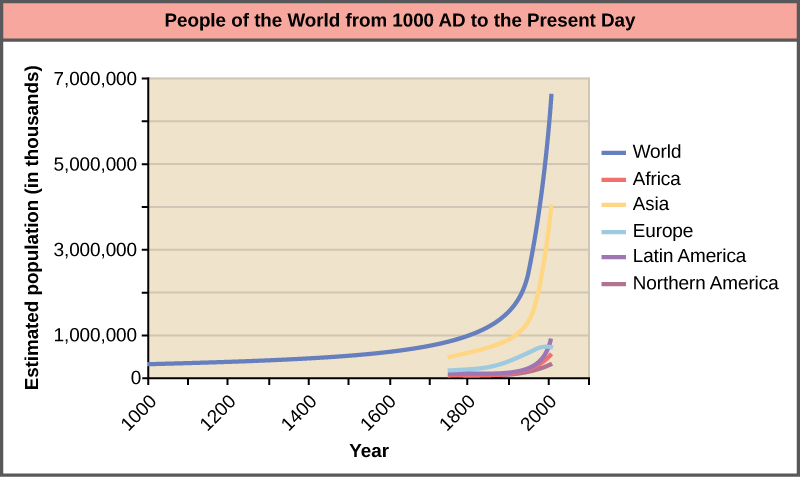

Figure 45.14図 45.14
Human population growth since 1000 AD is exponential (dark blue line). Notice that while the population in Asia (yellow line), which has many economically underdeveloped countries, is increasing exponentially, the population in Europe (light blue line), where most of the countries are economically developed, is growing much more slowly.
西暦1000年以降の人口は、指数関数的に増えている(濃い青線)。経済的に発展の遅れた国が多いアジア(黄線)では指数増加する一方、多くの国が経済的に発展しているヨーロッパ(水色線)では、増加がはるかに遅いことに注目しよう。
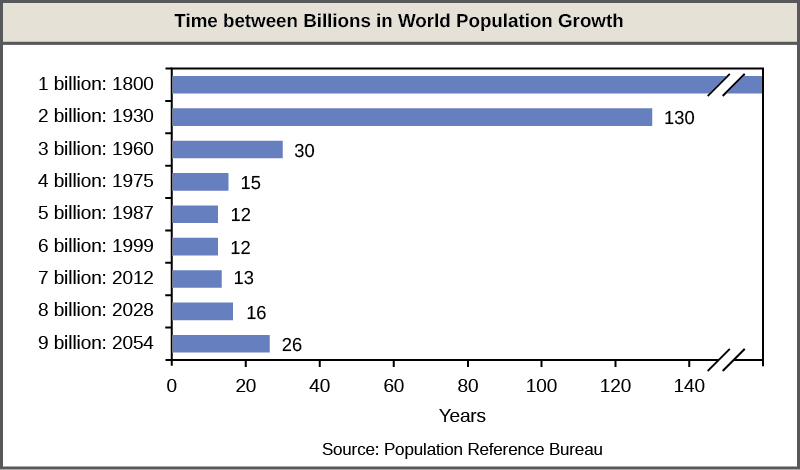
A consequence of exponential human population growth is a reduction in time that it takes to add a particular number of humans to the Earth. Figure 45.15 shows that 123 years were necessary to add 1 billion humans in 1930, but it only took 24 years to add two billion people between 1975 and 1999. As already discussed, our ability to increase our carrying capacity indefinitely may be limited. Without new technological advances, the human growth rate has been predicted to slow in the coming decades. However, the population will still be increasing and the threat of overpopulation remains.
英語のヒント
指数関数的な人口増加の結果、地球上に一定の人数が増えるまでの時間は短くなる。図45.15によると、1930年までに10億人増えるには123年かかったが、1975〜1999年に20億人増えるには24年しかかからなかった。すでに述べたように、環境収容力を無限に高め続ける能力には、限界があるかもしれない。新たな技術進歩がなければ、今後数十年で人口増加率は低下すると予測されている。しかし人口自体は増え続け、人口過剰の脅威は残る。
OpenStax, Rice University; Biology 2e. (credit: modification of work by Ryan T. Cragun) · CC BY 4.0 · Source出典

Figure 45.15図 45.15
The time between the addition of each billion human beings to Earth decreases over time. (credit: modification of work by Ryan T. Cragun)
地球上の人口が10億人ずつ増えるまでの時間は、時代とともに短くなる。(出典:Ryan T. Cragunの作品を改変)
Overcoming Density-Dependent Regulation密度依存的な調節を乗り越える
Humans are unique in their ability to alter their environment with the conscious purpose of increasing carrying capacity. This ability is a major factor responsible for human population growth and a way of overcoming density-dependent growth regulation. Much of this ability is related to human intelligence, society, and communication. Humans can construct shelter to protect them from the elements and have developed agriculture and domesticated animals to increase their food supplies. In addition, humans use language to communicate this technology to new generations, allowing them to improve upon previous accomplishments.
英語のヒント
人間は、環境収容力を高めるという意識的な目的をもって、環境を変えられる点で独特である。この能力は人口増加の主要な要因であり、密度依存的な増加調節を乗り越える手段でもある。多くの部分が、人間の知性、社会、コミュニケーションと関係している。人間は風雨から身を守る住居を作り、食料供給を増やすため農業を発展させ、動物を家畜化してきた。さらに、言語で技術を次世代へ伝え、以前の成果を改良できるようにしている。
Other factors in human population growth are migration and public health. Humans originated in Africa, but have since migrated to nearly all inhabitable land on the Earth. Public health, sanitation, and the use of antibiotics and vaccines have decreased the ability of infectious disease to limit human population growth. In the past, diseases such as the bubonic plaque of the fourteenth century killed between 30 and 60 percent of Europe’s population and reduced the overall world population by as many as 100 million people. Today, the threat of infectious disease, while not gone, is certainly less severe. According to the Institute for Health Metrics and Evaluation (IHME) in Seattle, global death from infectious disease declined from 15.4 million in 1990 to 10.4 million in 2017. To compare to some of the epidemics of the past, the percentage of the world's population killed between 1993 and 2002 decreased from 0.30 percent of the world's population to 0.14 percent. Thus, infectious disease influence on human population growth is becoming less significant.
英語のヒント
人口増加のほかの要因には、移住と公衆衛生がある。人間はアフリカで生まれ、その後、地球上のほぼすべての居住可能な陸地へ移動した。公衆衛生、衛生設備、抗生物質やワクチンの使用により、感染症が人口増加を抑える力は小さくなった。過去には、14世紀の腺ペストのような病気がヨーロッパの人口の30〜60%を奪い、世界全体の人口を最大1億人減らした。現在も感染症の脅威は消えていないが、確かに軽減している。シアトルの保健指標評価研究所(IHME)によると、世界の感染症による死亡数は、1990年の1,540万人から2017年の1,040万人へ減った。過去の流行と比べると、1993〜2002年に死亡した世界人口の割合は、0.30%から0.14%へ低下した。このように、人口増加に対する感染症の影響は小さくなっている。