第45章個体群と群集の生態学
Community Dynamics群集の動態
Community dynamics are the changes in community structure and composition over time. Sometimes these changes are induced by environmental disturbances such as volcanoes, earthquakes, storms, fires, and climate change. Communities with a stable structure are said to be at equilibrium. Following a disturbance, the community may or may not return to the equilibrium state.
英語のヒント
群集の動態とは、構造や構成が時間とともに変わることである。火山、地震、嵐、火災、気候変動などの環境攪乱が引き起こすこともある。構造が安定した群集は、平衡状態にあるという。攪乱の後、群集は平衡状態へ戻る場合も、戻らない場合もある。
Succession describes the sequential appearance and disappearance of species in a community over time. In primary succession, newly exposed or newly formed land is colonized by living things; in secondary succession, part of an ecosystem is disturbed and remnants of the previous community remain.
英語のヒント
遷移とは、時間とともに群集内の種が順に現れ、消えていくことである。一次遷移では、新たに露出または形成された土地へ生物が定着する。二次遷移では、生態系の一部が攪乱されるが、前の群集の一部が残っている。
Primary Succession and Pioneer Species一次遷移と先駆種
Primary succession occurs when new land is formed or rock is exposed: for example, following the eruption of volcanoes, such as those on the Big Island of Hawaii. As lava flows into the ocean, new land is continually being formed. On the Big Island, approximately 32 acres of land is added each year. First, weathering and other natural forces break down the substrate enough for the establishment of certain hearty plants and lichens with few soil requirements, known as pioneer species (Figure 45.32). These species help to further break down the mineral rich lava into soil where other, less hardy species will grow and eventually replace the pioneer species. In addition, as these early species grow and die, they add to an ever-growing layer of decomposing organic material and contribute to soil formation. Over time the area will reach an equilibrium state, with a set of organisms quite different from the pioneer species.
英語のヒント
一次遷移は、新しい土地ができたり、岩が露出したりするときに起こる。例えば、ハワイ島のような場所での火山噴火の後である。溶岩が海へ流れ込み、新しい陸地が次々にできる。ハワイ島では、毎年約32エーカーの陸地が加わる。まず風化などの自然の力が基質を砕き、土壌がわずかでも生きられる丈夫な植物や地衣類、すなわち先駆種が定着できるようにする(図45.32)。これらは、鉱物豊富な溶岩をさらに土壌へ変えるのを助ける。そこへ、より耐性の低い種が育ち、やがて先駆種に置き換わる。最初の種が育って死ぬと、分解する有機物の層が厚くなり、土壌形成に寄与する。時間がたつと、先駆種とは大きく異なる生物の集まりからなる、平衡状態へ達する。
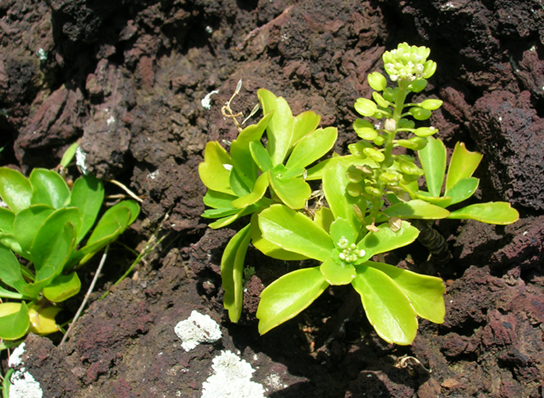
Figure 45.32図 45.32
During primary succession in lava on Maui, Hawaii, succulent plants are the pioneer species. (credit: Forest and Kim Starr)
ハワイのマウイ島の溶岩上で起こる一次遷移では、多肉植物が先駆種となる。(出典:Forest and Kim Starr)
Secondary succession二次遷移
A classic example of secondary succession occurs in oak and hickory forests cleared by wildfire (Figure 45.33). Wildfires will burn most vegetation and kill those animals unable to flee the area. Their nutrients, however, are returned to the ground in the form of ash. Thus, even when areas are devoid of life due to severe fires, the area will soon be ready for new life to take hold.
英語のヒント
二次遷移の典型例は、山火事で焼けたオークとヒッコリーの森林で見られる(図45.33)。火災は植生の大部分を燃やし、逃げられない動物を殺す。しかし栄養物質は灰となって地面へ戻る。したがって、激しい火災で生物がいなくなった区域でも、まもなく新しい生命が定着できる状態になる。
Before the fire, the vegetation was dominated by tall trees with access to the major plant energy resource: sunlight. Their height gave them access to sunlight while also shading the ground and other low-lying species. After the fire, though, these trees are no longer dominant. Thus, the first plants to grow back are usually annual plants followed within a few years by quickly growing and spreading grasses and other pioneer species. Due to, at least in part, changes in the environment brought on by the growth of the grasses and other species, over many years, shrubs will emerge along with small pine, oak, and hickory trees. These organisms are called intermediate species. Eventually, over 150 years, the forest will reach its equilibrium point where species composition is no longer changing and resembles the community before the fire. This equilibrium state is referred to as the climax community, which will remain stable until the next disturbance.
英語のヒント
火災前は、主要なエネルギー資源である日光を得られる高木が優占していた。その高さによって日光を得る一方、地面や背の低い種を陰にしていた。しかし火災後には、高木の優占はなくなる。最初に戻るのは通常、一年生植物である。数年以内に、速く育って広がるイネ科草本や、ほかの先駆種が続く。これらの成長がもたらす環境変化などにより、長い年月のうちに低木と、小さなマツ、オーク、ヒッコリーが現れる。これらを中間段階の種という。やがて150年をかけ、種の構成が変わらず、火災前の群集に似た平衡点へ達する。この平衡状態を極相群集といい、次の攪乱まで安定して続く。
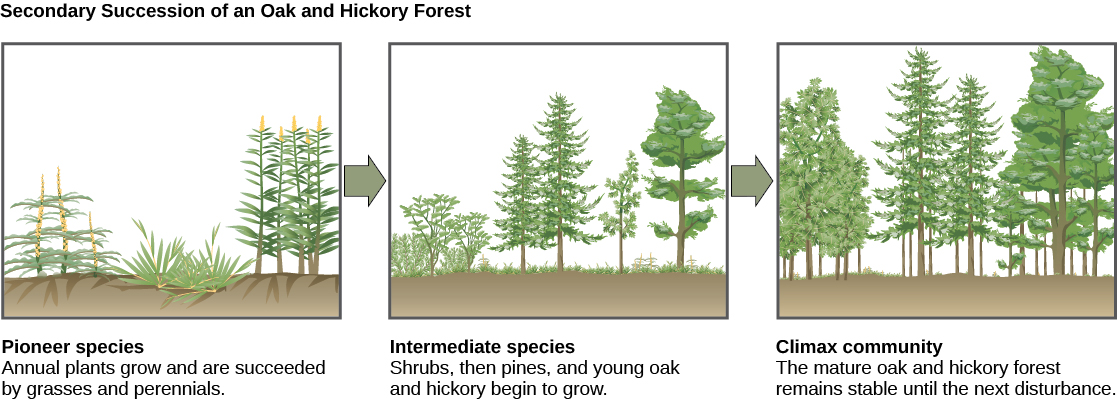


Figure 45.33図 45.33
Secondary succession is shown in an oak and hickory forest after a forest fire.
森林火災後の、オークとヒッコリーの森林の二次遷移。
Section Summaryこの節のまとめ
Communities include all the different species living in a given area. The variety of these species is called species richness. Many organisms have developed defenses against predation and herbivory, including mechanical defenses, warning coloration, and mimicry, as a result of evolution and the interaction with other members of the community. Two species cannot exist in the same habitat competing directly for the same resources. Species may form symbiotic relationships such as commensalism or mutualism. Community structure is described by its foundation and keystone species. Communities respond to environmental disturbances by succession (the predictable appearance of different types of plant species) until a stable community structure is established.
群集には、ある区域に暮らすすべての種が含まれる。種の多さを種の豊富さという。多くの生物は進化と群集内の相互作用を通じて、機械的防御、警告色、擬態など、捕食や植食に対する防御を発達させた。2種が同じ生息地で同じ資源をめぐり、直接競争したまま共存することはできない。種は片利共生や相利共生などの関係を作ることがある。群集の構造は、基盤種とキーストーン種によって記述される。環境攪乱の後、群集は、異なる植物種が予測可能な順序で現れる遷移を経て、安定した構造へ至る。
Review Questions確認問題
Exercises 31–34練習問題 31–34
Exercise 31問題 31
The first species to live on new land, such as that formed from volcanic lava, are called ________.
火山の溶岩からできた土地など、新しい土地に最初に住む種を________と呼ぶ。
- climax community極相群集
- keystone speciesキーストーン種
- foundation species基盤種
- pioneer species先駆種
Solution解き方
D
D
Exercise 32問題 32
Which type of mimicry involves multiple species with similar warning coloration that are all toxic to predators?
複数の種が似た警告色をもち、すべて捕食者に対して有毒である擬態は、どの型か。
- Batesian mimicryベイツ型擬態
- Müllerian mimicryミュラー型擬態
- Emsleyan/Mertensian mimicryエムズリー型/メルテンス型擬態
- Mertensian mimicryメルテンス型擬態
Solution解き方
B
B
Exercise 33問題 33
A symbiotic relationship where both of the coexisting species benefit from the interaction is called ________.
共に暮らす両方の種が利益を得る共生関係を、________と呼ぶ。
- commensalism片利共生
- parasitism寄生
- mutualism相利共生
- communism共産主義
Solution解き方
C
C
Exercise 34問題 34
Which of the following is not a mutualistic relationship?
相利共生に当てはまらないものはどれか。
- a shark using an aquatic cleaning stationサメが水中のクリーニングステーションを利用すること
- a helminth feeding from its host寄生蠕虫が宿主から栄養を取ること
- a bumblebee collecting pollen from a flowerマルハナバチが花から花粉を集めること
- bacteria living in the gut of humans細菌が人間の腸内に住むこと
Solution解き方
B
B