第45章個体群と群集の生態学
Simple Learned Behaviors単純な学習行動
The majority of the behaviors previously discussed were innate or at least have an innate component (variations on the innate behaviors may be learned). They are inherited and the behaviors do not change in response to signals from the environment. Conversely, learned behaviors, even though they may have instinctive components, allow an organism to adapt to changes in the environment and are modified by previous experiences. Simple learned behaviors include habituation and imprinting—both are important to the maturation process of young animals.
英語のヒント
ここまでの行動の多くは生得的、または少なくとも生得的要素をもつものだった。その変形が学習されることはあるが、基本は遺伝し、環境からの信号に応じて変化しない。これに対し学習行動は、本能的要素を含む場合でも、環境変化への適応を可能にし、以前の経験で修正される。単純な学習行動には馴化と刷り込みがあり、どちらも若い動物の成熟過程で重要である。
Habituation馴化
Habituation is a simple form of learning in which an animal stops responding to a stimulus after a period of repeated exposure. This is a form of non-associative learning, as the stimulus is not associated with any punishment or reward. Prairie dogs typically sound an alarm call when threatened by a predator, but they become habituated to the sound of human footsteps when no harm is associated with this sound, therefore, they no longer respond to them with an alarm call. In this example, habituation is specific to the sound of human footsteps, as the animals still respond to the sounds of potential predators.
英語のヒント
馴化は、刺激に繰り返しさらされると、やがて反応しなくなる単純な学習である。刺激が罰や報酬と結び付いていないため、非連合学習の一種である。プレーリードッグは通常、捕食者に脅かされると警戒声を上げる。しかし人間の足音に害が伴わなければ慣れてしまい、警戒声を出さなくなる。この例では馴化は人間の足音に特異的で、捕食者となりうる動物の音には、なお反応する。
Imprinting刷り込み
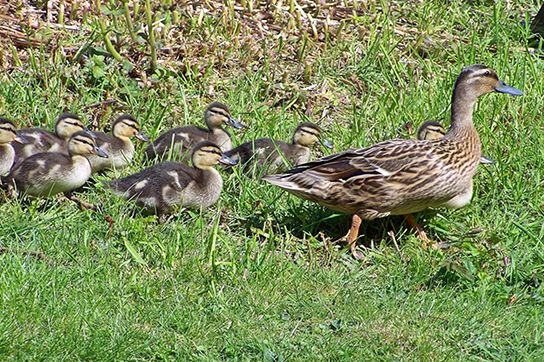
Imprinting is a type of learning that occurs at a particular age or a life stage that is rapid and independent of the species involved. Hatchling ducks recognize the first adult they see, their mother, and make a bond with her. A familiar sight is ducklings walking or swimming after their mothers (Figure 45.39). This is another type of non-associative learning, but is very important in the maturation process of these animals as it encourages them to stay near their mother so they will be protected, greatly increasing their chances of survival. However, if newborn ducks see a human before they see their mother, they will imprint on the human and follow it in just the same manner as they would follow their real mother.
英語のヒント
刷り込みは、特定の年齢や生活段階に、相手の種にかかわらず素早く起こる学習である。孵化したカモは、最初に見る成体である母親を認識し、結び付きを作る。ひなが母親の後を歩いたり泳いだりする姿は、よく知られている(図45.39)。これも非連合学習の一種だが、成熟過程で非常に重要である。母親の近くにとどまって保護されるため、生存の可能性が大きく高まる。しかし生まれたばかりのカモが、母親より先に人間を見ると、人間に刷り込まれ、本当の母親にするのと同じように後を追う。
OpenStax, Rice University; Biology 2e. (credit: modification of work by Mark Harkin) · CC BY 4.0 · Source出典
Figure 45.39図 45.39
The attachment of ducklings to their mother is an example of imprinting. (credit: modification of work by Mark Harkin)
カモのひなが母親に結び付くことは、刷り込みの例である。(出典:Mark Harkinの作品を改変)
Conditioned Behavior条件付けられた行動
Conditioned behaviors are types of associative learning, where a stimulus becomes associated with a consequence. During operant conditioning, the behavioral response is modified by its consequences, with regards to its form, strength, or frequency.
英語のヒント
条件付けられた行動は、刺激がある結果と結び付く連合学習の一種である。オペラント条件付けでは、行動の結果によって、その形、強さ、頻度が変えられる。
Classical Conditioning古典的条件付け
In classical conditioning, a response called the conditioned response is associated with a stimulus that it had previously not been associated with, the conditioned stimulus. The response to the original, unconditioned stimulus is called the unconditioned response. The most cited example of classical conditioning is Ivan Pavlov’s experiments with dogs (Figure 45.40). In Pavlov’s experiments, the unconditioned response was the salivation of dogs in response to the unconditioned stimulus of seeing or smelling their food. The conditioning stimulus that researchers associated with the unconditioned response was the ringing of a bell. During conditioning, every time the animal was given food, the bell was rung. This was repeated during several trials. After some time, the dog learned to associate the ringing of the bell with food and to respond by salivating. After the conditioning period was finished, the dog would respond by salivating when the bell was rung, even when the unconditioned stimulus, the food, was absent. Thus, the ringing of the bell became the conditioned stimulus and the salivation became the conditioned response. Although it is thought by some scientists that the unconditioned and conditioned responses are identical, even Pavlov discovered that the saliva in the conditioned dogs had characteristic differences when compared to the unconditioned dog.
英語のヒント
古典的条件付けでは、条件反応と呼ばれる反応が、それまで結び付いていなかった刺激、すなわち条件刺激と結び付く。元の無条件刺激に対する反応は、無条件反応という。最もよく引用される例は、イワン・パブロフのイヌの実験である(図45.40)。この実験の無条件反応は、食べ物を見たり嗅いだりする無条件刺激に対して、唾液が出ることだった。研究者がそれと結び付けた刺激は、ベルの音である。条件付けの間、餌を与えるたびにベルを鳴らし、何度か繰り返した。しばらくすると、イヌはベルの音と餌を結び付け、唾液を出すようになった。条件付けの後は、餌という無条件刺激がなくても、ベルが鳴ると唾液が出た。こうしてベルの音が条件刺激、唾液の分泌が条件反応になった。一部の科学者は、無条件反応と条件反応は同一だと考える。しかしパブロフ自身も、条件付けたイヌと、していないイヌの唾液に特徴的な違いを発見していた。
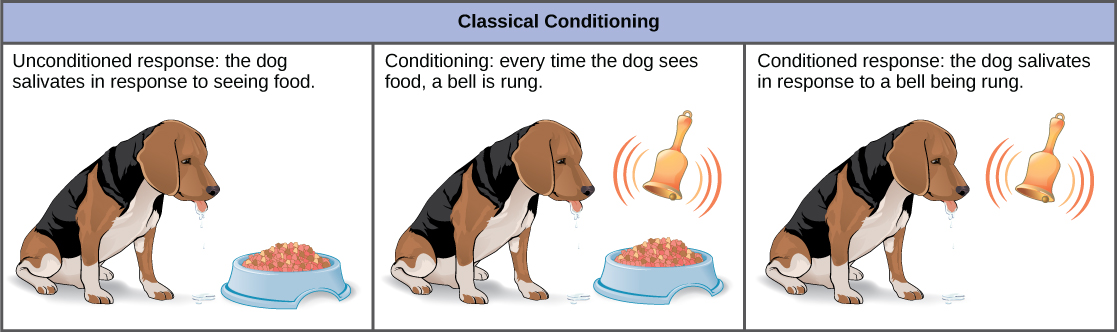


Figure 45.40図 45.40
In the classic Pavlovian response, the dog becomes conditioned to associate the ringing of the bell with food.
古典的なパブロフの反応では、イヌはベルの音を餌と結び付けるよう条件付けられる。
It had been thought by some scientists that this type of conditioning required multiple exposures to the paired stimulus and response, but it is now known that this is not necessary in all cases, and that some conditioning can be learned in a single pairing experiment. Classical conditioning is a major tenet of behaviorism, a branch of psychological philosophy that proposes that all actions, thoughts, and emotions of living things are behaviors that can be treated by behavior modification and changes in the environment.
英語のヒント
この条件付けには、刺激と反応を組み合わせて何度も経験させる必要がある、と考える科学者もいた。しかし現在では、必ずしもそうではなく、1回の組み合わせだけで学習される条件付けもあると分かっている。古典的条件付けは行動主義の主要な原則である。行動主義は心理学の思想の一分野で、生物のあらゆる行為、思考、感情は行動であり、行動の修正と環境の変化によって扱えるとする。