第45章個体群と群集の生態学
Single versus Multiple Reproductive Events一回繁殖と反復繁殖
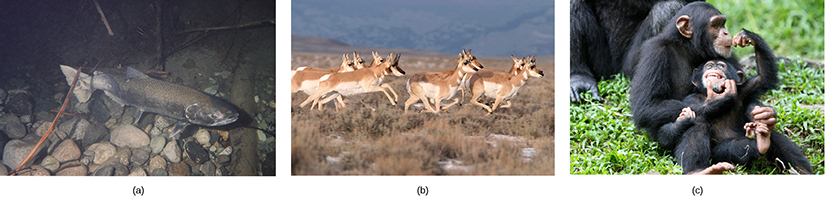
Some life history traits, such as fecundity, timing of reproduction, and parental care, can be grouped together into general strategies that are used by multiple species. Semelparity occurs when a species reproduces only once during its lifetime and then dies. Such species use most of their resource budget during a single reproductive event, sacrificing their health to the point that they do not survive. Examples of semelparity are bamboo, which flowers once and then dies, and the Chinook salmon (Figure 45.7a), which uses most of its energy reserves to migrate from the ocean to its freshwater nesting area, where it reproduces and then dies. Scientists have posited alternate explanations for the evolutionary advantage of the Chinook’s post-reproduction death: a programmed suicide caused by a massive release of corticosteroid hormones, presumably so the parents can become food for the offspring, or simple exhaustion caused by the energy demands of reproduction; these are still being debated.
英語のヒント
産子力、繁殖時期、親の世話などの生活史形質は、複数の種が用いる一般的な戦略としてまとめられる。一回繁殖は、生涯に一度だけ繁殖し、その後死ぬ場合である。その1回に資源の大部分を使い、生き残れないほど健康を犠牲にする。例には、一度花を咲かせて枯れるタケや、マスノスケがある(図45.7a)。マスノスケは蓄えたエネルギーの多くを使い、海から淡水の産卵場所へ移動し、そこで繁殖して死ぬ。科学者は、繁殖後に死ぬことの進化的な利点について、別々の説明を提案している。1つは、副腎皮質ホルモンの大量放出による、プログラムされた自死で、おそらく親が子の食料となるためだというもの。もう1つは、繁殖のエネルギー要求による単なる消耗である。これらは今も議論されている。
Iteroparity describes species that reproduce repeatedly during their lives. Some animals are able to mate only once per year, but survive multiple mating seasons. The pronghorn antelope is an example of an animal that goes into a seasonal estrus cycle (“heat”): a hormonally induced physiological condition preparing the body for successful mating (Figure 45.7b). Females of these species mate only during the estrus phase of the cycle. A different pattern is observed in primates, including humans and chimpanzees, which may attempt reproduction at any time during their reproductive years, even though their menstrual cycles make pregnancy likely only a few days per month during ovulation (Figure 45.7c).
英語のヒント
OpenStax, Rice University; Biology 2e. (credit a: modification of work by Roger Tabor, USFWS; credit b: modification of work by Mark Gocke, USDA; credit c: modification of work by “Shiny Things”/Flickr) · CC BY 4.0 · Source出典

Figure 45.7図 45.7
The (a) Chinook salmon mates once and dies. The (b) pronghorn antelope mates during specific times of the year during its reproductive life. Primates, such as humans and (c) chimpanzees, may mate on any day, independent of ovulation. (credit a: modification of work by Roger Tabor, USFWS; credit b: modification of work by Mark Gocke, USDA; credit c: modification of work by “Shiny Things”/Flickr)
(a)マスノスケは一度繁殖すると死ぬ。(b)プロングホーンは、生殖可能な生涯の間、年の特定の時期に交尾する。人間や(c)チンパンジーなどの霊長類は、排卵とは独立に、どの日にも交尾しうる。(出典:a:Roger Tabor, USFWS、b:Mark Gocke, USDA、c:“Shiny Things”/Flickrの各作品を改変)