第45章個体群と群集の生態学
Life Histories of K-selected and r-selected SpeciesK選択種とr選択種の生活史
While reproductive strategies play a key role in life histories, they do not account for important factors like limited resources and competition. The regulation of population growth by these factors can be used to introduce a classical concept in population biology, that of K-selected versus r-selected species.
英語のヒント
繁殖戦略は生活史の重要な部分を占めるが、資源の制限や競争といった重要な要因を十分には扱わない。これらの要因による個体群増加の調節から、個体群生物学の古典的な考え方である、K選択種とr選択種の概念を導入できる。
The concept relates to a species’ reproductive strategies, habitat, and behavior, especially in the way that they obtain resources and care for their young. It includes length of life and survivorship factors as well. Population biologists have grouped species into the two large categories—K-selected and r-selected—although the categories are really two ends of a continuum.
英語のヒント
この概念は、種の繁殖戦略、生息地、行動、特に資源を得て子を世話する方法に関係する。寿命や生存に関わる要因も含む。個体群生物学者は、種をK選択とr選択の2つの大きなカテゴリーに分けてきた。ただし実際には、連続体の両端を表している。
K-selected species are species selected by stable, predictable environments. Populations of K-selected species tend to exist close to their carrying capacity (hence the term K-selected) where intraspecific competition is high. These species have few, large offspring, a long gestation period, and often give long-term care to their offspring (Table 45.2). While larger in size when born, the offspring are relatively helpless and immature at birth. By the time they reach adulthood, they must develop skills to compete for natural resources. In plants, scientists think of parental care more broadly: how long fruit takes to develop or how long it remains on the plant are determining factors in the time to the next reproductive event. Examples of K-selected species are primates (including humans), elephants, and plants such as oak trees (Figure 45.13a).
英語のヒント
Oak trees grow very slowly and take, on average, 20 years to produce their first seeds, known as acorns. As many as 50,000 acorns can be produced by an individual tree, but the germination rate is low as many of these rot or are eaten by animals such as squirrels. In some years, oaks may produce an exceptionally large number of acorns, and these years may be on a two- or three-year cycle depending on the species of oak (r-selection).
英語のヒント
オークは非常にゆっくり育ち、最初の種子、すなわちドングリを作るまで平均20年かかる。1本の木が5万個ものドングリを作れるが、多くは腐るかリスなどに食べられるため、発芽率は低い。非常に多くのドングリを作る年があり、種によっては2〜3年周期となることがある。これはr選択の特徴である。
As oak trees grow to a large size and for many years before they begin to produce acorns, they devote a large percentage of their energy budget to growth and maintenance. The tree’s height and size allow it to dominate other plants in the competition for sunlight, the oak’s primary energy resource. Furthermore, when it does reproduce, the oak produces large, energy-rich seeds that use their energy reserve to become quickly established (K-selection).
英語のヒント
オークは、ドングリを作り始めるまで何年もかけて大きく育つため、エネルギー収支の大きな割合を成長と維持へ配分する。高く大きな体によって、主なエネルギー資源である日光をめぐる競争で、ほかの植物より優位に立てる。さらに、いざ繁殖すると、大きくエネルギー豊富な種子を作る。種子はその蓄えを使って、速やかに定着する。これはK選択の特徴である。
In contrast, r-selected species have a large number of small offspring (hence their r designation (Table 45.2)). This strategy is often employed in unpredictable or changing environments. Animals that are r-selected do not give long-term parental care and the offspring are relatively mature and self-sufficient at birth. Examples of r-selected species are marine invertebrates, such as jellyfish, and plants, such as the dandelion (Figure 45.13b). Dandelions have small seeds that are wind dispersed long distances. Many seeds are produced simultaneously to ensure that at least some of them reach a hospitable environment. Seeds that land in inhospitable environments have little chance for survival since their seeds are low in energy content. Note that survival is not necessarily a function of energy stored in the seed itself.
英語のヒント
Characteristics of K-selected and r-selected species K選択種とr選択種の特徴 |
|
|---|---|
Characteristics of K-selected species K選択種の特徴 |
Characteristics of r-selected species r選択種の特徴 |
Mature late 成熟が遅い |
Mature early 成熟が早い |
Greater longevity 寿命が長い |
Lower longevity 寿命が短い |
Increased parental care 親の世話が多い |
Decreased parental care 親の世話が少ない |
Increased competition 競争が強い |
Decreased competition 競争が弱い |
Fewer offspring 子の数が少ない |
More offspring 子の数が多い |
Larger offspring 子が大きい |
Smaller offspring 子が小さい |
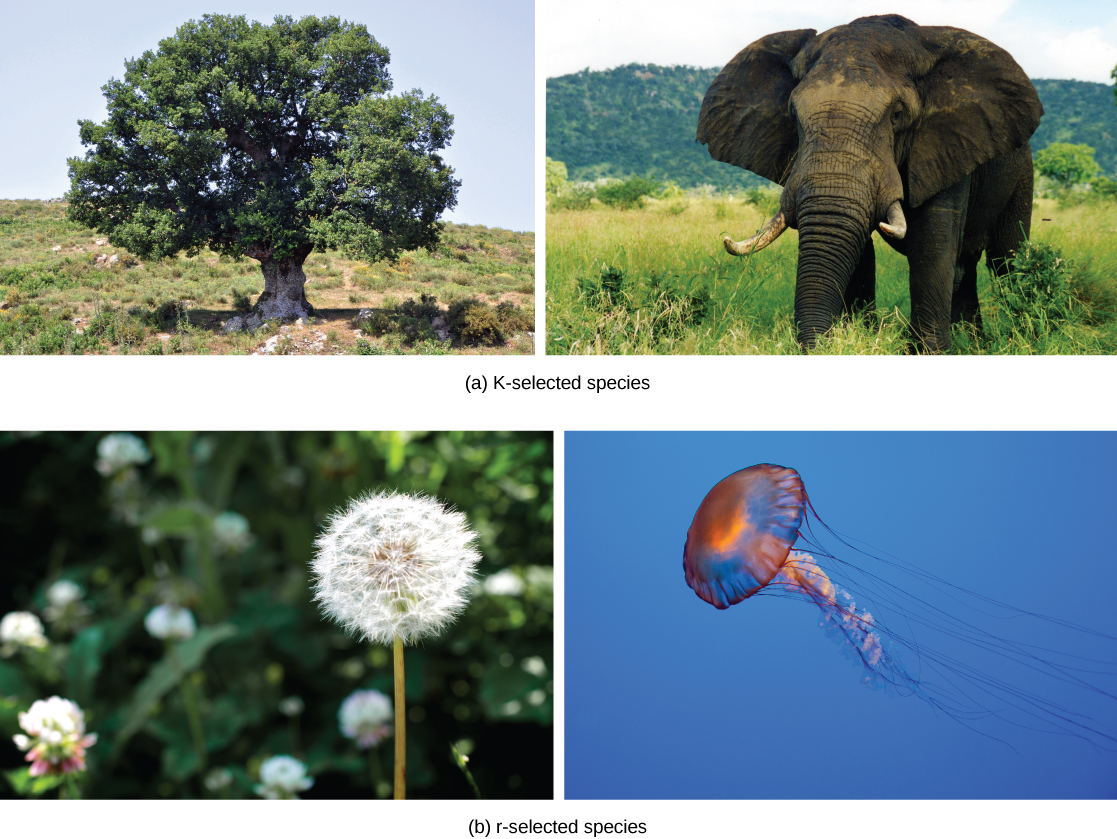

Figure 45.13図 45.13
(a) Elephants are considered K-selected species as they live long, mature late, and provide long-term parental care to few offspring. Oak trees produce many offspring that do not receive parental care, but are considered K-selected species based on longevity and late maturation. (b) Dandelions and jellyfish are both considered r-selected species as they mature early, have short lifespans, and produce many offspring that receive no parental care.
(a)ゾウは長寿で成熟が遅く、少数の子を長く世話するためK選択種とされる。オークは多数の子を作り、親の世話をしないが、長寿と晩熟に基づいてK選択種とされる。(b)タンポポとクラゲは、成熟が早く短命で、世話を受けない多数の子を作るため、いずれもr選択種とされる。
Modern Theories of Life History現代の生活史理論
By the second half of the twentieth century, the concept of K- and r-selected species was used extensively and successfully to study populations. The r- and K-selection theory, although accepted for decades and used for much groundbreaking research, has now been reconsidered, and many population biologists have abandoned or modified it. Over the years, several studies attempted to confirm the theory, but these attempts have largely failed. Many species were identified that did not follow the theory’s predictions. Furthermore, the theory ignored the age-specific mortality of the populations which scientists now know is very important. New demographic-based models of life history evolution have been developed which incorporate many ecological concepts included in r- and K-selection theory as well as population age structure and mortality factors.
英語のヒント
20世紀後半までには、K選択種とr選択種の概念は、個体群研究で広く効果的に使われていた。r・K選択説は数十年間受け入れられ、多くの画期的な研究に用いられたが、現在は再検討され、多くの個体群生物学者が放棄、または修正している。長年にわたり、複数の研究が理論の確認を試みたものの、大半は成功しなかった。予測に従わない種が多数見つかった。さらにこの理論は、現在では非常に重要と分かっている年齢別の死亡率を考慮していなかった。新たに、個体群の統計的特性に基づく生活史進化モデルが開発された。r・K選択説に含まれる多くの生態学的概念に加え、齢構成や死亡に関わる要因を組み込んでいる。