第45章個体群と群集の生態学
Age Structure, Population Growth, and Economic Development年齢構成、人口増加、経済発展
The age structure of a population is an important factor in population dynamics. Age structure is the proportion of a population at different age ranges. Age structure allows better prediction of population growth, plus the ability to associate this growth with the level of economic development in the region. Countries with rapid growth have a pyramidal shape in their age structure diagrams, showing a preponderance of younger individuals, many of whom are of reproductive age or will be soon (Figure 45.16). This pattern is most often observed in underdeveloped countries where individuals do not live to old age because of less-than-optimal living conditions. Age structures of areas with slow growth, including developed countries such as the United States, still have a pyramidal structure, but with many fewer young and reproductive-aged individuals and a greater proportion of older individuals. Other developed countries, such as Italy, have zero population growth. The age structure of these populations is more conical, with an even greater percentage of middle-aged and older individuals. The actual growth rates in different countries are shown in Figure 45.17, with the highest rates tending to be in the less economically developed countries of Africa and Asia.
英語のヒント
人口の年齢構成は、人口動態の重要な要因である。各年齢範囲にある人の割合を意味し、人口増加をよりよく予測し、地域の経済発展の水準と結び付けられる。急速に増加する国の年齢構成図は、若年者の多さを示すピラミッド型になる。その多くは生殖可能な年齢か、間もなくそこへ達する(図45.16)。この型は、生活条件が十分でなく、高齢まで生きられない、経済発展の遅れた国で最もよく見られる。米国のような先進国を含む、増加の遅い地域もピラミッド型だが、若年者と生殖可能年齢の人がかなり少なく、高齢者の割合が大きい。イタリアなど、人口増加がゼロの先進国もある。その年齢構成は、さらに中高年者の割合が大きい、より円錐に近い形になる。各国の実際の増加率を図45.17に示す。最も高い率は、アフリカやアジアの、経済的に発展の遅れた国に多い傾向がある。
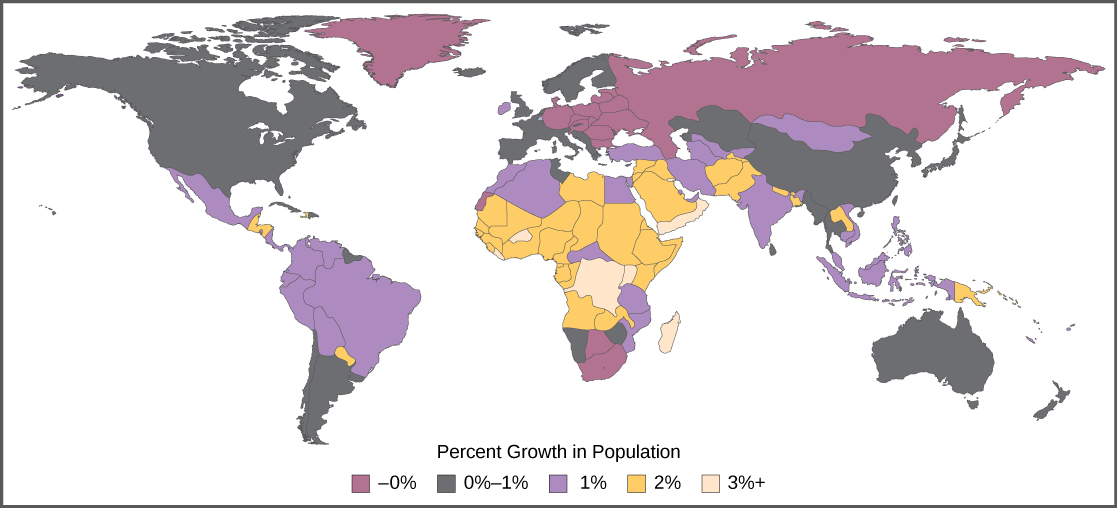

Figure 45.17図 45.17
The percent growth rate of population in different countries is shown. Notice that the highest growth is occurring in less economically developed countries in Africa and Asia.
各国の人口増加率(%)。最も高い増加率が、アフリカやアジアの、経済発展の遅れた国で見られることに注目しよう。
Long-Term Consequences of Exponential Human Population Growth人間の指数関数的な人口増加が長期的にもたらす結果
Many dire predictions have been made about the world’s population leading to a major crisis called the “population explosion.” In the 1968 book The Population Bomb, biologist Dr. Paul R. Ehrlich wrote, “The battle to feed all of humanity is over. In the 1970s hundreds of millions of people will starve to death in spite of any crash programs embarked upon now. At this late date nothing can prevent a substantial increase in the world death rate.” Paul R. Erlich, prologue to The Population Bomb, (1968; repr., New York: Ballantine, 1970). While many experts view this statement as incorrect based on evidence, the laws of exponential population growth are still in effect, and unchecked human population growth cannot continue indefinitely.
英語のヒント
世界人口が「人口爆発」という大きな危機につながるという、深刻な予測が数多くなされてきた。生物学者ポール・R・エーリックは、1968年の著書『人口爆弾』に、次のように書いた。「全人類を養うための戦いは終わった。今からどのような緊急対策に着手しても、1970年代には数億人が餓死するだろう。今となっては、世界の死亡率の大幅な上昇を防ぐことは、何もできない。」Paul R. Erlich, The Population Bomb序文(1968年、再版:New York: Ballantine, 1970)。多くの専門家は、証拠に基づいてこの記述を誤りと見なしている。それでも指数増加の法則は働き続け、抑制のない人口増加を無期限に続けることはできない。
Several nations have instituted policies aimed at influencing population. Efforts to control population growth led to the one-child policy in China, which is now being phased out. India also implements national and regional policies to encourage family planning. On the other hand, Japan, Spain, Russia, Iran, and other countries have made efforts to increase population growth after birth rates dipped. Such policies are controversial, and the human population continues to grow. At some point the food supply may run out, but the outcomes are difficult to predict. The United Nations estimates that future world population growth may vary from 6 billion (a decrease) to 16 billion people by the year 2100.
英語のヒント
いくつかの国は、人口に影響を与える政策を導入してきた。増加を抑える取り組みは、中国の一人っ子政策につながり、これは現在、段階的に廃止されつつある。インドも、家族計画を奨励する国や地域の政策を実施している。一方、日本、スペイン、ロシア、イランなどは、出生率が低下した後、人口増加を促す取り組みを行ってきた。こうした政策には議論があり、人間の人口は増え続けている。いつか食料供給が尽きるかもしれないが、結果を予測するのは難しい。国連は、2100年の世界人口が、減少した場合の60億人から、160億人までの範囲になりうると推定している。
Another result of population growth is the endangerment of the natural environment. Many countries have attempted to reduce the human impact on climate change by reducing their emission of the greenhouse gas carbon dioxide. However, these treaties have not been ratified by every country. The role of human activity in causing climate change has become a hotly debated socio-political issue in some countries, including the United States. Thus, we enter the future with considerable uncertainty about our ability to curb human population growth and protect our environment.
英語のヒント
人口増加のもう1つの結果は、自然環境が危険にさらされることである。多くの国は、温室効果ガスである二酸化炭素の排出を減らし、人間が気候変動に与える影響を小さくしようとしてきた。しかし、これらの条約をすべての国が批准しているわけではない。気候変動を引き起こす人間活動の役割は、米国を含む一部の国で、激しい議論の対象となる社会的・政治的問題になった。したがって、人口増加を抑え、環境を守る能力について、かなりの不確実性を抱えたまま、私たちは未来へ進んでいる。