第45章個体群と群集の生態学
Finding Sex Partners交尾相手を見つける
Not all animals reproduce sexually, but many that do have the same challenge: they need to find a suitable mate and often have to compete with other individuals to obtain one. Significant energy is spent in the process of locating, attracting, and mating with the sex partner. Two types of selection occur during this process: intersexual selection, where individuals of one sex choose mates of the other sex, and intrasexual selection, the competition for mates between species members of the same sex. Intersexual selection is often complex because choosing a mate may be based on a variety of visual, aural, tactile, and chemical cues. An example of intersexual selection is when female peacocks choose to mate with the male with the brightest plumage. This type of selection often leads to traits in the chosen sex that do not enhance survival, but are those traits most attractive to the opposite sex (often at the expense of survival). Intrasexual selection involves mating displays and aggressive mating rituals such as rams butting heads—the winner of these battles is the one that is able to mate. Many of these rituals use up considerable energy but result in the selection of the healthiest, strongest, and/or most dominant individuals for mating.
英語のヒント
すべての動物が有性生殖するわけではないが、行う動物の多くは共通の課題をもつ。適した相手を見つけ、しばしばほかの個体と競争して相手を得なければならない。相手の探索、誘引、交尾には、多くのエネルギーが使われる。この過程には2種類の選択がある。一方の性が他方の性の相手を選ぶ異性間選択と、同じ性の個体間で相手をめぐって競争する同性内選択である。異性間選択は、視覚・聴覚・触覚・化学的なさまざまな手掛かりに基づくため、複雑なことが多い。雌のクジャクが最も鮮やかな羽毛の雄を選ぶ例がある。この選択はしばしば、選ばれる側に、生存には役立たず、むしろ生存を犠牲にしてでも異性を最も引き付ける形質を生む。同性内選択には、求愛ディスプレイや、雄ヒツジの頭突きのような攻撃的な交尾儀式がある。戦いの勝者が交尾できる。多くの儀式は大量のエネルギーを使うが、最も健康で、強く、優位な個体が繁殖相手に選ばれる結果につながる。
Three general mating systems, all involving innate as opposed to learned behaviors, are seen in animal populations: monogamous, polygynous, and polyandrous.
英語のヒント
動物個体群には、一夫一妻、一夫多妻、一妻多夫という3つの一般的な配偶システムが見られる。いずれも、学習行動ではなく生得的行動が関わる。
In monogamous systems, one male and one female are paired for at least one breeding season. In some animals, such as the gray wolf, these associations can last much longer, even a lifetime. Several theories may explain this type of mating system. The “mate-guarding hypothesis” states that males stay with the female to prevent other males from mating with her. This behavior is advantageous in such situations where mates are scarce and difficult to find. Another explanation is the “male-assistance hypothesis,” where males that help guard and rear their young will have more and healthier offspring. Monogamy is observed in many bird populations where, in addition to the parental care from the female, the male is also a major provider of parental care for the chicks. A third explanation for the evolutionary advantages of monogamy is the “female-enforcement hypothesis.” In this scenario, the female ensures that the male does not have other offspring that might compete with her own, so she actively interferes with the male’s signaling to attract other mates.
英語のヒント
一夫一妻では、1頭の雄と1頭の雌が、少なくとも1繁殖期の間つがいになる。ハイイロオオカミなどでは、関係がもっと長く、ときには生涯続く。説明する理論にはいくつかある。「配偶者防衛仮説」は、他の雄との交尾を防ぐため、雄が雌のそばにいるとする。相手が少なく、見つけにくい状況で有利である。「雄の援助仮説」では、雄が子の保護・養育を助けることで、より多くの健康な子を残せるとする。多くの鳥では、雌に加えて雄もひなの世話の主要な担い手であり、一夫一妻が見られる。3つ目は「雌による強制仮説」である。雌は、自分の子と競争しかねない別の子を雄がもたないよう、他の相手を引き付ける雄の信号を積極的に妨げる。
Polygynous mating refers to one male mating with multiple females. In these situations, the female must be responsible for most of the parental care as the single male is not capable of providing care to that many offspring. In resourced-based polygyny, males compete for territories with the best resources, and then mate with females that enter the territory, drawn to its resource richness. The female benefits by mating with a dominant, genetically fit male; however, it is at the cost of having no male help in caring for the offspring. An example is seen in the yellow-rumped honeyguide, a bird whose males defend beehives because the females feed on their wax. As the females approach, the male defending the nest will mate with them. Harem mating structures are a type of polygynous system where certain males dominate mating while controlling a territory with resources. Harem mating occurs in elephant seals, where the alpha male dominates the mating within the group. A third type of polygyny is a lek system. Here there is a communal courting area where several males perform elaborate displays for females, and the females choose their mate from this group. This behavior is observed in several bird species including the sage grouse and the prairie chicken.
英語のヒント
一夫多妻では、1頭の雄が複数の雌と交尾する。雄1頭では多数の子を世話できないため、主に雌が世話を担う。資源に基づく一夫多妻では、雄が最良の資源をもつ縄張りを争い、その豊かさに引き付けられて入ってきた雌と交尾する。雌は、優位で遺伝的適応度の高い雄と交尾できるが、子育てに雄の助けがないという代価を払う。キゴシミツオシエという鳥に例がある。雌が蜜蝋を食べるため、雄は蜂の巣を守り、近づく雌と交尾する。ハーレム型も一夫多妻の一種で、資源のある縄張りを支配する特定の雄が交尾を独占する。ゾウアザラシでは、最優位の雄が群れ内の交尾を支配する。3つ目はレック型である。共同の求愛場所で複数の雄が精巧なディスプレイを行い、雌がその中から相手を選ぶ。キジオライチョウやソウゲンライチョウなど、いくつかの鳥に見られる。
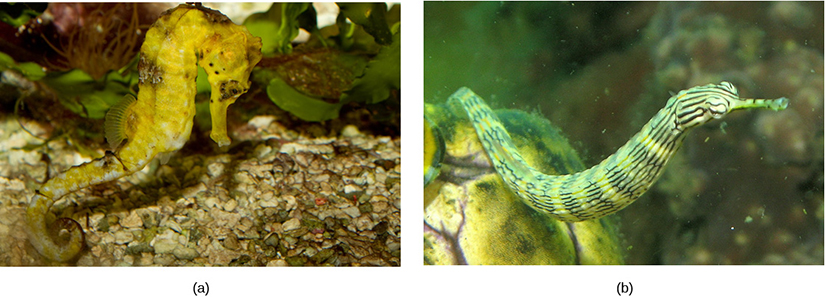
In polyandrous mating systems, one female mates with many males. These types of systems are much rarer than monogamous and polygynous mating systems. In pipefishes and seahorses, males receive the eggs from the female, fertilize them, protect them within a pouch, and give birth to the offspring (Figure 45.38). Therefore, the female is able to provide eggs to several males without the burden of carrying the fertilized eggs.
英語のヒント
一妻多夫では、1頭の雌が多くの雄と交尾する。この型は、一夫一妻や一夫多妻よりはるかに少ない。ヨウジウオやタツノオトシゴでは、雄が雌から卵を受け取り、受精させ、袋の中で保護し、子を産む(図45.38)。そのため雌は、受精卵を抱える負担なしに、複数の雄へ卵を渡せる。
OpenStax, Rice University; Biology 2e. (credit a: modification of work by Brian Gratwicke; credit b: modification of work by Stephen Childs) · CC BY 4.0 · Source出典

Figure 45.38図 45.38
Polyandrous mating, in which one female mates with many males, occurs in the (a) seahorse and the (b) pipefish. (credit a: modification of work by Brian Gratwicke; credit b: modification of work by Stephen Childs)
1頭の雌が多くの雄と交尾する一妻多夫は、(a)タツノオトシゴと(b)ヨウジウオに見られる。(出典:a:Brian Gratwicke、b:Stephen Childsの各作品を改変)