第45章個体群と群集の生態学
Operant Conditioningオペラント条件付け
In operant conditioning, the conditioned behavior is gradually modified by its consequences as the animal responds to the stimulus. A major proponent of such conditioning was psychologist B.F. Skinner, the inventor of the Skinner box. Skinner put rats in his boxes that contained a lever that would dispense food to the rat when depressed. While initially the rat would push the lever a few times by accident, it eventually associated pushing the lever with getting the food. This type of learning is an example of operant conditioning. Operant learning is the basis of most animal training. The conditioned behavior is continually modified by positive or negative reinforcement, often a reward such as food or some type of punishment, respectively. In this way, the animal is conditioned to associate a type of behavior with the punishment or reward, and, over time, can be induced to perform behaviors that they would not have done in the wild, such as the “tricks” dolphins perform at marine amusement park shows (Figure 45.41).
英語のヒント
オペラント条件付けでは、動物が刺激へ反応するにつれ、その行動が結果によって徐々に変えられる。主要な提唱者は、スキナー箱を考案した心理学者B・F・スキナーだった。スキナーは、押すと餌が出るレバーのある箱へラットを入れた。初めは偶然レバーを何度か押したが、やがて押すことと餌を得ることを結び付けた。これがオペラント条件付けの例である。オペラント学習は、動物訓練の多くの基礎となる。条件付けられた行動は、正または負の強化、しばしばそれぞれ餌などの報酬や何らかの罰によって、繰り返し修正される。このように動物は、行動を罰や報酬と結び付けるよう条件付けられ、時間とともに、野生では行わない行動もするようになる。水族館などのショーでイルカが行う「芸」が例である(図45.41)。
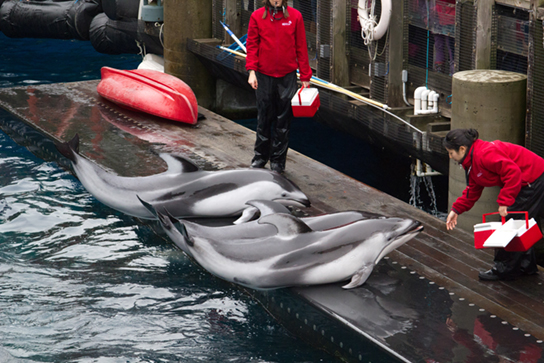
Figure 45.41図 45.41
The training of dolphins by rewarding them with food is an example of positive reinforcement operant conditioning. (credit: Roland Tanglao)
餌を報酬として与えるイルカの訓練は、正の強化を用いるオペラント条件付けの例である。(出典:Roland Tanglao)
Cognitive Learning認知学習
Classical and operant conditioning are inefficient ways for humans and other intelligent animals to learn. Some primates, including humans, are able to learn by imitating the behavior of others and by taking instructions. The development of complex language by humans has made cognitive learning, the manipulation of information using the mind, the most prominent method of human learning. In fact, that is how students are learning right now by reading this book. As students read, they can make mental images of objects or organisms and imagine changes to them, or behaviors by them, and anticipate the consequences. In addition to visual processing, cognitive learning is also enhanced by remembering past experiences, touching physical objects, hearing sounds, tasting food, and a variety of other sensory-based inputs. Cognitive learning is so powerful that it can be used to understand conditioning in detail. In the reverse scenario, conditioning cannot help someone learn about cognition.
英語のヒント
人間やほかの知的な動物にとって、古典的・オペラント条件付けは効率のよい学習法ではない。人間を含む一部の霊長類は、他者の行動の模倣や指示によって学べる。人間は複雑な言語を発達させ、心で情報を操作する認知学習を、最も主要な学習法にした。実際、今この本を読む学習者も、そうして学んでいる。読んで物や生物の像を頭に描き、それらの変化や行動を想像し、結果を予測できる。視覚処理だけでなく、過去の経験を思い出すこと、物に触れること、音を聞くこと、食べ物を味わうことなど、多様な感覚入力も認知学習を高める。認知学習は強力で、条件付けを詳しく理解するためにも使える。しかし逆に、条件付けで認知について学ぶことはできない。
Classic work on cognitive learning was done by Wolfgang Köhler with chimpanzees. He demonstrated that these animals were capable of abstract thought by showing that they could learn how to solve a puzzle. When a banana was hung in their cage too high for them to reach, and several boxes were placed randomly on the floor, some of the chimps were able to stack the boxes one on top of the other, climb on top of them, and get the banana. This implies that they could visualize the result of stacking the boxes even before they had performed the action. This type of learning is much more powerful and versatile than conditioning.
英語のヒント
認知学習の古典的研究は、ヴォルフガング・ケーラーがチンパンジーを使って行った。問題の解き方を学べることから、抽象的思考が可能だと示した。届かない高さにバナナをつるし、床に箱をいくつか無作為に置くと、一部のチンパンジーは箱を積み重ね、上へ登ってバナナを取った。これは、実際に行動する前に、箱を積んだ結果を思い描けたことを示唆する。この学習は、条件付けよりはるかに強力で、幅広く使える。
Cognitive learning is not limited to primates, although they are the most efficient in using it. Maze running experiments done with rats by H.C. Blodgett in the 1920s were the first to show cognitive skills in a simple mammal. The motivation for the animals to work their way through the maze was a piece of food at its end. In these studies, the animals in Group I were run in one trial per day and had food available to them each day on completion of the run (Figure 45.42). Group II rats were not fed in the maze for the first six days and subsequent runs were done with food starting at day seven. Group III rats were not fed for two days, and runs with food started on day three. The results were that the control rats, Group I, learned quickly, and figured out how to run the maze in seven days. Group III did not learn much during the two days without food, but rapidly caught up to the control group when given the food reward. Group II learned very slowly for the six days with no reward to motivate them, and they did not begin to catch up to the control group until the day food was given, and then it took two days longer to learn the maze.
英語のヒント
認知学習を最も効率よく使うのは霊長類だが、それだけに限られない。1920年代にH・C・ブロジェットがラットで行った迷路実験は、単純な哺乳類の認知能力を初めて示した。動物が迷路を進む動機は、出口に置いた餌だった。I群は1日1回の試行を行い、毎日、走り終えると餌を得た(図45.42)。II群は最初の6日間は迷路内で餌をもらえず、7日目から得た。III群は最初の2日間もらえず、3日目から得た。対照群のI群は速く学び、7日で道順を覚えた。III群は餌のない2日間にはあまり学ばなかったが、報酬が与えられると急速に対照群へ追い付いた。II群は、動機付ける報酬のない6日間には非常にゆっくり学び、餌を得た日から追い付き始め、迷路を覚えるまでさらに2日かかった。
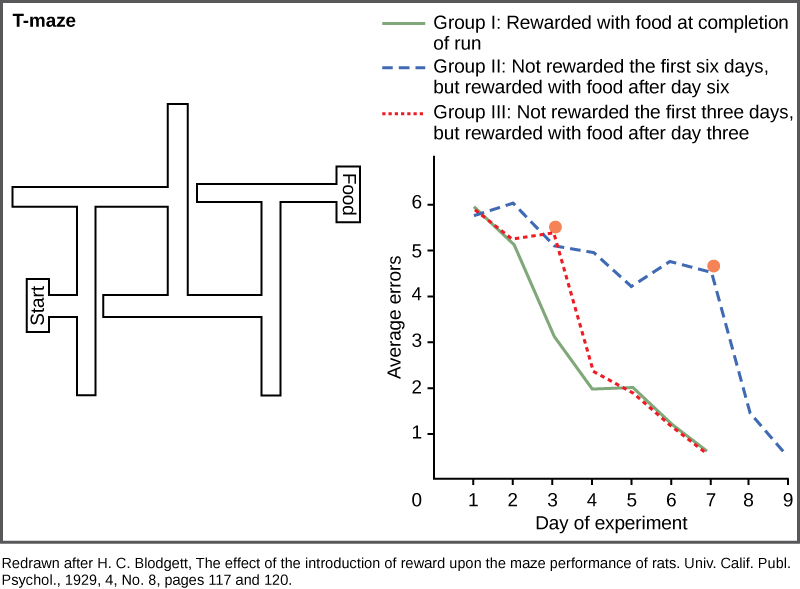


Figure 45.42図 45.42
Group I (the green solid line) found food at the end of each trial, group II (the blue dashed line) found food starting on day seven, and group III (the red dotted line) found food starting at day three. Notice that rats given food earlier learned faster and eventually caught up to the control group. The orange dots on the group II and III lines show the days when food rewards were added to the mazes.
I群(緑の実線)は毎試行の終わりに餌を得た。II群(青の破線)は7日目から、III群(赤の点線)は3日目から餌を得た。早く餌を与えられたラットほど速く学び、やがて対照群に追い付くことに注目しよう。II群とIII群の線のオレンジの点は、迷路へ餌の報酬を加えた日を示す。
It may not be immediately obvious that this type of learning is different than conditioning. Although one might be tempted to believe that the rats simply learned how to find their way through a conditioned series of right and left turns, E.C. Tolman proved a decade later that the rats were making a representation of the maze in their minds, which he called a “cognitive map.” This was an early demonstration of the power of cognitive learning and how these abilities were not just limited to humans.
英語のヒント
この学習が条件付けとどう違うかは、すぐには明らかでないかもしれない。ラットは単に、右左への一連の曲がり方を条件付けによって覚えた、と思いたくなる。しかし10年後、E・C・トールマンは、ラットが頭の中で迷路の表象を作っていると証明し、それを「認知地図」と呼んだ。これは認知学習の力と、その能力が人間だけのものではないことを示した、初期の例だった。