第29章脊椎動物
29.7 The Evolution of Primates29.7 霊長類の進化
Learning Objectives学習目標
By the end of this section, you will be able to do the following:
この節を学び終えると、次のことができるようになる。
- Describe the derived features that distinguish primates from other animals霊長類をほかの動物から区別する派生形質を説明する。
- Describe the defining features of the major groups of primates霊長類の主要な群を特徴づける形質を説明する。
- Identify the major hominin precursors to modern humans現生人類に先行する主要なホミニンを挙げる。
- Explain why scientists are having difficulty determining the true lines of descent in hominidsヒト科の本当の系統関係を決めることが、科学者にとって難しい理由を説明する。
Order Primates of class Mammalia includes lemurs, tarsiers, monkeys, apes, and humans. Non-human primates live primarily in the tropical or subtropical regions of South America, Africa, and Asia. They range in size from the mouse lemur at 30 grams (1 ounce) to the mountain gorilla at 200 kilograms (441 pounds). The characteristics and evolution of primates are of particular interest to us as they allow us to understand the evolution of our own species.
英語のヒント
哺乳綱の霊長目には、キツネザル、メガネザル、サル、類人猿、ヒトが含まれる。ヒト以外の霊長類は、主に南アメリカ、アフリカ、アジアの熱帯・亜熱帯域に生息する。大きさは、体重30 g(1オンス)のネズミキツネザルから、200 kg(441ポンド)のマウンテンゴリラまで及ぶ。霊長類の特徴と進化は、私たち自身の種の進化を理解する手掛かりになるため、特に関心を引く。
Characteristics of Primates霊長類の特徴
All primate species possess adaptations for climbing trees, as they all descended from tree-dwellers. This arboreal heritage of primates has resulted in hands and feet that are adapted for climbing, or brachiation (swinging through trees using the arms). These adaptations include, but are not limited to: 1) a rotating shoulder joint, 2) a big toe that is widely separated from the other toes (except humans) and thumbs sufficiently separated from fingers to allow for gripping branches, and 3) stereoscopic vision, two overlapping fields of vision from the eyes, which allows for the perception of depth and gauging distance. Other characteristics of primates are brains that are larger than those of most other mammals, claws that have been modified into flattened nails, typically only one offspring per pregnancy, and a trend toward holding the body upright.
英語のヒント
霊長類のすべての種は、樹上生活をする祖先に由来するため、木登りへの適応を備える。この樹上性の遺産によって、手足は木登りや腕渡り、すなわち腕を使って木々の間をぶら下がって移動することに適応した。その適応には、1)回転する肩関節、2)ほかの足指から大きく離れた足の親指(ヒトを除く)と、枝を握れるほどほかの指から離れた手の親指、3)両眼の視野が重なり、奥行きを感じて距離を測れる立体視、などがある。霊長類のほかの特徴には、大部分のほかの哺乳類より大きな脳、鉤爪から変化した平たい爪、通常は1回の妊娠につき1頭だけの子、体を直立させる傾向がある。
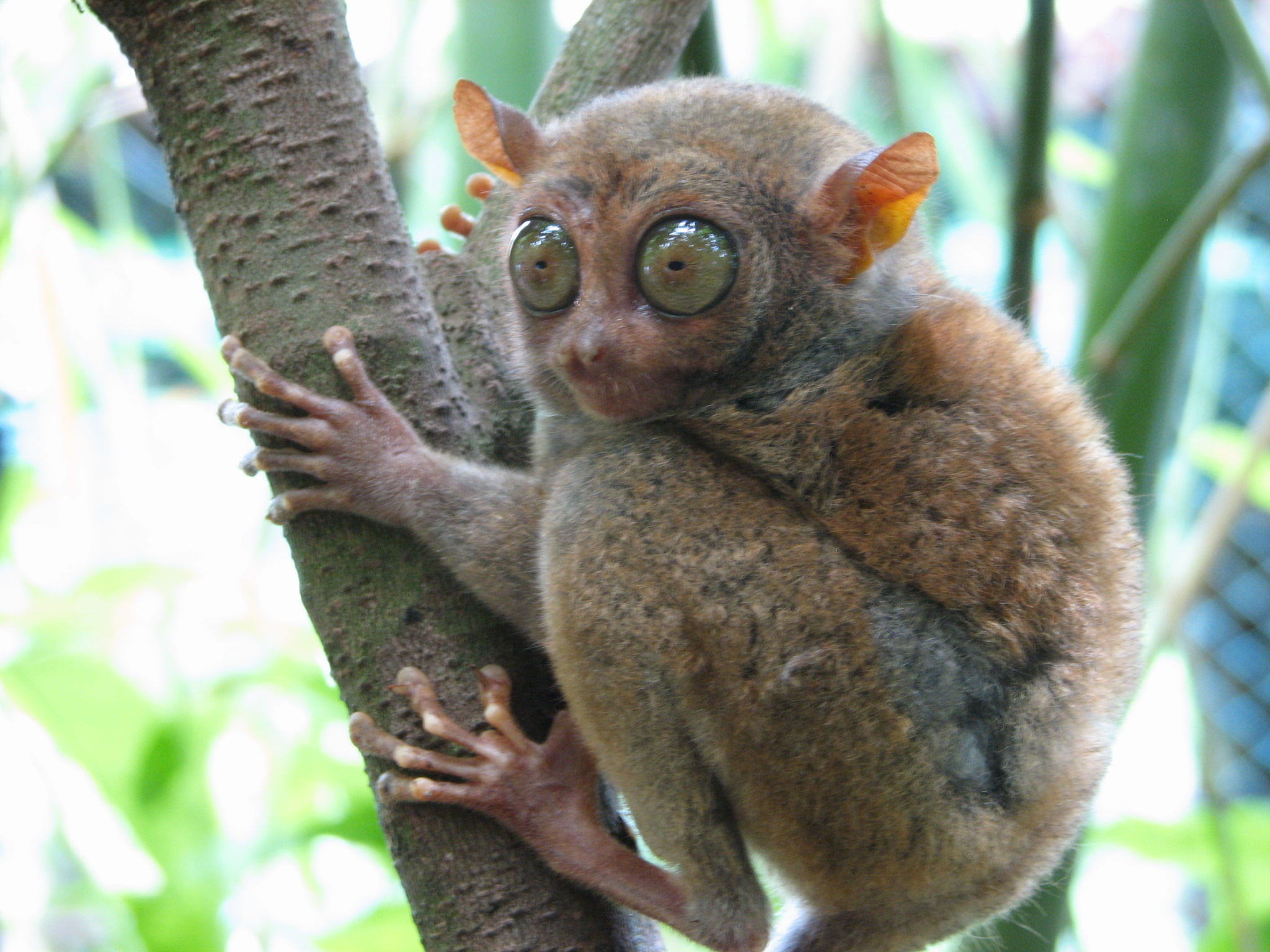
Order Primates is divided into two groups: Strepsirrhini (“turned-nosed”) and Haplorhini (“simple-nosed”) primates. Strepsirrhines, also called the wet-nosed primates, include prosimians like the bush babies and pottos of Africa, the lemurs of Madagascar, and the lorises of Southeast Asia. Haplorhines, or dry-nosed primates, include tarsiers (Figure 29.42) and simians (New World monkeys, Old World monkeys, apes, and humans). In general, strepsirrhines tend to be nocturnal, have larger olfactory centers in the brain, and exhibit a smaller size and smaller brain than anthropoids. Haplorhines, with a few exceptions, are diurnal, and depend more on their vision. Another interesting difference between the strepsirrhines and haplorhines is that strepsirrhines have the enzymes for making vitamin C, while haplorhines have to get it from their food.
英語のヒント
霊長目は、曲鼻類(Strepsirrhini、「曲がった鼻」)と直鼻類(Haplorhini、「単純な鼻」)の二群に分けられる。鼻が湿った霊長類とも呼ばれる曲鼻類には、アフリカのガラゴやポト、マダガスカルのキツネザル、東南アジアのロリスなどの原猿類が含まれる。鼻が乾いた霊長類である直鼻類には、メガネザル(図29.42)と真猿類(新世界ザル、旧世界ザル、類人猿、ヒト)が含まれる。一般に曲鼻類は夜行性の傾向があり、脳の嗅覚中枢が大きい一方、真猿類より体も脳も小さい。直鼻類は、少数の例外を除いて昼行性で、視覚への依存が強い。曲鼻類と直鼻類のもう一つの興味深い違いは、曲鼻類にはビタミンCをつくる酵素があるのに対し、直鼻類は食物から摂取しなければならないことである。
mtoz; Bohol Tarsier. OpenStax, Biology 2e adaptation. · CC BY-SA 2.0 · Source出典
Figure 29.42図 29.42
A Philippine tarsier. This tarsier, Carlito syrichta, is one of the smallest primates—about 5 inches long, from nose to the base of the tail. The tail is not shown, but is about twice the length of the body. Note the large eyes, each of which is about the same size as the animal's brain, and the long hind legs. (credit: mtoz (http://creativecommons.org/licenses/by-sa/2.0), via Wikimedia Commons)
フィリピンメガネザル。このメガネザル(Carlito syrichta)は最小の霊長類の一つで、鼻先から尾の付け根まで約5インチである。尾は写っていないが、体の長さの約2倍ある。それぞれが脳とほぼ同じ大きさの大きな眼と、長い後肢に注目しよう。(クレジット:mtoz、http://creativecommons.org/licenses/by-sa/2.0、Wikimedia Commons 経由)
Evolution of Primates霊長類の進化
The first primate-like mammals are referred to as proto-primates. They were roughly similar to squirrels and tree shrews in size and appearance. The existing fossil evidence (mostly from North Africa) is very fragmented. These proto-primates remain largely mysterious creatures until more fossil evidence becomes available. Although genetic evidence suggests that primates diverged from other mammals about 85 MYA, the oldest known primate-like mammals with a relatively robust fossil record date to about 65 MYA. Fossils like the proto-primate Plesiadapis (although some researchers do not agree that Plesiadapis was a proto-primate) had some features of the teeth and skeleton in common with true primates. They were found in North America and Europe in the Cenozoic and went extinct by the end of the Eocene epoch (approximately 56 to 34 MYA).
英語のヒント
最初の霊長類に似た哺乳類は、原始霊長類と呼ばれる。大きさと外見は、リスやツパイにおおむね似ていた。現存する化石証拠は主に北アフリカのもので、非常に断片的である。さらに化石証拠が得られるまでは、これらの原始霊長類の多くは謎のままである。遺伝的証拠は、霊長類がほかの哺乳類から約8500万年前に分岐したことを示唆する。しかし、比較的確かな化石記録がある最古の霊長類に似た哺乳類は、約6500万年前にさかのぼる。プレシアダピスなどの原始霊長類の化石には、歯と骨格に真の霊長類との共通点がある。ただし、プレシアダピスが原始霊長類だったことに同意しない研究者もいる。これらは新生代の北アメリカとヨーロッパで見つかり、始新世(約5600万〜3400万年前)の終わりまでに絶滅した。
The first true primates date to about 55 MYA in the Eocene epoch. They were found in North America, Europe, Asia, and Africa. These early primates resembled present-day prosimians such as lemurs. Evolutionary changes continued in these early primates, with larger brains and eyes, and smaller muzzles being the trend. By the end of the Eocene epoch, many of the early prosimian species went extinct due either to cooler temperatures or competition from the first monkeys.
英語のヒント
最初の真の霊長類は、始新世の約5500万年前にさかのぼる。北アメリカ、ヨーロッパ、アジア、アフリカで見つかっている。これらの初期霊長類は、キツネザルなど現生の原猿類に似ていた。進化的変化は続き、脳と眼が大きくなり、吻が小さくなる傾向があった。始新世の終わりまでに、寒冷化、または最初のサルとの競争によって、初期の原猿類の多くが絶滅した。
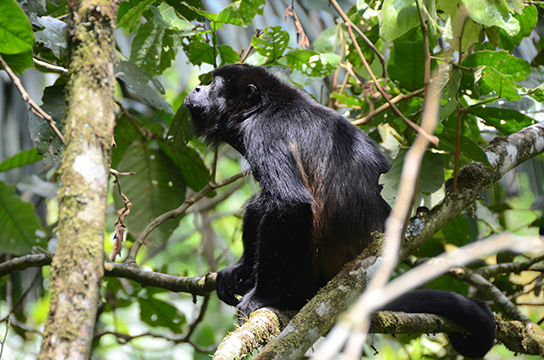
Anthropoid monkeys evolved from prosimians during the Eocene epoch. By 40 million years ago, evidence indicates that monkeys were present in the New World (South America) and the Old World (Africa and Asia). New World monkeys are also called Platyrrhini—a reference to their broad noses (Figure 29.43). Old World monkeys are called Catarrhini—a reference to their narrow, downward-pointed noses. There is still quite a bit of uncertainty about the origins of the New World monkeys. At the time the platyrrhines arose, the continents of South American and Africa had drifted apart. Therefore, it is thought that monkeys arose in the Old World and reached the New World either by drifting on log rafts or by crossing land bridges. Due to this reproductive isolation, New World monkeys and Old World monkeys underwent separate adaptive radiations over millions of years. The New World monkeys are all arboreal, whereas Old World monkeys include both arboreal and ground-dwelling species. The arboreal habits of the New World monkeys are reflected in the possession of prehensile or grasping tails by most species. The tails of Old World monkeys are never prehensile and are often reduced, and some species have ischial callosities—thickened patches of skin on their seats.
英語のヒント
真猿類のサルは、始新世に原猿類から進化した。証拠によると、4000万年前までには、新世界(南アメリカ)と旧世界(アフリカとアジア)の両方にサルがいた。新世界ザルは広鼻類(Platyrrhini)とも呼ばれ、その名は幅広い鼻に由来する(図29.43)。旧世界ザルは狭鼻類(Catarrhini)と呼ばれ、その名は細く下を向く鼻に由来する。新世界ザルの起源には、なおかなりの不確かさがある。広鼻類が現れたとき、南アメリカ大陸とアフリカ大陸は、すでに離れていた。そのため、サルは旧世界で出現し、丸太のいかだに乗って漂流するか、陸橋を渡るかして、新世界に到達したと考えられている。この生殖隔離によって、新世界ザルと旧世界ザルは、何百万年もの間、別々に適応放散を遂げた。新世界ザルはすべて樹上性だが、旧世界ザルには樹上性と地上性の両方の種がいる。新世界ザルの樹上生活は、大部分の種がものをつかめる尾をもつことに反映されている。旧世界ザルの尾には把握能力がなく、短くなることも多い。一部の種には、尻の皮膚が厚くなった部分である尻だこがある。
OpenStax, Rice University; Biology 2e. (credit: Xavi Talleda) Embedded rights notice: Copyright 2011 © Xavi Talleda; Copyright 2011 © Xavi Talleda · CC BY 4.0 · Source出典

Figure 29.43図 29.43
A New World monkey. The howler monkey is native to Central and South America. It makes a call that sounds like a lion roaring. (credit: Xavi Talleda)
新世界ザル。ホエザルは中央・南アメリカに在来する。ライオンのほえ声に似た鳴き声を出す。(クレジット:Xavi Talleda)
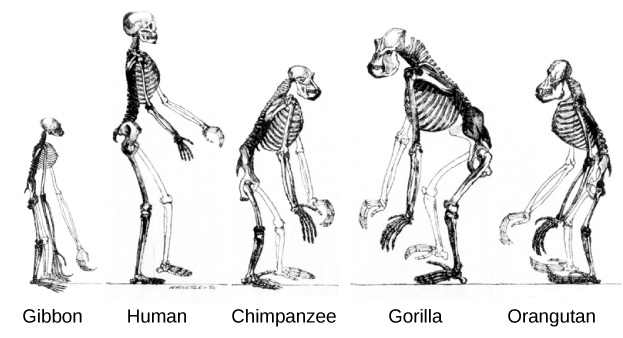
Apes evolved from the catarrhines in Africa midway through the Cenozoic, approximately 25 million years ago. Apes are generally larger than monkeys and they do not possess a tail. All apes are capable of moving through trees, although many species spend most their time on the ground. When walking quadrupedally, monkeys walk on their palms, while apes support the upper body on their knuckles. Apes are more intelligent than monkeys, and they have larger brains relative to body size. The apes are divided into two groups. The lesser apes comprise the family Hylobatidae, including gibbons and siamangs. The great apes include the genera Pan (chimpanzees and bonobos) Gorilla (gorillas), Pongo (orangutans), and Homo (humans) (Figure 29.44).
英語のヒント
類人猿は、新生代半ばの約2500万年前に、アフリカの狭鼻類から進化した。一般にサルより大きく、尾がない。すべての類人猿は木々の間を移動できるが、多くの種は時間の大部分を地上で過ごす。四足で歩く際、サルは手のひらで歩くのに対し、類人猿は指の関節で上半身を支える。類人猿はサルより知能が高く、体の大きさに比べて脳が大きい。類人猿は二群に分かれる。小型類人猿はテナガザル科を構成し、テナガザルとフクロテナガザルを含む。大型類人猿には、チンパンジー属(Pan、チンパンジーとボノボ)、ゴリラ属(Gorilla)、オランウータン属(Pongo)、ヒト属(Homo)が含まれる(図29.44)。
OpenStax, Rice University; Biology 2e. (credit: modification of work by Tim Vickers) · CC BY 4.0 · Source出典

Figure 29.44図 29.44
Primate skeletons. All great apes have a similar skeletal structure. (credit: modification of work by Tim Vickers)
霊長類の骨格。大型類人猿はすべて、よく似た骨格構造をもつ。(クレジット:Tim Vickers の作品を改変)
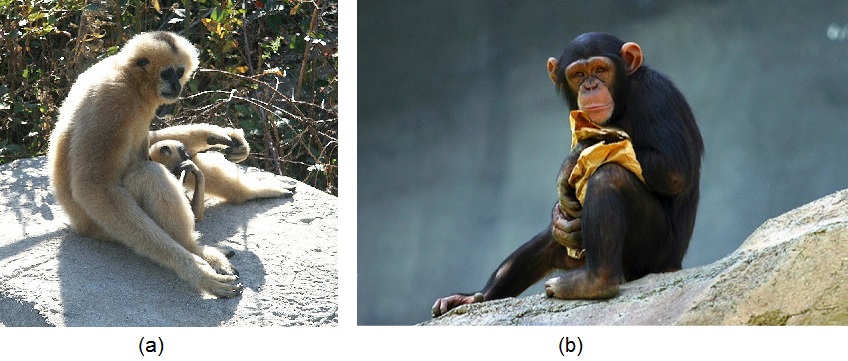
The very arboreal gibbons are smaller than the great apes; they have low sexual dimorphism (that is, the sexes are not markedly different in size), although in some species, the sexes differ in color; and they have relatively longer arms used for swinging through trees (Figure 29.45a). Two species of orangutan are native to different islands in Indonesia: Borneo (P. pygmaeus) and Sumatra (P. abelii). A third orangutan species, Pongo tapanuliensis, was reported in 2017 from the Batang Toru forest in Sumatra. Orangutans are arboreal and solitary. Males are much larger than females and have cheek and throat pouches when mature. Gorillas all live in Central Africa. The eastern and western populations are recognized as separate species, G. berengei and G. gorilla. Gorillas are strongly sexually dimorphic, with males about twice the size of females. In older males, called silverbacks, the hair on the back turns white or gray. Chimpanzees (Figure 29.45b) are the species considered to be most closely related to humans. However, the species most closely related to the chimpanzee is the bonobo. Genetic evidence suggests that chimpanzee and human lineages separated 5 to 7 MYA, while chimpanzee (Pan troglodytes) and bonobo (Pan paniscus) lineages separated about 2 MYA. Chimpanzees and bonobos both live in Central Africa, but the two species are separated by the Congo River, a significant geographic barrier. Bonobos are slighter than chimpanzees, but have longer legs and more hair on their heads. In chimpanzees, white tail tufts identify juveniles, while bonobos keep their white tail tufts for life. Bonobos also have higher-pitched voices than chimpanzees. Chimpanzees are more aggressive and sometimes kill animals from other groups, while bonobos are not known to do so. Both chimpanzees and bonobos are omnivorous. Orangutan and gorilla diets also include foods from multiple sources, although the predominant food items are fruits for orangutans and foliage for gorillas.
英語のヒント
樹上生活に強く適応したテナガザルは、大型類人猿より小さい。性的二型は小さく、雌雄の体格に著しい違いはないが、一部の種では色が異なる。腕は比較的長く、木々の間をぶら下がって移動するために使う(図29.45a)。オランウータンの2種は、インドネシアの異なる島、ボルネオ島(P. pygmaeus)とスマトラ島(P. abelii)に在来する。第3の種、Pongo tapanuliensis は、2017年にスマトラ島のバタン・トルの森から報告された。オランウータンは樹上性で、単独生活をする。雄は雌よりはるかに大きく、成熟すると頬と喉に袋状の構造ができる。ゴリラはすべて中央アフリカに生息する。東部と西部の個体群は、G. berengei と G. gorilla という別種として認められている。ゴリラの性的二型は強く、雄は雌の約2倍の大きさである。シルバーバックと呼ばれる年長の雄では、背中の毛が白色または灰色になる。チンパンジー(図29.45b)は、ヒトに最も近縁と考えられている種である。しかし、チンパンジーに最も近縁な種はボノボである。遺伝的証拠は、チンパンジーとヒトの系統が500万〜700万年前に分かれ、チンパンジー(Pan troglodytes)とボノボ(Pan paniscus)の系統は約200万年前に分かれたことを示唆する。両種とも中央アフリカに生息するが、大きな地理的障壁であるコンゴ川で隔てられている。ボノボはチンパンジーより華奢だが、脚は長く、頭の毛も多い。チンパンジーでは尾の位置の白い毛束が幼い個体の目印となるが、ボノボはこの毛束を一生保つ。ボノボの声はチンパンジーより高い。チンパンジーはより攻撃的で、ときに別の群れの個体を殺すが、ボノボでそのような行動は知られていない。チンパンジーもボノボも雑食性である。オランウータンとゴリラも複数の由来の食物を食べるが、主な食物は、オランウータンでは果実、ゴリラでは葉である。
OpenStax, Rice University; Biology 2e. (credit a: MAC. credit b: modification of work by Aaron Logan) · CC BY 4.0 · Source出典

Figure 29.45図 29.45
Lesser and great apes. This white-cheeked gibbon (a) is a lesser ape. In gibbons of this species, females and infants are buff and males are black. This young chimpanzee (b) is one of the great apes. It possesses a relatively large brain and has no tail. (credit a: MAC. credit b: modification of work by Aaron Logan)
小型類人猿と大型類人猿。このホオジロテナガザル(a)は小型類人猿である。この種では雌と幼児は淡黄褐色、雄は黒色である。若いチンパンジー(b)は大型類人猿の一つで、比較的大きな脳をもち、尾がない。(クレジットa:MAC。クレジットb:Aaron Logan の作品を改変)